
The Chronomancer and the Twins of Time
La Mamounia is an abstraction in every travel magazine I’ve ever read, but now it’s real: cool marble underfoot, palms arching overhead, the hush of money disguised as discretion. The doorman’s bow is nearly theatrical, but I’m grateful, as exhaustion and the low buzz of nausea coil together at my centre.
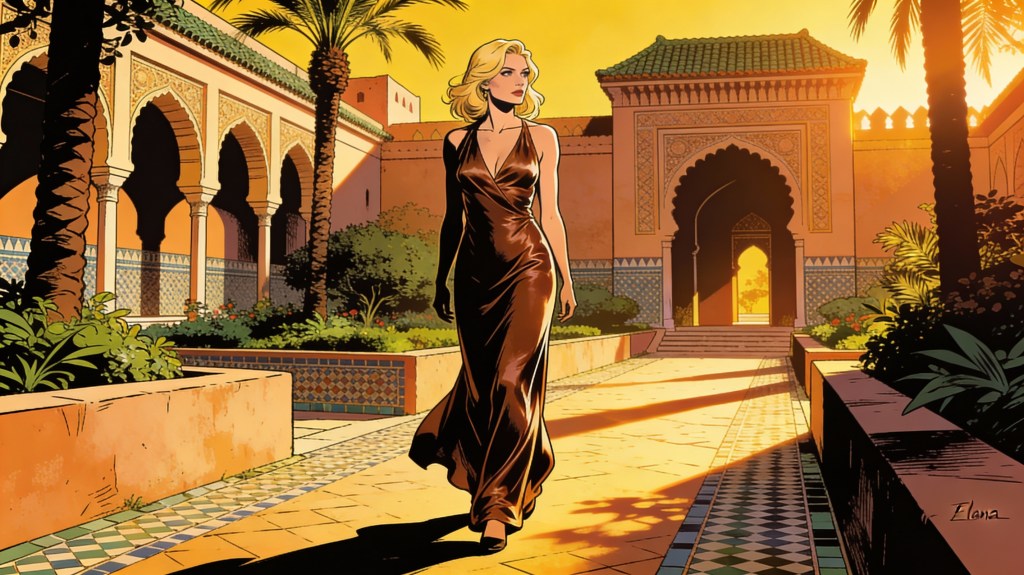
The suite is all zellige tiles and rosewater, sunlight sliding in long golden streaks. I peel off travel clothes and stand a moment in front of the mirror. My hand lingers over a barely rounded stomach, a body in transition. I shower, letting the cool water erase airports, interviews, and the memory of too many hours spent untethered from myself. My mind runs ahead, hoarding stories, but the physicality of water, the hush, the scent of argan oil, ground me back in the now.
I wrap myself in a robe and sink into the divan by the window. Marrakech sprawls beyond the gardens—terracotta, palms, the Atlas mountains sketched faint against the afternoon sky. My phone buzzes: Karim, already downstairs in the lounge, claiming an armchair like he was born to it. Dinner at 8? he texts. I’ll behave.
I smile despite my fatigue. Hasna sent him, I’m certain of it—not just to Marrakech, but to me. Her way of ensuring I don’t stumble into trouble alone. Or perhaps ensuring I stumble into exactly the right kind of trouble.
For now, I let myself rest. The suite holds me in its quiet luxury, and I drift between waking and not, my hand still resting on the curve of new life neither of us has named yet.
Dinner at La Mamounia
By evening, I’ve slipped into Laly’s dynasty maxi dress—silk crepe de Chine that falls in easy whispers over skin. In the mirror, I study the drape: my breasts fuller, heavier, testing the boundaries of the design. The fabric both conceals and reveals, a useful ambiguity. I brush a hand over the curve below my breastbone, not flinching from what’s new, but not advertising it either.
The restaurant downstairs lingers between grandeur and comfort: lanterns casting velvet shadows, musicians tuning up for the evening’s entertainments. Karim rises as I approach, eyes tracking me across the room—familiar, but searching. There’s a flicker of wariness there, a silent inventory.
He’s seen me naked plenty: Dakhla’s beach, Tallinn’s sauna, Poland’s accidental moonlight. That history means he notices when something shifts, even if he doesn’t speak it. His gaze catches on the different fall of silk, the way the dress drapes where it used to skim. For a moment, he seems to search my face.
“That dress is new,” he says, nonchalant, but the subtext runs deeper. “Laly always did know how to make you look like royalty—even when you’re plotting revolutions.”
“Revolutions need cover,” I reply, sliding into my seat. The silk catches lamplight as I settle.
He glances again—thoughtful, not impolite, just curious. His eyes dart, linger, move away. I wonder if he’s measuring years or seasons, remembering a different cut, a different body. I wonder if he senses, in some quiet way, that something is shifting under the silk.
My appetite is unsure, but Karim, attentive, orders cautious dishes—vegetable tagine, steamed semolina, the kind of food that sits lightly. When we’re settled and the mint tea arrives with ceremony, he leans in, conspiratorial.
“You want to ask why I’m here—not just in Marrakech, but here, at your elbow.”
I answer with a half-smile, half-challenge. “Hasna sent you?”
He grins, the admission easy. “She didn’t let me return to my tourists in Tangier. Told me to watch the political intrigue here.” He pauses, his smile widening. “‘Karim, you listen better than you talk, for once—useful for a change.’ Her words, not mine.”
“And now?” I prod, letting the question hang as the server refills our tea.
He shrugs with the practised elegance of a man used to the ambiguity of orders. “Now, I’m just here to accompany you, Elena. Keep you from getting shot at—since trouble always finds you.” He winks to take the sting from the truth.
The warmth in the restaurant feels suddenly intimate; the boundaries between dinner, duty, and old tensions smudge just a little. We eat, and the conversation circles warmth, old jokes, the city’s festival fever. If he’s guessed at the change in me, he keeps it locked behind his careful gaze. But I catch him watching, sometimes, the way my hand moves—protective, unthinking—over the silk just below my breastbone.
I sip the tea, letting the sweetness settle my stomach and the possibility of intrigue settle my nerves. For now, the story of my body is my own to tell, and Marrakech’s tales spin on, swirling us into the night. For all the plotting that brought me here, I suddenly feel—oddly—both protected and known.
And somehow, the real stories haven’t even begun.
I.Ph.
 The C.O.M.C. Files