
The Chronomancer and the Twins of Time
Lunch settles, but the city doesn’t; I decide there’s no need to return to the office after all. Instead, I push through the marble-etched lobby and out into London’s slow afternoon sun. My body—restless from too many hours hunched over laptops and notes—wants movement. So I walk. Past crowds and columns, winding through backstreets, letting the city stretch out before me as far as my feet can take me.
Poultry is alive with the usual crowd—bankers, barristers, municipal crests gleaming, historic facades just barely holding their dignity against the stream of commuters. I weave past a trio of suited women, their laughter mixing with the crisp snap of business conversations and espresso steam.
Heading east, I pass the Bank of England, its limestone walls indifferent to the flux of city life. It feels solid, immovable—a monument built to weather uncertainty. I catch snatches of every accent: couriers slicing through the crowd, tourists prodding maps and clutching umbrellas against unpromised rain.
I slip into the quieter lanes behind Lombard Street. Here, the sun glances off glass, and the shadows hold tight in old Victorian alleyways. I pass a tiny bakery spilling the smell of sourdough into the street, then a Persian café: blue-tiled windows, cardamom and rose wafting through the door. I linger for a moment, drawing in the spice.
Down by the curve of the Thames, I catch its metallic shimmer between buildings. Lawyers’ chambers stack up, bicycles ring by, somewhere a church bell clatters. A flower stand appears, the vendor singing a Turkish lullaby, oblivious to the rush. I feel almost invisible moving through it all.
Somewhere along a quieter street, I dial Mrs. H.
“I won’t be coming back today,” I say, almost apologetic but not quite. “If anything’s urgent, just ring me. I’m reachable.”
She’s brisk, as always, but I can feel relief in her voice—a day without my distractions may suit her just fine.
A row of Georgian terraced houses catches my eye, their bricks old and burnished with weather. I pause outside an antiques shop; in the window hang Romani charms—silver pendants, a battered drum, sepia photographs with enigmatic eyes. I wonder if anyone here knows the stories they represent, or if memory in this city, like everywhere, is a game of forgetting and rediscovery.
I keep going, passing a market awash in the colours of fresh produce, traders calling back and forth. There’s a mural splashed across a crumbling wall—a family of wanderers at a crossroads, painted with a kind of defiant joy. I smile, recognising something universal in their stance: a story still waiting to be told.
Eventually, I slow beside a graffiti-covered underpass and raise my hand for a cab. As one approaches I change my mind and gesture my apologies, the city’s chaos and scent cling to me. I realise my walk has become research in motion—each street a living text, every face a note in an unending diaspora. I am still gathering meaning, step by step.
As I make my way through London’s patchwork streets, weaving past marble columns and ancient brick, I catch a prickle at the back of my neck—a little stab of instinct, a familiar unease. It’s nothing definitive, no objective evidence, just that flicker as if someone’s gaze is tracing my steps.
At first, I brush it off. Maybe I’m still wired from months of watching my back across borders; maybe it’s just the city’s relentless energy pressing in, making me alert in ways I can’t switch off. But the feeling lingers. As I pause by the antiques shop window with its Romani charms, I sense it again—an itch at the edge of awareness, like a presence that keeps to the shadows. I glance at reflections in the glass, scanning for stray glances, hunched shoulders, someone moving when I move.
On Lombard Street, I slow down, letting the crowd spill past me, and double check my route—a habit formed in places where caution isn’t just sensible, it’s survival. Maybe it’s nothing, perhaps it’s everything, but I walk a little faster, slipping deeper into backstreets, letting myself blend in.
I keep walking, each step a small rebellion against the staleness of routine. Eventually, when fatigue seeps through, I’ll hail a cab for the last messy stretch home. Maybe, if I’m lucky, the driver will launch into a story I’ve never heard. All afternoon, I’m author and audience—collecting scenery, letting research settle, knowing London is my fieldsite as much as any village east of the Bosporus.
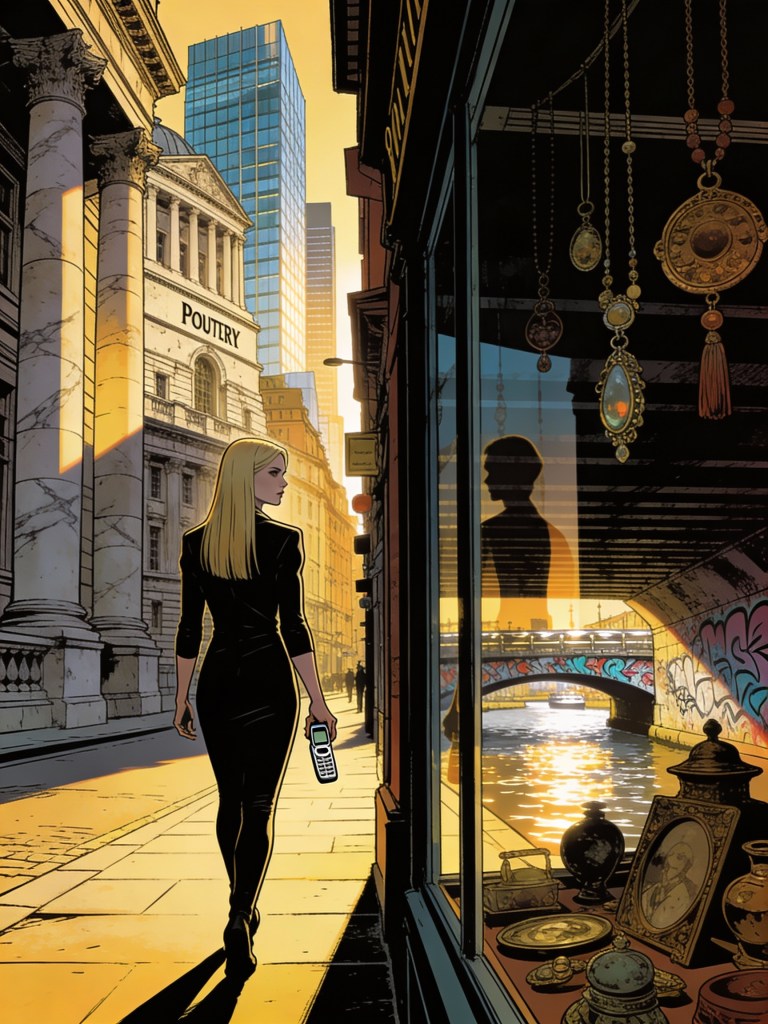
As I step through my front door, the day’s city dust trailing behind me, I spot the old flip phone sitting on the counter—a relic among my scatter of notes and books, its cover scarred, its ringtone stubbornly unmodern. Roger Boswell’s mark. I haven’t thought about the old Fox in weeks, and I’m half tempted to let it ring just for the nostalgia.
But curiosity wins. I snap it open.
“Hello, old Fox. Still flexing?” My voice comes out cooler than I feel. “If you’re ringing, you need something. So what is it this time?”
His laugh is a low rumble, smile audible through the static. “ “Hiya luv, you alright to come out and play?”. Harry’ll come scoop you up after dark, so be ready.”
Just like that. No explanations. Typical Boswell: never more than half the info at once, his instructions wrapped in stories he’ll never entirely share.
I lean against the counter, an odd warmth rising with the old thrill of the unexpected. After all the cities, crossings, and careful escapes, I suppose this is how you know the game hasn’t ended. Still being the queen on the board.
I.Ph.
 The C.O.M.C. Files