
The Chronomancer and the Twins of Time
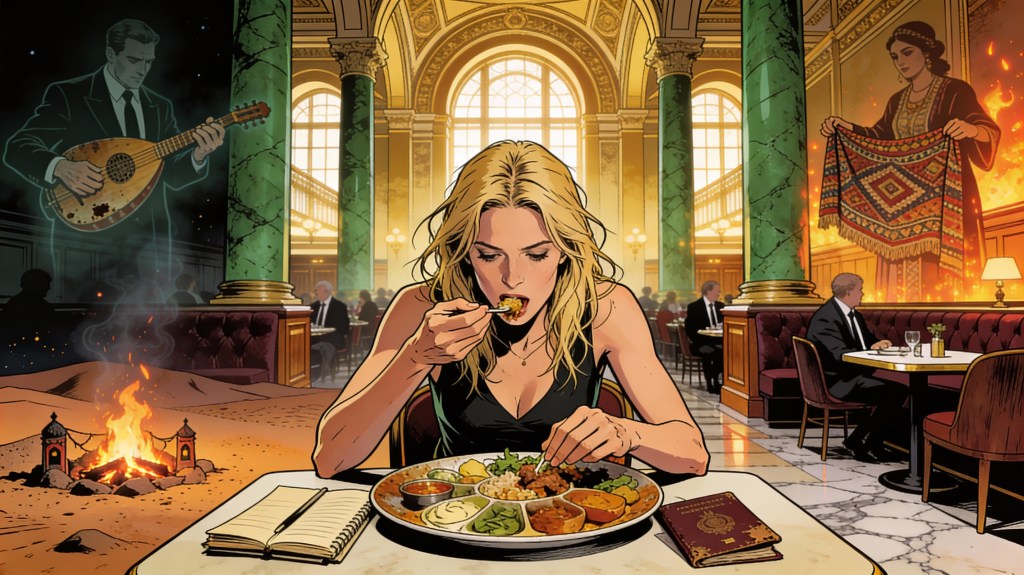
My mind won’t stay in the office. It keeps drifting back to midnight in the desert, Asdar pressing a battered oud into my hands, his family’s voices rising in a song older than any border. I’d tried to smooth my tangled hair, fingers working through knots as if appearing less wild might earn me answers, but it only made things stranger—every face in the circle staring, some curious, some respectful, a few grinning as though I’d stepped off a moon landing. Then a small woman moved forward, dark eyes bright, holding out a sjal—patterned, handwoven, edges flickering orange in the firelight.
The office phone rings. Mrs. H dispatches reminders about the Istanbul file.
I try to pull my attention back to the screen, to the clinical phrase I’ve typed: “Romani contributions to Persian culture.” It feels bloodless. My thoughts reach instead for fragments—a girl’s tattooed hands beating a drum in the shadow of ruins, a tooth extractor recounting legends as he works. Asdar’s hand steady as we navigated checkpoints, his laughter carrying the weight of generations.
The present lurches back. My stomach rumbles like distant thunder. What did I even eat for breakfast? Tail end of last night’s bread with hard cheese, wolfed down while scrolling news snippets, or a few stray walnuts pinched from their bag as I tried not to spill coffee on my notes? I made coffee twice, too strong each time, the second cup growing cold.
Asdar always insisted on breakfast: flatbread, sour yoghurt, sharp herbs. In Iran, missing a meal would earn you a scolding and a plate stacked higher than necessary. There’s a story in that—the ways food anchors us, the rituals that mark ordinary days as meaningful. But right now I just need something warm to quiet the restless ache that comes whenever I’m suspended between stories, between cities, between the sentence I’ve written and the one I haven’t.
I decide I can’t finish this chapter hungry.
The Ned is a ten-minute walk, that grand cathedral of consumption in EC2. Soaring ceilings, towering windows, African verdite columns, plush upholstery, acres of polished oak and marble. It cost a reported £200 million—a hosanna to the city’s love affair with itself, pin-striped hustlers and money chasing money beneath columns you could measure history against.
I barely notice the spectacle. I order something far too large, possibly meant for sharing, and eat it alone and fast, still in fieldworker mode. Plates arrive and disappear, marble glinting under sauce stains I leave unwiped. Around me, deals are being made, gossip traded, futures decided over steak and cocktails.
I feel oddly invisible, grateful for the anonymity. Known to no one here, just another guest refuelling before heading back to the brittle work of untangling diaspora. The contrast isn’t lost on me—Asdar’s breakfast insistence, the Romani girl’s drum, the circled faces in firelight, and now this: alone in a temple to capital, overfed and still somehow displaced.
I finish the draft later that evening, not with a conclusion but with a question: If the oldest Romani melodies vanished tomorrow, would Iran know how much it had lost? Or would culture quietly rethread itself, as it always does?
I send the chapter to my editor, hoping it hums with life, with uncertainty, with hope.
I.Ph.
 The C.O.M.C. Files