
The Chronomancer and the Twins of Time
I am back in London before the city has even realised summer is slipping away. The CYcrds Institute—Centre for Yield, Crisis & Research on Diaspora Societies, EC2—resumes its grip on my days with the quiet insistence of a place that never really sleeps.
Mrs. H is already waiting in her glass-walled office, files neatly aligned, the Istanbul dossier at the top of the stack.
“Your approval,” she says without preamble, “so we can send the first deck as promised to Burçu Şaşmaz, deputy chief of cabinet, DEİK.”
It is less a request than a baton-pass in a long relay.
So I review it—page by page—knowing that with my signature, the project will begin to move eastward, from these rarefied EC2 corridors toward the Bosphorus and, beyond that, to an Iran where every crossing now comes shadowed by suspicion. Each evening, I make the same return trip home, the city unspooling in reverse, and I think about how my life moves in circuits: Yerevan to London, London to EC2, Istanbul as a hinge.
I crave routine—not for comfort, but for oxygen. My days at CYcrds are smaller, deliberate: emails, meetings, the hum of the office muffled through double-glazed glass.
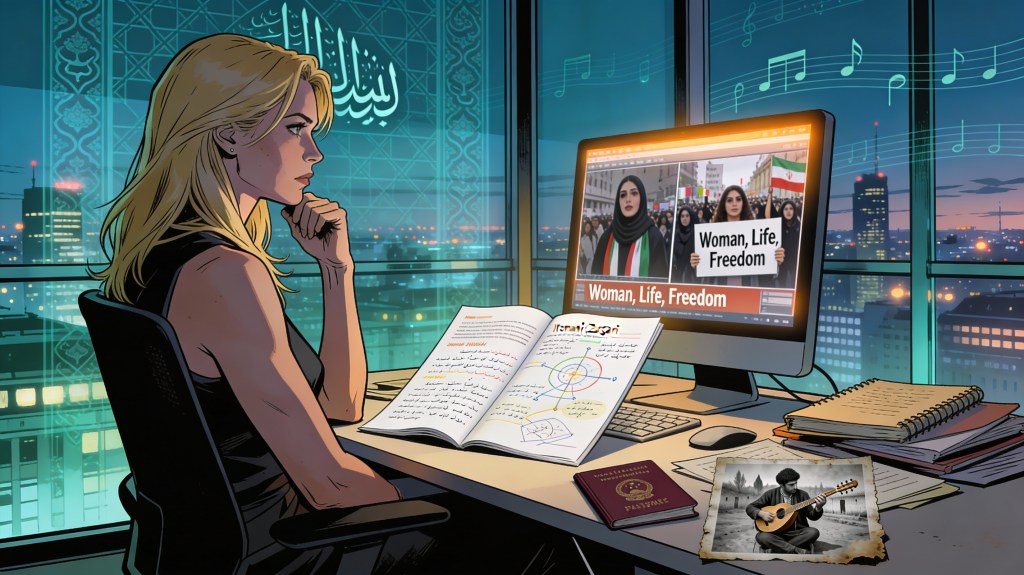
The Istanbul project is signed, so my mind drifts back to a different obligation: the promise I made to the Iranian Romani. To tell their stories, their music, their vanished ancestors. In these years after “Woman, Life, Freedom,” with security forces firing into crowds in cities whose names I know too well, the debt feels heavier, not lighter.
I sit at my desk in EC2, fingers hovering above the keyboard. The manuscript must be more than data; it has to hum with the weight of its history and the risk of its present.
I begin with their origins. The Romani of Iran: Indo-Aryan wanderers, their roots tracing back to northern India over a thousand years ago, braided into the old story of musicians brought to Persia in the time of kings. How many times have migrants remade a country, invisible but essential?
Their professions crowd my mind. For centuries, the Romani took the jobs no one else wanted: blacksmiths, barbers, dancers, circumcisers. “Impure,” said the Zoroastrian priests, a judgment that outlived the temples and slipped into everyday speech. Is it impurity, or simply necessity, when your labour builds villages and treats wounds?
I dig into music; here the Romani shine. Iranian folk tunes—kept alive by Romani hands—stretch from North Khorasan to Mazandaran, from Sistan and Baluchestan to forgotten corners of Alborz. Musicians, storytellers, artisans whose work fills weddings and mourning tents, even as their names rarely appear in official histories.
Villages like Zargar flicker in the literature, half-footnote, half-ghost. Their dialect, Zargari, is a blend of Romani, Persian, and Azeri Turkish—linguistic inventiveness hammered together out of need. I try to sketch this stubborn multilingualism in my text, but words always feel insufficient.
But then, discrimination. Persian “kowli”—the slur, the knife in the smile, a label that still means closed doors, police stops, quiet exclusion from housing or permits without anyone ever writing the word down. I trace mass expulsions and scattered diaspora: pushed westward in earlier centuries, pushed inward to Iran’s own peripheries. Always marginal, never allowed to forget their difference.
I pause. My coffee is cold. I think of Asdar in Iran, gripping my arm, sharing stories in whispers because neighbours were listening. His question—”Who will remember us if we disappear?”—has only become sharper since the streets filled with banners and then with armoured vehicles. My promise to him, to all those unseen in anthropological annals, anchors me to this work.
I press on: the present. Modern Romani in Iran—adapting, surviving, navigating a state that has always preferred tidy categories and now treats any blurred identity as a potential security problem. Many have lost their traditional trades, forced into precarious urban work. Where do they go when the world refuses to see them?
I list their contributions, refusing to let them fade: artisanship, music that crosses ethnic lines at weddings even when those gatherings have become suspect, medicine practised in settlements the state visits only when it wants to count, tax, or punish. Their survival is an act of creativity and quiet defiance.
I lean back and reread my draft. It is not enough—but it is a start. The Iranian Romani deserve more than invisibility; they are threads in the tapestry of Iran, old as myths and stubborn as hope, threads the authorities keep trying to unpick even as the pattern of revolt reappears in new colours, insisting that the country is larger and more unruly than any file can contain.
I.Ph.
Author’s Note
This chapter moves between what the world has seen of Iran and what it has mostly not seen. The references to protests and to the “Woman, Life, Freedom” movement speak to the widely documented crackdown that followed Mahsa (Jina) Amini’s death in 2022, when images of women and students confronting the regime briefly filled global screens. and to the continuing waves of demonstrations and crackdowns that have followed, including those of recent weeks.
Alongside those visible acts of defiance, there are communities whose repression and precariousness rarely reach international headlines. The Iranian Romani, including Zargari communities from places such as Zargar, have long faced social stigma, economic exclusion and state suspicion, often described with slurs or bureaucratic euphemisms instead of being recognised as part of Iran’s cultural fabric.
By placing the Iranian Romani within the same frame as the post‑2022 protests, this story tries to suggest that the regime’s violence is not only directed at those who appear on our screens, but also at those who have been kept off‑screen for generations. The portrayal here remains fictional and limited; readers are encouraged to seek out reporting and scholarship—especially work by Romani and Iranian writers—that examines these histories and present realities in greater depth.
May the gods have mercy on the shameless
I.Ph.
 The C.O.M.C. Files