
The room is quiet except for the gentle sounds I make gathering myself—a sleeve catches a red nipple, the glass of tea clinks softly as I set it down. Sandi stays close, her arm draped across the covers, not rushing, just present.
A brisk knock interrupts. Before I can call out, the door opens and Mitra steps in, her face pulled tight with urgency.
“I’m sorry to intrude,” she says, closing the door behind her. “But I need to make some decisions, now.”
I sit up a bit, brow creasing. “What decisions?”
She edges forward, fingers knitting together—deliberate, composed. “My sons need their mother. Roger Boswell is pressing me to take you home—to London. And flights are scarce in the next window, so…” She softens for just a second, offering me something gentler than her usual edge. “…please, tell me: are you coming with me? We could be in the city by tomorrow night, breathing—” she flickers a smile, dry, “—normal London polluted air.”
I just look at her for a moment, weighing everything—escape, return, the warmth of Sandi at my side. It sounds less like a proposition than a challenge, or maybe a gift.
I meet Mitra’s gaze, steady. I’m not letting her hurry me.
“Well, nothing like a good wiff of London fish and chips,” I offer, dry and with a flicker at my lips. “Give me an hour and I’ll answer, ok?”
She studies me and then gives that single, tight nod, all business, before slipping out and closing the door quietly behind her.
The moment the latch clicks, I exhale, untangle myself from Sandi, and cross the room. My fingers linger a moment on her forearm—a silent thank you—before I head to the bathroom.“I’m not letting anybody or anything get between me and my shower,” I say, mostly to myself. “Water, bubbles—all mine.”
I let the hot spray hit and tip my head back, the rush streaming down, erasing intrusion, rinsing salt and other people’s pressures away. For now, there is only skin, heat, and the honest pressure of water.
Halfway through lathering my hair, the thought drops in:
Gods below…Hungry again!
A laugh slips out, real—sharp and a little wicked. Some appetites, it seems, remain undefeated, no matter the storm.
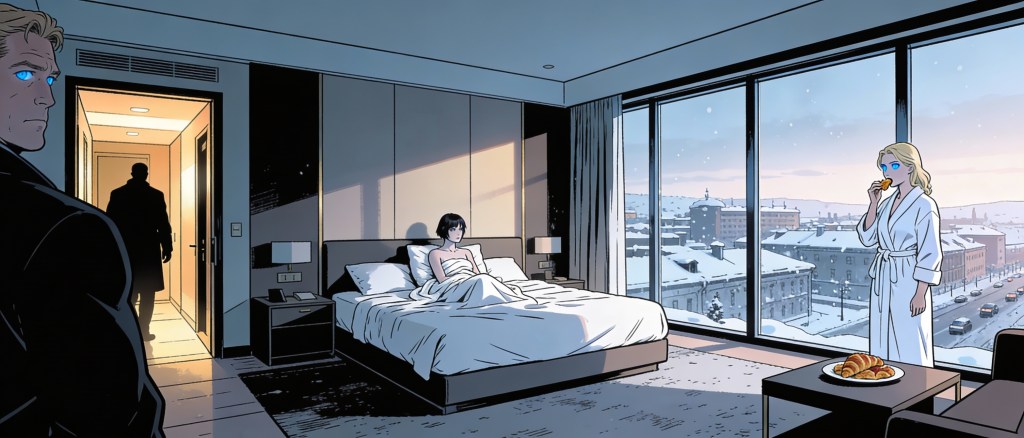
I step out, wrapped in steam and a fresh robe. Beads of water glisten at my collarbone, hair tumbling in damp lines down my back. The room’s scented with remnants of breakfast and a whisper of sandalwood from my shampoo. I feel reset—alive, clear, hungry, and more certain than I was before.
Sandi is still in bed, knees tucked up, gaze distant, a sentinel in her own way.
Tarmo occupies the space of the door, outwardly relaxed but his eyes sharp, fixed—waiting for something to fall into place.
I help myself to a slice of gata, breaking off a buttery bite as if claiming space, making intent physical. Both of them watch—Sandi quietly, Tarmo with that analytical calm.
Dabbing a syrup smear from my lips, I stand there, letting the pause stretch as I gather their attention.
“So, you already know I had a visitor,” I say, informal, unafraid. “Mitra wants me to fly back with her to London—soon. Not many planes left. And, well, nothing like proper London fish and chips.”
My tone is sardonic, but when I look from Tarmo to Sandi, my resolve is deliberate, unapologetic.
Tarmo barely moves. Light catches the glass in his hand, a thin arc playing across his knuckles. His only motion is a slow tap of one finger.
“Fair enough,” he says, voice low and even. “You’re leaving.” It’s not permission—it’s an acknowledgement, the kind he stores away to build his next move.
His gaze slides from me to Sandi, calculating the current between us, the gap and the pull.
“You’ll have your break, Elena. But breaks can be… fertile ground. Clear air, clear eyes. Sometimes the most valuable moves come from the ones who look like they’re sitting things out.”
He gives a faint curve of his mouth, not really a smile—more cypher than warmth.
“So enjoy your air. Enjoy your breakfast. When the next storm comes, you’ll see it from exactly where you’ve chosen to stand.”
He turns around—no drama, just the quiet, inevitable poise of someone who never needs to raise his voice to have all the answers.
“As for the storm,” he says, holding the door, “I’ll make sure it knows where to find you.”
The door latch clicks shut. The stillness that follows is rare: oddly fragile, like Yerevan under fresh snow outside the Alexander’s windows: air held tight, streets waiting for the first tread, the cold carrying that faint, omniscient threat on its breath. I let it settle, noticing how much lighter—how much sharper—I feel.
Tornado, hurricane, blizzard, hail, dust—storms are to be reckoned with, but the real problem, for Tarmo, will be the fire and geomagnetic storm he hasn’t even started to factor in, and are of his making.
I.Ph.
 The C.O.M.C. Files