
Tarmo’s composure shifts mid-breath.
Something raw, almost animal, grazes his senses — she can see it in the way his nostrils flare, the brief, involuntary pause. Not a sight, but a scent, faint yet undeniable. Elena. It clings to Sandi like a watermark under heat.
He mutters half under his breath, “No distraction…”
“What?” Sandi asks, all innocence, smiling inside.
That’s why she kissed Elena on her still-sticky cunt and slid her fingers inside her before coming here — so he would smell her. One–nil, you prick. Confusion in him is rare currency, and she intends to spend it.
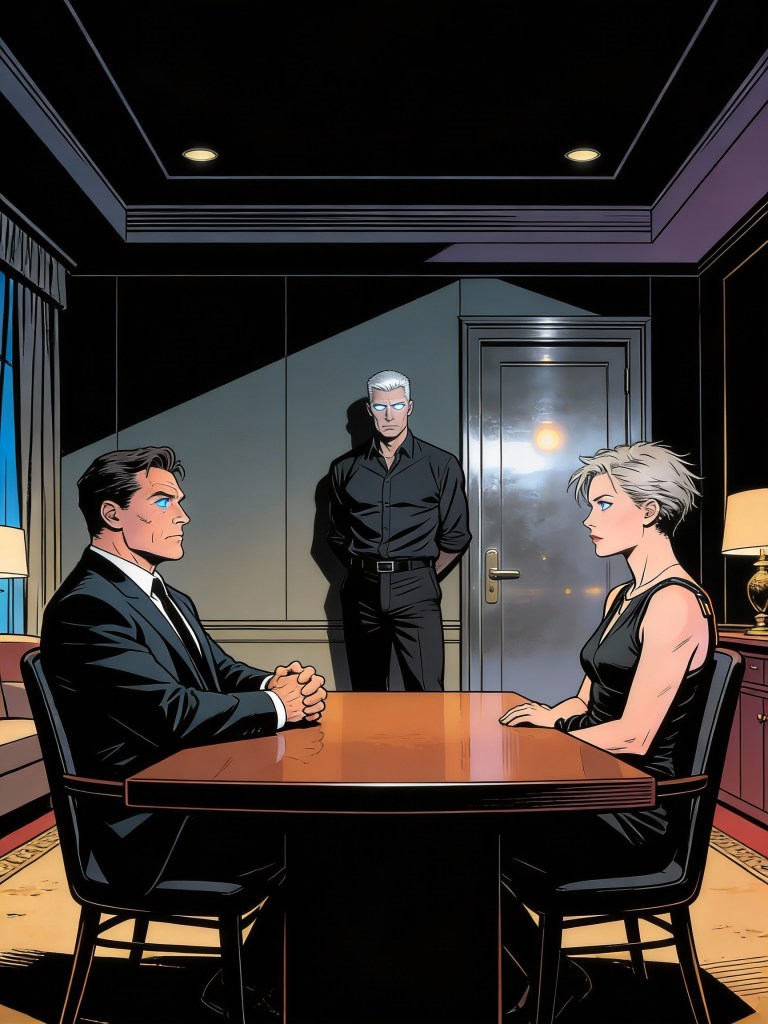
He turns his eyes on her, all sharp steel now.
“Don’t play games you can’t win, Sandi.”
She stills, letting the smile fade.
“What happened with the information you were supposed to deliver to my allies?” His gaze cuts through her like wire. “Did Bartek know anything about the inside intel? I know you were sleeping with him since Poland.”
The pang hits like a jab under the ribs — old, not forgotten, never really dulled.
“No,” she says, voice low but firm. “He did not. And he died protecting me — protecting your information.”
Tarmo holds her in his stare for a long moment, like he’s testing the metal at its breaking point.
“In Iran,” he says, voice flattening, “what did you give away, and to whom?”
Heat rises in her neck; her throat tightens.
“I think you got a good look this morning at the result of my answers,” she says hoarsely, anger barely filtered.
Behind her, Mikael shifts his weight just slightly — a reminder he’s there, maybe a silent judgment, maybe something else. She doesn’t look back to find out.
Tarmo exhales once, then steeples his fingers, elbows resting lightly on the armrests. The gesture is slow, deliberate, like he’s sliding a new piece onto the board.
“How much,” he says, each word distinct, “do you remember from the satchel?”
The question hangs between them, more dangerous than any accusation. Because they both know: whatever she answers next will decide whether she leaves this suite under her own weight.
She can almost see the map behind his eyes, the way he’s already running routes and borderlines.
Somaliland’s wind-scoured coast. Berbera: a port deal rattling Mogadishu, stirring Addis, sending Gulf diplomats whispering. The Bab al-Mandeb Strait, a third of the world’s ships sliding by like silent prizes — Turkey, the Emirates, China, everyone angling for a foothold. Nothing is abstract to him; each coordinate is written in his ledger the same way as her bruises and the names she carries.
And at the center of one branch of that map: Ekrem İmamoğlu — the ally who pried Istanbul from Erdoğan’s grip, made the city burn like dry grass in summer. Now İmamoğlu sits behind bars, and the vacuum his absence leaves drags every opportunist in Ankara — and Moscow — toward it.
He smells Elena on her and shoves the thought away; she can see the flicker in his eyes. No distractions — not when every frayed thread in this room could unravel a web stretched from Hargeisa to the Golden Horn.
“I’m not referring to… that,” he says, voice as flat as smoked glass. “I’m waiting for the summary. After Bartek died, when you were taken. Where first? Or did they move you straight to Iran? Speak.”
Sandi’s mind goes instantly to Istanbul — the switch, the black SUV, Baku, then Tabriz. The hands that tried to break her apart for codes. The taste of dust and petrol crossing into Azerbaijan, Farsi arguments muffled from the next room, the way they guarded her like cargo and then, just as quickly, like a venomous snake. The Iranians were the sharp end, but Belarus and Russia were the quiet architects pulling the strings behind her route.
“They were moving me to test the nets,” she says finally. “Keeping me away from Erdoğan’s men — they were already hunting the keeper of the codes. My satchel was the bait. The real hook was what I was supposed to bring İmamoğlu for you.”
His gaze tightens at the name, just a fraction. She knows what he’s remembering: the last Istanbul backroom, unfiltered cigarettes, quiet calculus, politics as water finding every crack. Now İmamoğlu is buried in steel and concrete, and Erdoğan’s reach is longer than ever.
Silence settles. The hum of the mini-fridge is suddenly a roar in the hush. Mikael shifts fractionally again in the background, catlike, a sentinel in plain clothes.
Tarmo steeples his fingers again, slower this time, weighing.
“How much,” he repeats, “do you remember from the satchel?”
Sandi’s fingers flex beneath the table, restless, betraying more than she wants them to. Her mind won’t stop circling — uncertainty and intuition snapping back and forth like wires in a live current.
What do these codes really hold?
Mitra and Karim bled to get them. Banking routes. Asset locations. Encrypted schedules for regional actors. Or something sharper — leverage over the shifting corridors of Somaliland, the Horn, the places where even Erdoğan’s men lost the trail.
Are they just technical scraps? Or keys? Alliances, weapons, a whole new map of power.
If she tells Tarmo everything she remembers — every fragment, every detail buried since Iran — what happens? Is she pulled closer, trusted, briefed, sent back out as some vanguard? Or has she already exhausted her window, used up her share of value?
She looks at him. The posture never loosens. The gleam in his eyes isn’t interest, it’s calculation — as if each flicker of her hesitation is already written into a move he’s prepared.
And inside her, there’s this dry, near-smile thought: he’ll twist forward whatever she says. He already has the codes. He already has Mitra and Karim tied in enough to pull them where he wants. He’s charted the African expansion of CYcrds with that smooth inevitability of his — the perfect alibi, entrepreneurship as camouflage, a clean surface stretched over a dirty web of plays.
He’ll send her and Elena into the labyrinth, shadow work, while he opens fresh fronts under the glow of legitimacy. And isn’t that the irony? She’s breaking herself down here, parsing truth and loyalty like a desperate student, while to him she’s a piece he will always recast, no matter the confession.
The truth presses cold but clear: he will use whatever she gives him, not for her, not even for them, but to sculpt the world into his architecture. Secret by secret, fragment by fragment, until every shadow bends along the lines he already drew.
For a flicker, she almost laughs.
The thought lands sharp, absurd, irresistible:
What if I just — walked?
Stand up, stretch, shake it off with a grin: Sorry, Tarmo, I’ve sacked myself. Wild ride, sure, but I’m off for lower mortality and better coffee. Tada. See you never.
She can almost picture it: the way his eyes wouldn’t even blink. Not shock, not anger. No — he’d catalogue it in the space of a breath, as though unpredictable defection were another data point folded into his endless algorithms. To leave him — not a man anymore, but a gravitational constant, an institution circling itself.
But the joke collapses as quick as it forms. She can’t walk. Not like that.
Because what roots her here is Elena. Not only as a lover, not only a partner. More. A soul she won’t abandon to the undertow of Tarmo’s appetite, his games, his architectures of fear and finesse.
Sandi rubs her jaw, trying to scrub the buzz of the thought from her skin. Leaving isn’t just saving herself; leaving is throwing Elena to swim alone with the tycoon who bends continents with as much elegance as he orders breakfast.
And somewhere in her a whisper: Maybe I’m free.
But Elena isn’t. Not yet. And if Sandi steps off, if she slips away into self-preservation, then his forces close around Elena unbuffered.
That wouldn’t be escape.
That would be abdication. Worse than surrender — desertion.
I.Ph.
 The C.O.M.C. Files