
The Ledger
The corridor to the far sauna suite was silent but for the muted creak of old floorboards under Tarmo’s steps. He didn’t speak, didn’t glance back to see if Mikael was following. There was nothing to say yet, and too much to be said all at once.
Inside, the air soaked them in heat and eucalyptus oil, the stones hissing as water struck. The steam was a world apart — the kind of place where decades could be boiled down to a handful of words, where skin flushed and muscles let go of their winter stiffness. They stayed there for hours, easing the cold out of their bones.
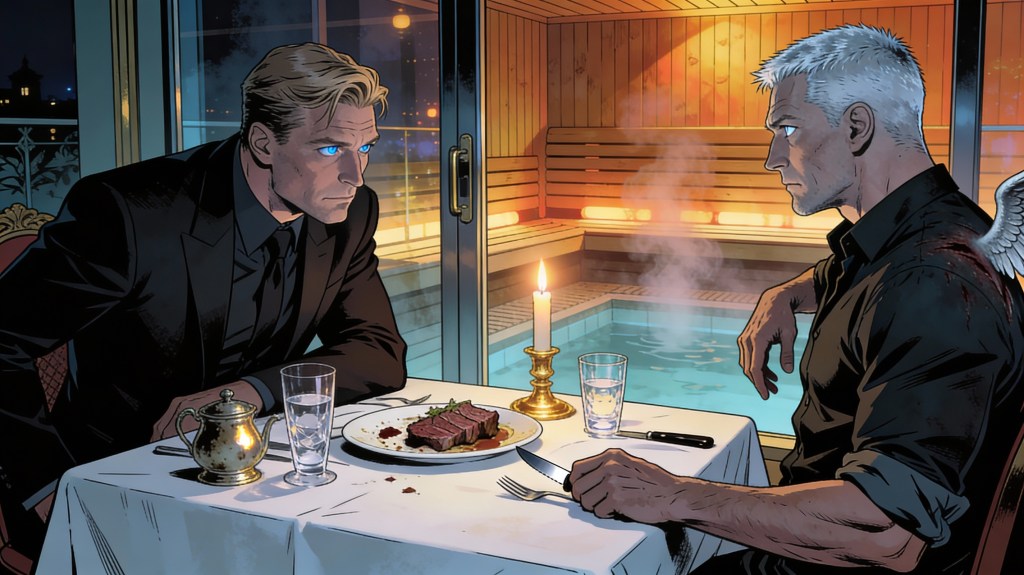
Later came dinner in the small private room adjoining the suite: heavy linen, old silver, food prepared with such care it felt ripped from another life entirely — a life before they’d learned how to hold a gun without trembling. War had no place at this table.
But war came anyway, and in the end they spoke low, deliberate, like old merchants counting debts.
At first, it was all Tarmo.
“Why,” he asked bluntly, “did you have your rifle drawn at the cave?”
He didn’t lean forward. Didn’t need to.
“I know you, Mikael. You only raise a weapon when it matters. What moved you? And don’t insult me with talk of bribes — that’s not your ledger. So spill it. Explain how my right hand, my shadow for over three decades, ended up the wild card in the equation.”
Mikael turned the knife above the venison, like the question over as a stone in his palm. He spoke slowly, in the way of men who measure every word.
“Since the moment that woman—Elena—entered your orbit,” he said, “she’s been poison to what used to be your coherent brain.
First, Tallinn — sudden change of plans, not for business, but to bring her to Pärnu.
Then Tartu. A mess again, because you were distracted. Hasna Bilal nearly slipped her out from under our noses.
Kardova followed — she became a leverage point, and it turned into a historic clusterfuck.
Zurich?” Mikael lets out a dry laugh. “You really lost it there. Lucky she had her own mind and saved the Narva operation, or we’d still be cleaning blood off the ledger.
Then St. Petersburg. Things steady—until you show up yourself. Do I need to go on?
Gdańsk. The Asupeni Mountains. Every time, she’s either a thorn in your skull or a blade at your throat.
I stepped in because she’d proven herself useful—earned my respect, even. But you—” He hesitates, eyes narrowing, a deeper struggle showing through his practiced calm. Mikael’s fingers drift briefly to the place between his shoulder blades, then drop, as if he’s remembered something he refuses to scratch. “Then came the shaman. That’s when everything tipped.”
He sets the knife down, breath held a moment too long.
“A few weeks ago, I would’ve said it was about protecting your interests from distraction, maybe even saving you from yourself, Tarmo. But since the shaman, there’s something else in me. A kind of noise—an urge I don’t recognize, pushing me and holding me back at the same time. I raised the rifle because the ledger was breaking, not just for you, but for all of us. I drew because something had to stop. I just didn’t know if it was you, her, or what the two of you were becoming. I didn’t pull the trigger. I couldn’t. . Karim fired instead. But I’m not sure anymore if it was me hesitating, or something older weighing the cost.”
Tarmo’s gaze hardens, though beneath it is a flicker of worry. “Older? Magic? Destiny? Or just regret?”
Mikael shakes his head, almost weary. “Not magic, and not faith either. Maybe it’s debts older than Moscow or this life time. Sometimes now I feel split—one part the man you know, the other part…watching, recording, judging the lines in that same ledger. The shaman told me I’m not only who I thought to be. I’m still trying to believe it.”
Tarmo doesn’t flinch, but the tension runs through the room like fresh steam. “So what do I call you now—Mikael, or the stranger inside you? Am I still dealing with the ledger, or something beyond my reckoning?”
Mikael steadies himself. “For now, I’m still that man. If anything changes, you’ll know it before I do. But this ledger, every mark—it still matters to me.”
The heat had long left their bones, but the air in the little private room was suddenly suffocating. Steam hadn’t softened either of them.
Tarmo didn’t answer.
He lets the silence settle, heavy as a stone in Mikael’s glass of water.
Across the small table, his consigliere—his shadow for thirty years—is all lean muscle, frost, and suspicion. A man who could tell you the caliber of a bullet from the sound it made passing his ear.
And Tarmo… Tarmo is thinking about Uruk.
Not the Uruk in history books, with crumbling ziggurats and ochre-painted bull gods. The other Uruk, the one only the shaman opened—a place they walked as beings more than men, long before clay tablets twisted the truth and names vanished from memory.
He ought to tell Mikael.
Tell him that it was there—inside her—he finally heard the gods call his name, just as they had in those old lost days. That everything Mikael called “distraction”—Gdańsk, Asupeni, Zurich—was only the echo of something ten thousand years deep.
But what would that sound like, across a table to a hard-boned Russian agent who lived his life by the gravity of fact and bullet?
Would he laugh?
Would he close the door on thirty years and walk out into the snow, never turning around?
Would he just watch, dead-eyed, and decide Tarmo had tipped over into the kind of madness men cure with bullets?
No, Tarmo decides. You don’t hand over that kind of truth in a sauna-side dining room. You bank it close, a coal kept in your chest, waiting to catch.
Instead, he leans back, pours them both another vodka, letting Mikael’s challenge hang in the air, answering it only with the faintest, most deliberate smile.
The silence stretches—the kind that lets Mikael tilt his head, a predator’s patience slipping into curiosity. And for an instant, Tarmo senses the split in Mikael: the man he’s trusted with his life, and the shadow—the watcher, the judge, the record-keeper awakened by myth and shaman.
He could lay it all out, bare as a sacrificial blade: Elena, Uruk, the gods still whispering her name inside him. Or he could do the one thing Mikael would never expect: step down from the clouds, speak from the place where man and myth meet.
Tarmo pours a thin line of vodka into Mikael’s glass, leaving his own untouched.
He shrugs—a gesture big enough to contain decades, small enough to mean nothing at all, a sign that wounds are only ledgers waiting to be balanced.
“After all,” Tarmo says quietly, “even I, Tarmo Amellal, am just a man.”
That draws the faintest lift of Mikael’s eyebrow—the look he saves for bluffing or bleeding out. In Tarmo’s mind, that look is old, too: borrowed from someone who’s seen the dawn over Uruk and the brink of every grave.
“But being a man,” Tarmo continues, voice tightening, “means we get back to the things at hand. You, Mikael, are going to make up for what you almost cost me. And you’ll earn my trust again. That starts now.”
He leaned forward, the candlelight catching the sharp planes of his face.
“We have Sandi to question — even if she doesn’t know yet how much she’ll give us. You’ll be in the room when she breaks. And after that, we get the codes from Mitra and Karim, before someone else decides they’re worth more dead than breathing.”
Mikael’s eyes stayed on him, unreadable, his thumb tracing the base of his glass. The heat between them was no longer from the sauna. It was the kind that came before the first move in a game neither man could afford to lose.
Tarmo picked up his own glass at last, holding it halfway to his lips without drinking.
“Do this right,” he said, “and maybe we’ll talk about trust over dinner again.”
The faintest smile — or was it a baring of teeth — crossed Mikael’s face.
“Then let’s get to work,” he said.
I.Ph.
 The C.O.M.C. Files