
The Pass
Minutes later, we descend toward the others—Sandi walking between Mitra and me, shivering but alive. Each step feels borrowed, the weight of the mountain pressing on our shoulders, reminding us how quickly luck can vanish.
Below, the wolf—Asdar—stands braced against the wind. His eyes sweep the high slopes, searching for any sign of shadows re-forming or fate changing its mind.
Mikael waits in the lee of the rocks, his arm freshly bandaged where Karim’s shot grazed him. His gaze finds mine and holds—hard, unblinking, as if nothing else in the world matters now but what passes between us.
The wind shifts, cutting sideways across the pass. Snow lifts in a white sheet, and for half a second I see it: a shadow rising from his shoulders, too symmetrical to be coat fabric catching wind. Two lines, curved and deliberate, extending upward before folding back against his body. The architecture is wrong—the angles don’t match human anatomy, the span too wide for arms.
I blink hard. Snow stings my eyes. When I look again, there’s nothing but wool and the hunch of a man trying to stay warm.
My throat tightens. Altitude sickness, I tell myself. Oxygen deprivation does strange things to perception. But my hands are shaking, and not from cold.
I’ve spent fifteen years cataloguing the impossible—rituals that shouldn’t work, objects that carry weight beyond physics, caves that smell like prophecy. I know the difference between seeing things and seeing things.
Whatever Mikael was three days ago, he isn’t anymore.
The mountain let us through this time. No one believes it will be so generous again.
The Transfer
The last of the Romani convoy halts at the mouth of the pass, engines idling in the cold. Zargari gives me a curt nod—a gesture that settles accounts without ceremony.
“Our work is done,” he says, clipped and final.
But before the engines gun and the tires spit slush, he catches Asdar’s eye. Something passes between them—not words, just the weight of understanding between men who answer to the same elder, the same prophecy.
Asdar steps forward. Mitra watches him approach, the key still gripped in her hand. For a long moment, she doesn’t move. The iron sits in her palm like it belongs there, like it’s been waiting for her specifically across generations.
“The elder said it would come to this,” Asdar says quietly. His Farsi is mountain-dialect, rougher than hers, but the formality underneath is unmistakable. “That the key would need a keeper who walks between.”
“Between what?” Mitra’s voice is tight.
“Worlds. Forms.” He glances at me, then back to her. “I’m the only one here who can carry it where it needs to go.”
Mitra’s jaw works. I watch her fingers tighten around the iron bow, the tiny script biting into her palm. She knows something about that key that I don’t—something that makes letting go feel like amputation.
But finally, slowly, she extends her hand.
Asdar takes it with both palms, the way you’d receive something sacred. The moment the key leaves Mitra’s skin, I see her sway slightly. Karim catches her elbow.
Tarmo steps forward then, drawing the deck of cards from his inner pocket. The marked ones and the blank ones, still shuffled together. He doesn’t hand them over immediately.
“If these fall into the wrong hands—”
“They won’t,” Asdar cuts him off. Not rudely, but with the kind of certainty that doesn’t invite argument. “The elder told me what they unlock. What they’ll become. I know what I’m carrying.”
Something in his tone makes my stomach clench. What they’ll become. Not what they are now, but what they’re meant to transform into.
Tarmo studies him for another beat, then hands over the deck. “You lose those, we lose everything.”
“I know.” Asdar tucks both key and cards inside his coat, against his chest, where they disappear into layers of wool and whatever else he carries close to his skin. When his hand emerges, there’s no bulge, no sign of anything hidden. It’s like the objects have been absorbed.
Behind us, the Romani engines rev. Zargari raises one hand—farewell or blessing, impossible to tell which—and then they’re gone, tires spitting slush, vanishing into the switchbacks below.
The wind shifts immediately, sharper now, laced with snow that stings every inch of exposed skin. Without the convoy, we look smaller. More exposed.
Mitra pulls her scarf higher, but her eyes are still on Asdar. “If you lose them,” she says quietly, “you lose more than objects. You understand that?”
He meets her gaze. “I understand what lives in the iron. What’s written there.” His hand rests briefly over his heart, where the key sits hidden. “The names aren’t just past. They’re future.”
Future. The word hangs in the cold air. I think of the cave three days ago, of Tarmo’s hands creating circuits I recognized too late, of the warmth that still pools in my belly despite altitude and exhaustion.
Future names. Future descendants.
I press my hand to my stomach again, trying to settle the unease that won’t fade.
“From here,” Mitra says, voice carrying to all of us, “we’re the only shield we have.”
The White Knife
We move in a crooked line along the knife-edge of the mountain. Sandi stumbles between Karim and Tarmo, her legs shaky, each breath costing her too much. Mikael trudges a few paces behind, rifle slung, coat sleeve dark and crusted with frozen blood where Karim’s shot found him. He hasn’t spoken since.
Asdar walks at the front, moving with inherited certainty even in whiteout conditions. I watch the way he navigates—not reading terrain, but feeling it. Or being guided by something I can’t see.
The key and cards are somewhere inside his coat. Against his heart. Carrying names that haven’t been born yet.
I wonder if mine is written there. If the child—impossible, I’m fifty, it’s impossible—is already inscribed in iron, waiting to be unlocked.
Asdar sweeps the ridge ahead. “Maybe twenty minutes before weather closes in. After that, it’s everyone’s game—ours and theirs.”
Snow lifts sideways, the pass narrowing, sheer drop vanishing into white. Footprints blur behind us almost as soon as they’re made. Every few minutes we slow to retighten the line, or Sandi’s knees threaten to buckle entirely.
Tarmo spots the movement below first—dark forms threading through the haze, too disciplined for bandits or locals. He mutters, just loud enough for Mitra to hear, “Erdogan’s men. They caught up faster than I expected.”
Tarmo checks back, voice taut. “They’ll hit us before the ridge if we don’t move faster.”
“Speed up, and she won’t make it,” Karim fires back.
Mitra’s eyes are fixed on the swirling light ahead. “If we make the ridge before the storm seals it, they can’t outflank us. Here, we choose the ground—not them.”
The gust blasts us low, storm swallowing sight. Shapes below blur into the snow, and the mountain feels alive—pressing down, paring us back to nothing but what we carry and what we can defend.
I tighten my grip on Sandi’s arm, my fingers stiff, skin numb. “On our own, then,” I mutter into the wind.
No one disagrees. The Romani are long gone. The only alliance left on the pass is survival.
The Relay
The dots below keep their distance, pacing us without closing the gap. They’re too far for a shot, but close enough to taste their persistence. Tarmo studies them through brief holes in the wind, squinting at the haze between gusts.
“They’re not pushing,” he says, voice low. “Not even trying to gain ground.”
Mikael’s reply is flat, scarf muffling the edge. “Because they don’t need to.”
The wind knifes in, needles of snow scouring the path. The group tightens, Elena and Karim half-carrying Sandi, her head sagging against the cold. Behind us, the shadows peel off, angling toward a break in the ridge.
“They’re leaving?” I ask, hope flickering despite everything.
Mitra shakes her head, eyes narrow. “No. They’re going to talk to someone already ahead of us.”
It hits—a cold weight in the gut. This isn’t retreat. It’s relay: message-running, coordination. The line of sight will vanish in the storm, but whoever’s waiting on the far side adjusts their aim, their watch, their welcome.
Asdar pushes forward, his outline cutting into the white. “From here, every step edges us closer to the trap.”
Karim’s tone is grim. “And we can’t turn back.”
“No,” Tarmo agrees, still scanning the ridgeline. “But we can choose how we walk into it.”
The wind roars, swallowing every word that follows. The pass ahead is nothing but blurring white, shifting ground, and guesswork. Somewhere beyond, men are waiting—now certain we’re coming.
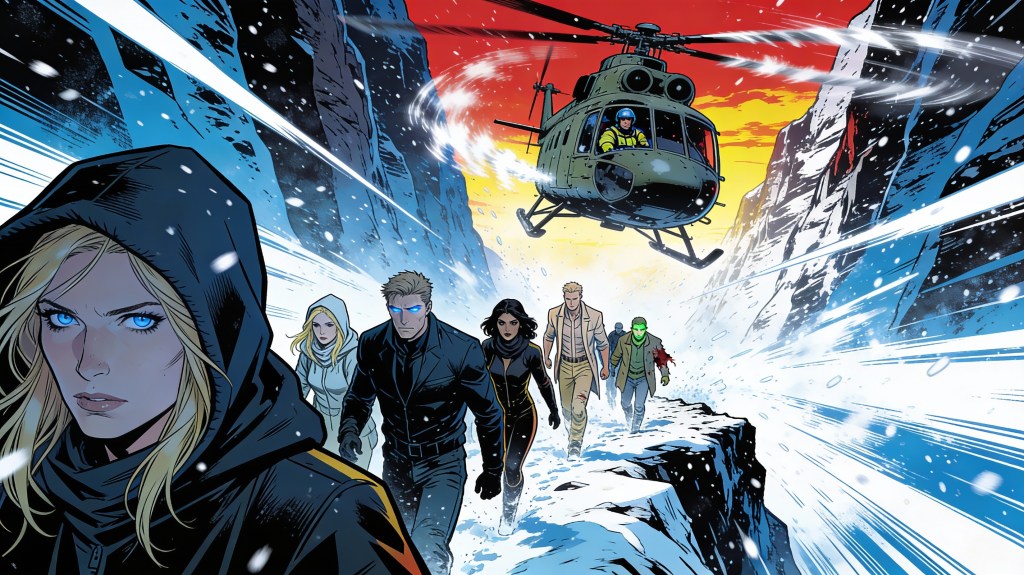
The Helicopter in the Snow
Despite the Zargari network peeling away, we press forward—Sandi barely conscious, Mikael’s arm bound tight, the wind carving the boundary between earth and sky to nothing.
Asdar’s radio crackles, just audible through the storm, while Tarmo unzips his pack, pulling out a sat-phone marked for private frequencies—a contact list most people would never see in a lifetime. He steps away, shielding the device with his body and one gloved hand against swirling ice.
“Blackbird, this is Amellal—coordinates as sent. Twelve minutes ago. You have my authorisation. Approach low and silent.” His voice is clipped, spoken like ritual.
The others watch him, half-doubtful, half-relieved, but there’s no time for questions or skepticism. The snowfall above thickens, churning the pass into a blank void, visibility reduced to the flicker of Karim’s battered torch.
Minutes pass, each one a war with cold and gravity—until the thump of rotors slices through the storm, audible long before any shape emerges. A matte-black helicopter drops from the clouds, skimming close with its lights killed, revealing only the merest sliver of itself as it lands on a shelf of drifted snow.
The pilot steps out, pure business—no uniform, no insignia, just Tarmo’s code words and the ironclad promise of a wire transfer so fat it’ll erase every trace once they’re gone before anyone else’s teams close in.
We scramble inside—Karim hauling Sandi, Mitra bracing Elena and Asdar, Mikael limping but eyes locked above. As the doors slam, we watch the snow swirl swallow the pass. Only now do Erdogan’s men break cover, scrambling to radio in the new coordinates—a heartbeat too late.
Through the smoked glass, Tarmo’s gaze finds Elena’s—a flicker of silent victory. Two survivors outmanoeuvring every hunter, by luck, by wealth, by pure audacity. No matter how tight the net, Tarmo’s billions and reach slice it open.
The whup of rotors, the blast of blizzard, the desperate dash: escape by air, bought with the kind of power only an operator, a field-player, and a myth-haunted lover can wield.
Old Debts, New Borders
The rotors thunder, shaking loose snow from the pass as we lift off. Inside the cabin, adrenaline hasn’t faded—Sandi slumps between Mitra and Karim, Asdar settling near Elena, Mikael pale and silent, clutching his bandaged arm.
Tarmo stands by the door, watching the pilot run through a final checklist. For a long moment, he studies Mikael—pale, silent, clutching his bandaged arm. Only hours ago, Mikael moved through the snow with a rifle trained toward the cave, his body language unreadable, his intent a mystery. Karim shot first, fast and precise, reading threat before anyone could ask questions.
The confusion sits heavy in Tarmo’s gut. Mikael—trusted, battle-tested, the man at his right hand for years—was always the one to flank, to cover, never to threaten. Why gun for the heart of his own people? Why raise a rifle toward the woman Tarmo would ransom his fortune for?
He feels the cold edge of betrayal, but history tangles the urge to condemn. Mikael is more than a risk or a liability—he’s the shadow at Tarmo’s edge, the quick hand in every boardroom and back alley, a keeper of debts and silent oaths. Years of shared danger do not unravel in a single night, no matter how sharp the fracture.
He glances again at Mikael—wounded but alive, eyes averted, the riddle of recent hours unsolved. Old debts, Tarmo reminds himself, don’t get paid off with a single score.
He signals the pilot with a nod. “All. We go together.”
The helicopter lifts, cocooning us in whirling snow, surging north and west over the border. Mountains flatten into the wild forests of Armenia. The pilot murmurs encrypted directions, dodging radar, following a route mapped by Tarmo’s network and fueled by wire transfers no border regime can block.
Twenty minutes, and Iranian peaks fade into shadow—Armenian hills begin to rise from the storm, promising new dice to roll, new threats to face.
I lean against the glass, eyes on Tarmo—grateful, wary, measuring the mercy shown to Mikael. Tarmo catches my gaze, just once, mouthing the words: “Old debts don’t pay themselves.”
We touch down in a frozen field outside Yerevan, dusk falling across bribed silence. The group emerges—battered, patched, together. Mikael staggers from the chopper, head low; Tarmo lets him walk, knowing the reckoning waits in the quiet that follows.
Sandi is alive, Elena is safe for now, and the codes burn in our pockets with all their unspent power.
Above us, the Armenian sky is thick with new possibilities. Tonight, survival is the currency—paid by the hard edge of Tarmo’s unwilling humanity.
I.Ph.
 The C.O.M.C. Files