
The Exchange — Kandovan
We gathered in the lee of the rock wall, wind scraping frost across our boots. Sandi stood at the center, pale but steady, flanked by Tarmo and Mitra. The captors held back, watching. Every rifle lowered but not forgotten.
I hung back with Asdar, my hand unconsciously pressed to my belly where warmth still pooled from the cave. Three days since the ritual, and my body felt different in ways I couldn’t name yet. Heavier. More present.
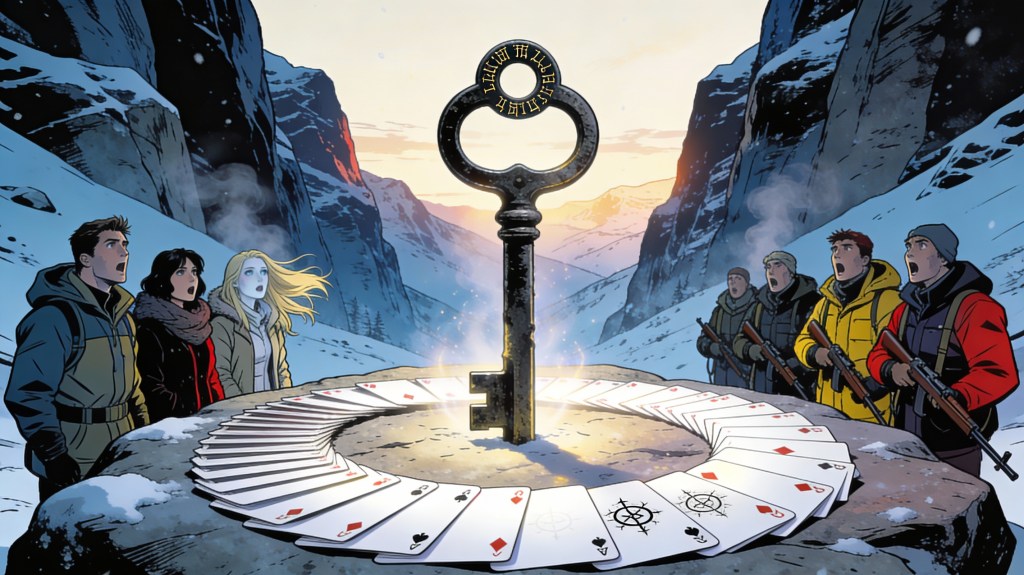
Tarmo’s hand tightened on the packet—the codes, old as anything in his possession. In his other hand, a heavy iron key hung against his glove, dark metal worn smooth where generations had turned it. Around the bow, a narrow ring of tiny cuts ran in a continuous band: curved and hooked strokes that looked like ornament until the eye lingered.
I’d seen scripts like that before. Temple inscriptions from Ugarit. Seal stones from Harappa. But never on iron, never still legible after what must have been centuries of handling.
Sandi’s chin lifted, her eyes on Mitra.
Mitra stepped forward, her own folio clutched tight. “We’re not just trading bodies. The codes are half the truth. The key—what unlocks them—is here.” She set the folio between them, fingers trembling just enough that only Sandi caught it.
The lead captor—Turkish military bearing, the kind of posture that came from Ankara academies, not mountain warfare—tilted his head. “You have both?” His Persian was educated, suspicious. The kind of man who’d been promised something by someone higher up the chain.
Tarmo nodded once. “Not for sale. Not today.”
Sandi’s eyes flicked between Mitra and the folio. “You found it?” Her voice barely carried.
“My father’s debt, finally called in.” Mitra’s words were for Tarmo only, but I caught them. Watched the way her hand shook when she said father, the way Sandi’s face shifted—recognition or memory, I couldn’t tell which.
The wind clutched at edges. No one breathed easily. I tasted copper at the back of my throat again, the way I had in the cave. My breasts ached.
The captor laughed, brittle. “Then let’s see you open it.”
Tarmo could have spread maps or paper on the flat rock between them. Instead, he reached into his coat and took out a narrow deck—fifty-two blank playing cards, edges squared, faces white as the snow under their boots. They looked wrong out here, too clean, too deliberate. He laid them down in a neat fan between both sides.
“Your codes,” he said, tapping the packet, “are just numbers and letters unless something answers them.”
He set the iron key in the middle of the blank field. The captor leaned closer. I watched his eyes widen slightly as he caught the fine strokes circling the bow—too regular to be scratches, too deliberate to be decorative.
Mitra and Sandi both stared at the ring of cuts as if the metal had just spoken their names aloud.
My anthropologist training kicked in: This is genealogy. This is lineage inscribed in iron. Each mark is a name.
Tarmo shifted his weight, and I caught the edge of something in his face—not quite a laugh, more like recognition of a joke being played on all of them. He was holding an object he couldn’t read, watching two women respond to script that bypassed language entirely and went straight to blood.
Sandi’s gaze caught on one small cluster of strokes, worn but not gone. The shape of it pulled at her visibly—a memory she’d never lived. Mitra’s fingers flexed around the folio, answering the same pull.
“Parlour tricks,” the captor snapped. “Open it.”
Mitra stepped to Sandi’s side, passing her the folio. “You hold the codes. I hold the key. Together, we decide what gets read, and who remembers it.” Her hand closed around the iron.
I watched her palm where it gripped the bow. No flinch, no burn—but her breathing changed. Deeper. Like she was drawing something up from inside herself to meet what the key demanded.
Tension rippled through the circle. Mikael—who’d been ex-KGB three days ago and now moved with something else threaded through him, something that made the hairs on my neck rise when he stood too close—shifted his stance. Karim’s eyes never left the leather sachet.
Mitra lowered the key until the ring of cuts hovered just above the nearest row of cards. For a moment nothing changed: only wind and thin breath and the scrape of snow somewhere higher on the ridge.
Then the face of the card directly beneath the oldest cluster of strokes darkened. Ink seeping up from inside the paper—not written, not printed. Surfacing. A single mark, black and exact, as if the card had finally remembered what it was always meant to show.
The captor’s men muttered in Turkish. Another card, further along the fan, flowered with a different symbol. Mitra lifted the key a fraction and the blooming stopped.
“Enough,” Tarmo said quietly.
She froze. The marks stayed, stark against white.
Sandi reached down, turning one card over and back again. The backs were still blank. Only the faces carried the signs. Her throat worked. “So if we walk away with nothing, you still have your hostages. But if you walk away with this”—she tapped the packet, then the key, then the marked card—”without us, none of it will answer you.”
The captors pressed forward. Tarmo held them back with a flat look. “We bring both, together, away from here. Split them, nothing unlocks. Take them by force, nothing can be used. That’s the deal.”
The leader stared at the blank cards and the dark key resting above them, trying to see the trick. He couldn’t read what was carved into the iron, couldn’t know why the symbols chose only some cards and not others. He only understood leverage, and he’d just lost his.
He gestured sharply. “Take them and go. If the mountain hears trouble after, it’s on your heads.”
Sandi moved first—hand on the codes, Mitra’s hand still on the key, their stories braided. The fan of cards closed with a soft, papery sound as Tarmo gathered them, unmarked and marked alike, and pocketed the deck with the same care he gave the packet.
As we slipped down the trail together, I felt it: the shift from scattered individuals to something tighter, more dangerous. Not trust. Necessity. No one else could risk letting the answer out of sight.
My hand pressed to my belly again, trying to settle the unease that had lived there since the cave. Three days of attributing it to stress, bad water, altitude sickness. But the warmth hadn’t faded, and my body kept insisting something had shifted in ways I couldn’t name.
The key in Mitra’s hand carried names. Future names. Descendants who would change the world.
I watched how it responded to her and Sandi—blood calling to blood, script bypassing language to speak directly to lineage. Whatever Tarmo had been part of in that cave, whatever Asdar had prepared before bringing me there, it was woven into this. Connected.
I just couldn’t see how yet.
The wind stirred, and the mountain waited for the reckoning.
I.Ph.
 The C.O.M.C. Files