
The trail curves and doubles back, vanishing more than once. In Ardabil, that means we’re close. Karim leads, every move practiced—border secrets are old currency for him. I keep pace, counting every shadow, every half-open door, stitching details into memory.
The hideout isn’t accidental. Down an unlabeled side street, three turns past alleys slick with old cooking oil, then a door behind a weathered rug that looks more like trash than cover.
Inside, it’s not so much a room as a stitched-together warren, lit by broken neon. The walls sweat with age, neglect bleeding through every joint. At the far end, a man sits with a chipped glass of tea, gaze measuring us for possibility before greeting.
The codeholder—or at least, he’s who we believe. Silence holds for a long moment.
Then I speak—dialect half-memory, half-ritual: “There was a night in the Zayandeh valley, when a man of your blood was pulled from the river. A stranger saved him.”
His eyelids flicker once, then fall into a slow nod. “Your father.” Not a question—a summoning. He gestures to a seat.
The debt hangs between us, heavy and alive. Here, it isn’t nostalgia; it’s currency powerful enough to crack locked doors.
“You come for codes,” he says. “You expect them for free, because of that night.”
Karim leans in, low, deliberate. “We expect them because the ledger is clear. Payment is due.”
The man ignores his tea, eyes moving from me to Karim. “Debt is sacred. So is caution. Others hunt what you hunt.”
I realize then: he’s not simply holding information—he’s balancing offers. Someone else has been here, or sent their shadow.
“What’s your price?” I ask.
“Simple. I give you what you want. You get me out of Ardabil alive when the streets bloody. And when another comes—and they will—you swear you never saw me.”
We can take the deal, or try to take the codes by force. Either way, it means choosing sides in a game more crowded than we guessed.
Karim’s hand rests near the knife—no fuss, but clear. I tap the table. The codeholder waits, tea cooling in his palm.
Outside, the alley stays quiet. Too quiet for this hour, for this neighborhood.
The codeholder sets down his glass. His hand doesn’t shake, but something in his shoulders shifts—preparation, or resignation. He reaches beneath the table.
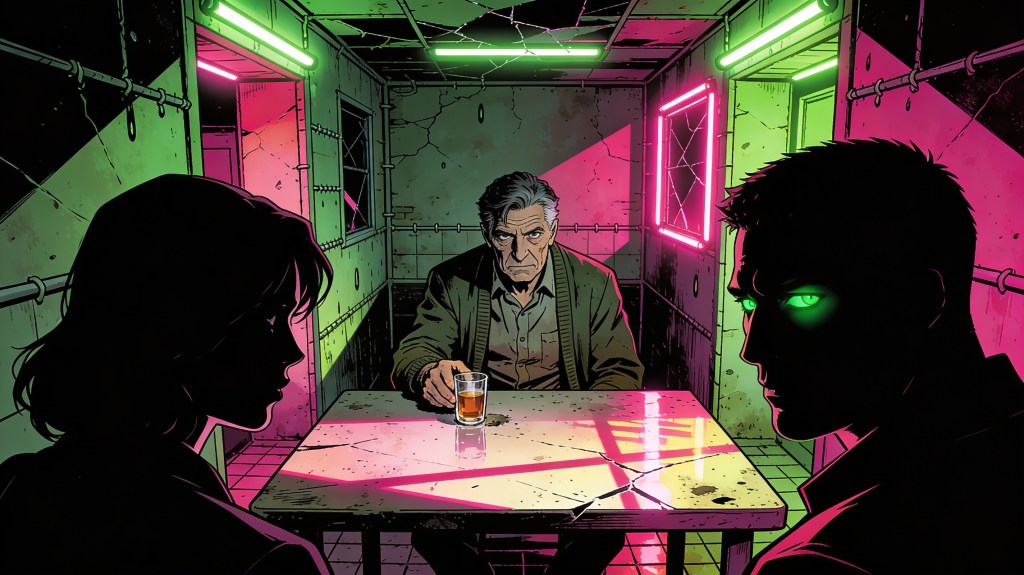
Karim moves. Not the knife yet, just his weight forward.
The codeholder’s hand emerges holding a folded square of paper, creased soft from handling. “The codes,” he says. “Take them. Get me out, or don’t—but if you leave me here, the next ones won’t ask nicely.”
I take the paper. It’s warm, which means he’s been carrying it close. Waiting for us, or waiting for whoever came first.
“Who else came?” I ask.
“Does it matter?” He stands, still watching the door. “You have what you need. I have your father’s debt. The equation balances, or it doesn’t.”
The paper pulses slightly against my palm—body heat, my own pulse, something. I fold it into my jacket.
Karim catches my eye. The look says: we take him or we don’t, but we decide now.
The door is fifteen feet behind us. The alley quiet. The codes already burning a hole in my pocket, even though that’s not how they work.
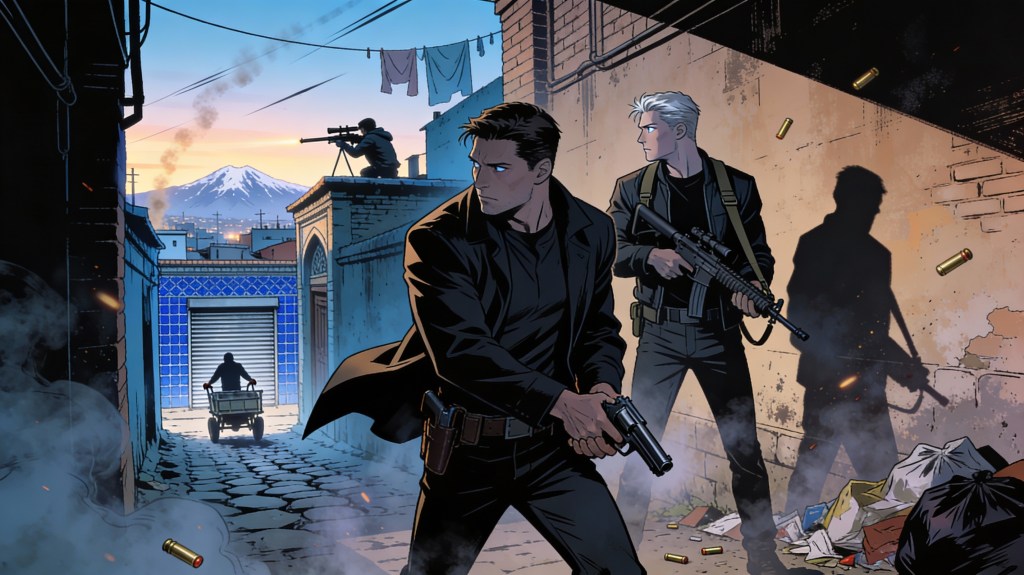
The alley still reeks of cordite when I holster the weapon. Mikael’s already scanning rooflines, that sniper stillness he gets when the noise stops but the situation hasn’t.
Early light over Tabriz, blue and bitter. Wind off Sahand, the kind that finds every gap in your jacket. We’re hours ahead of Elena and Asdar. Should feel like winning.
It doesn’t.
Reza’s voice cracks through: “Your choice is simple. Move now for Sandi, or wait for the woman and pray Erdogan’s people don’t get her first.”
The woman. Not Elena. Reza knows better than to use her name when I’m making tactical calls.
I watch the street—shutters opening, a cart rattling over stones, the city waking into its routines. Somewhere in this warren, Sandi’s waiting. Somewhere else, Elena’s tracking the same codes we are. And behind it all, Erdogan’s hunters, patient as winter.
The calculation writes itself: Take Sandi now, cut her loose before the net tightens. Let Elena draw the attention, use her as the distraction she’s too smart to volunteer for.
Smart. Efficient. The kind of thinking that wins wars.
I want to hate it.
Mikael doesn’t wait for me to argue with myself. “If Erdogan catches her here, you know where she ends up. Move first. Sandi’s the anchor.”
He’s right. Strategically, he’s always right. And that’s the problem—I can see it too clearly. Elena as bait, Elena as sacrifice, Elena as the piece you lose to win the game. The pattern’s already there, carved in before I even think it.
Then Reza: “Zargari’s been spotted near the bazaar. Dom’s people. They’re not here for shopping.”
My hand’s still on the weapon. Won’t let go.
Not just Erdogan, then. If Zargari and Dom are moving, Asdar’s close. And where Asdar goes—
—Elena follows. Elena walks into it. Elena becomes the center of something I can already see three moves ahead, and every outcome ends with me choosing the mission over her.
The wind sharpens. My hand finally leaves the weapon.
“Keep eyes on Zargari,” I tell Reza. “We’re taking the road through the rocks.”
“Finally,” Mikael says, that wolf-grin surfacing. “A plan that doesn’t wait for someone else to move first.”
But that’s not it. That’s not it at all.
We’re not moving first. We’re moving instead. Instead of going back for her. Instead of pulling her out before the city closes. Instead of being what she needs and being what the mission needs, I’m choosing—
—the same way I always choose.
We slip into the old city—past shuttered confectioners, past blue tiles that once meant something—and head for Kandovan. The cold at our backs. The choice already made.
And that old pattern settling in my chest like stone, like it always belonged there.
I.Ph.
 The C.O.M.C. Files