
The Dark Wagon
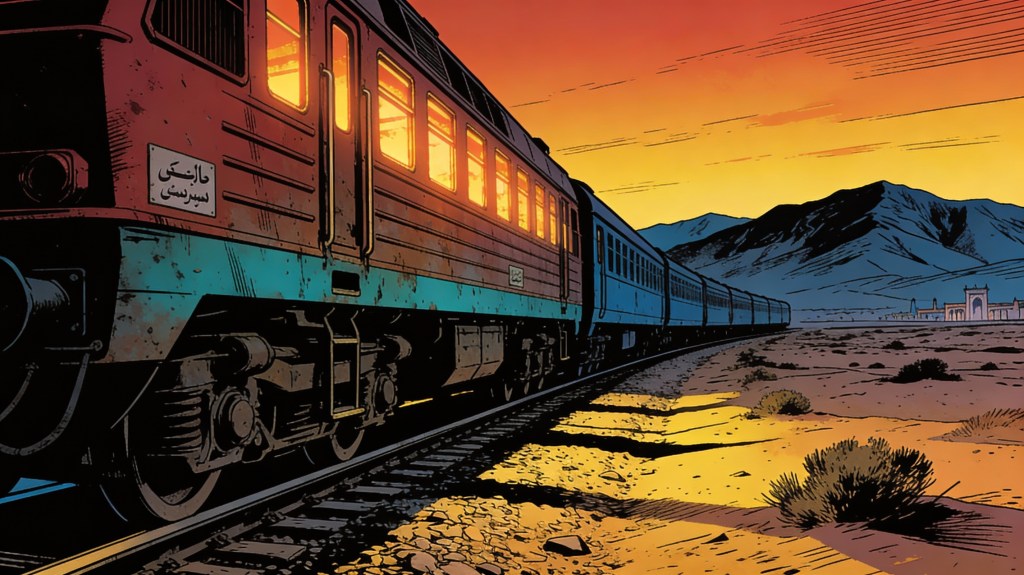
The horses carry us long enough that Tehran fades into a dusty shimmer. I sit tall in the saddle, wind pushing hair across my mouth, laughing at Asdar’s teasing shout, the nomads’ voices rough and bright in the cold morning. We stop at the rail siding, where steel lines cut east across scrub and emptiness—no romance here, just the long, groaning cargo train waiting.
This isn’t the Orient Express of storybooks, but a freight haulier where silence means respect. If we’re going to beat the days-long ride—valleys full of patrols and uncertainty—this is our one way out.
We dismount, exchanging grips, short embraces with nomads I barely know but trust. I promise them—just as I did the first day on horseback—that I’ll tell their story. Salt winds, shifting routes, the stubborn grace that drives them wherever others crawl.
“Write the truth,” an elder tells me, his eyes like desert shale. “Or not at all.”
I nod, and I mean it. The train waits, rumbling, the smell of oil, iron, cattle, and steam heavy as fate. I watch as the nomads vanish, their figures swallowed up by desert distance and legend.
For a moment, the wagon and its dark interior promise only silence ahead. But I carry their stories, and I won’t lose them to the emptiness.
Asdar climbs into the unlit wagon ahead of me and reaches down. Our hands lock, his grip steady, pulling me into the dark. Inside, I smell dust, rope, machine oil—no seats, just space to crouch among shadows and listen to the rails hum as the train starts moving.
It begins with quiet: the shared breath of fugitives run ragged by days on horseback. I lean back against a stack of tarpaulin-wrapped crates, cold seeping through my jacket. Asdar kneels beside me, no light, no words. The slow sway of the wagon presses us shoulder to shoulder, then closer.
What starts as the brush of his hand turns anchoring. The rails’ rhythm, the anonymity of night, the certainty that no one is watching—together, they make a refuge. I touch his jaw, feel the scratch of stubble, skin warm from the ride. He kisses me like it’s both the first and last time we’ll get away with it.
His breath warms my ear—whispered, urgent: “I am bursting if I don’t have you now.”
I laugh, low, startled by his need but perfectly ready for it. “Here? In this stinking, filthy wagon?”
Any place is better than none, I decide, and let him draw me in—willing, wanting, wary only of delay.
The air is thick with iron, salt, and the faint spice of his skin after hours in the saddle and under the sun. One of my hands finds the small of his back, the other presses into his shoulder—an anchor against the swaying dark. His mouth traces my face, my lips, my throat, down to my breasts, sucking as if it might revive him after some long famine.
Then, without hurry yet without hesitation, he moves lower—to my bellybutton, lingering as if listening for something under the skin—before sliding down to the heat where my body has already called him. He pulls me up against him; still on his knees, he enters me with a force that pulls the breath from my chest.
“Gods below, he keeps on amazing me,” I think, and say aloud, half-smiling, “Asdar, you can’t get me pregnant—even in a position like this.”
It’s meant as a tease, but his reply is only a low, almost reluctant growl: “We will see.”
The rhythm he finds matches the train’s chug—relentless, mechanical, inevitable—until the moment comes when his body stiffens and he spills into me with a shudder that holds more than just release.
But he doesn’t let go. He keeps me in his arms, legs wrapped around his hips, holding me there as the train carries us forward through the black.
“You know I worship you,” he says quietly, “and I would do anything for you. But… I have to be honest about what just happened.”
Still breathless, still wrapped in the heat we’ve made, I frown. “What do you mean by ‘what just happened’? We made love—well deserved, if you ask me.”
“Yes,” Asdar says, his gaze steady, “but you also treaded the In-Between with me.”
The word clings in the air, heavier than the scent of sweat and metal. I almost laugh, unable to say it myself. “What does that have to do with anything?” Then, with a shake of my head, “It’s been fifteen years since I last had my blood. Too ridiculous to think more of it.”
His serious amber eyes don’t move from mine.
I feel a thin chill crawl up my spine—and I tell myself it’s nothing.
When I close my eyes, I feel the train carrying us forward—away from Tehran, away from the nomads we waved into the horizon—with nothing left but the breath between us and his heat inside me. I don’t think of the dangers ahead, or of Sandi in Kandovani, or of the tangled web of enemies we’ve left in the capital.
For these few minutes, it’s just the hum of the rails, the shield of the night, and the man who lays down his shirt for me before drawing me into his arms.
The In-Between — Asdar’s Eyes
I know from the moment we climb onto that freight there’s no turning back.
The premonition of the Zargari woman.
“The night is nearly upon us, Asdar,” the elderly woman had said. “The winds whisper like the gilya—the song of fate—telling us history’s path bends before dawn’s light.”
“I feel the burden,” he had answered, uneasy, “but my eyes cannot see the road ahead. What must I do?”
“You must become the drom, the path, and carry the seed of destiny,” she replied, smiling with the knowing calm of many winters. “Tonight, you must lie with Elena.”
“To conceive?” he’d asked, hesitant. “But why me, and why Elena?”
“Because Elena holds the lumni, the light of many lives lived over countless sunrises and sunsets,” the woman said, her voice softening. “Her spirit is an unbroken chain, stretching beyond the ancient city of Uruk, bound by the blood of our people and kissed by the stars.”
“Such a weight of honour,” he had breathed, in awe.
“Honour?” She’d given a dry laugh, eyes suddenly sharp. “You’re just a leaf carried by the river’s flow. Remember, man nah taj to npastam ve nah takht to: I am neither your crown nor your throne. And don’t think you walk this path alone; others are circling in the shadows, waiting their turn to dance with destiny.”
Then she had fixed him with that piercing gaze, turned, and vanished into the dark, her churari—her woven shawl—fluttering like the wings of a night bird, leaving Asdar wrapped in the weight of fateful secrets.
The wagon reeks of dust and oil, iron thick on my tongue. But when she steps in, brushing hair from her face with that careless elegance, it stops being a hideout. It becomes a threshold.
I’ve held myself in check for days. Out of caution. Out of respect. Out of fear—though I’d never say it aloud. Not fear of death. Fear of crossing a line I can never uncross.
When she laughs at my urgency and calls the place filthy, I have to smile. She doesn’t understand—not yet—that the In-Between makes no distinction between a palace and a gutter. Once you step into it, the where doesn’t matter. Only the crossing does.
I take off my shirt, not to keep her from the dirt, but because ritual demands a layer between her and the world she’s leaving behind.
The train’s rhythm becomes mine, but the deeper pulse comes from elsewhere—that great beat in the space between moments, where old names are still whispered in the dark. Names we once carried in another age, buried under centuries.
She teases me about pregnancy; I almost stop. She doesn’t know—not now, not here—that the body’s clocks and mortal rules mean nothing in the place we’ve stepped into together. ‘We will see,’ I tell her, because the truth in it isn’t something she’s ready to hear.
My orgasm comes too quickly, but it’s not just release—it’s something else. It’s impregnation. I feel the seam between worlds flex. I feel her fall into it with me, unsuspecting, unshielded.
When she looks at me afterward, flushed and content, she believes we’ve just made love. She doesn’t realize we’ve touched something older than gods, older than cities—older even than the first walls of Uruk.
She says “fifteen years” like armour, as if human time means anything when those old currents reach for you.
What chills me is that she feels that thread of cold—and dismisses it.
That’s how it always begins.
With a shiver, ignored.
I.Ph.
Author’s note
A quick heads-up for those following Book V
From around chapter 36 onward, the story leans more into embodied / sexual magic: aka Chaos Magic.
The tone stays what you know from me: character‑driven, political, messy, layered and intimate, but the body and its fluids are more present on the page.
And believe you me it will get wet, even I blush when I reread, but hey: the red ink releases as required.
I’m also exploring options to move some of the spicier material to paid / subscriber access later, so current chapters may remain open while I figure out the practical side and let my (legal) drug riddled brain catch up. Yes the flew got me too in its claws.
Read on if this is your thing; if not, feel free to pause or step off this track and rejoin me elsewhere in the universe.
Thank you for reading, and for trusting me when things get a little more fluid than usual.
I.Ph.
 The C.O.M.C. Files