
Wrong Street, Wrong Men
The city is loud in the way only a place under watch can be—traffic snared into queues, market calls strangled to half-volume. I read it the way I read a balance sheet: numbers off, pressure lines exposed. Too many stalls closing early for bad weather. Shutters fall with the quiet finality of signed contracts.
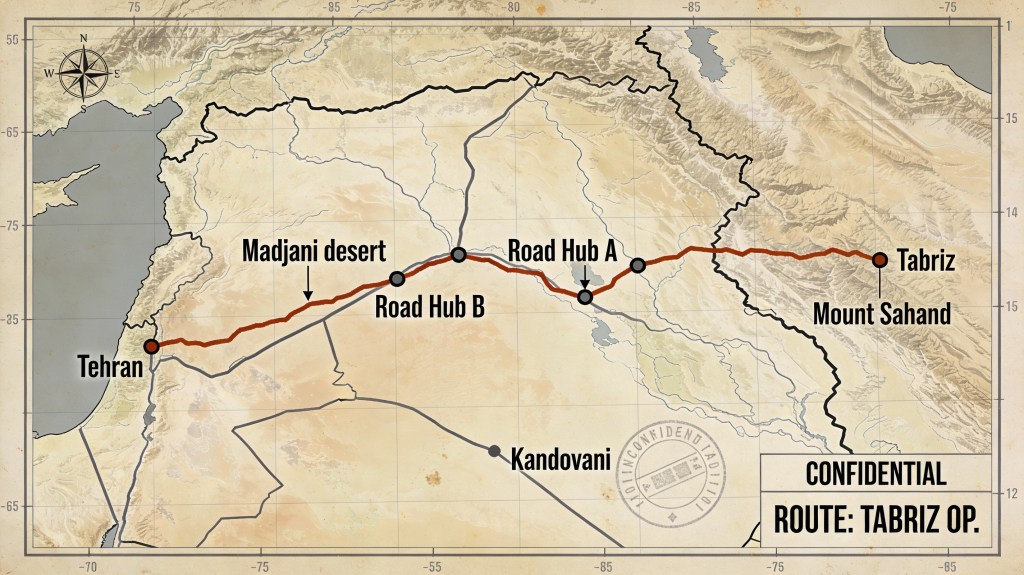
The road from the Madjani desert to Tabriz sandpapers my patience. Northern air clings thick—diesel, pomegranates, rain-damp stone. Mount Sahand hovers past the rooftops, Kandovani close enough to imagine. In this part of Iran, “close” can kill you before you arrive.
Reza threads us through tight streets to a small hotel, carpets dusted with cardamom and fatigue. Something’s wrong. The regime escort—our shadow with the quiet shoes and precise questions—has vanished. No farewell, no coded flick of the hand.
I see the absence first. Corners where they should stand stay empty. My hand lingers near the inside of my jacket.
“They’re not here,” I say, low.
Tarmo’s head tilts. He trusts patterns. I trust missing data.
Inside, we get a pause that pretends to be rest. Hot water hammers through tired pipes. Soap claws at desert grit. Reza trades sentences with the proprietor in Azeri; meaning slides past me, so I listen to tone instead: no fear, no awe, just a man keeping a roof neutral.
Tarmo pulls on a clean shirt like a man rearming—every button a decision. The escort’s absence isn’t generosity. It’s a vacancy, waiting to be filled.
Boots crash in the alley. Glass detonates inward. Not street kids. Professionals with angular certainty, mouths locked, weapons already in the work position. Erdogan’s men. Local loyalists, doing Ankara’s tidying.
First shot bites the doorframe. Wood splinters across my sleeve. I shoot back on reflex; glass salts my cheek.
“Two left,” Tarmo snaps, already shifting. Every move a calculated adjustment to risk, as if the room were another volatile portfolio. Each bullet justified, accounted for.
Reza hisses, shoving us toward the kitchen. “You do not want to know what’s on the other side.”
But we already do. Back door’s an obvious funnel.
I crouch at the threshold, sightlines shattered by cheap tiles and mirrors. In the fractured pieces of a hanging plate, I catch a profile—familiar. A fixer from Erdogan’s Africa teams, one of the men who circled Dakhla like vultures over a cake everyone wanted. This isn’t random. This is a line item coming due.
Shots rip through plaster, scream through metal. Steam from the kettle twists with cordite. Tarmo works angles, not heroics, keeping his body where their training says it shouldn’t be.
Lull. Three down. The rest flatten behind a truck in the alley, pinned but breathing.
“Alley. Now,” Tarmo says, hand closing on my arm.
We ghost out the side, slipping into the arterial dark—narrow lanes, wet stone, distant traffic. The city swallows the noise as if it never happened.
We don’t talk until the sounds have thinned to memory. When we stop, it’s under a broken streetlight that paints us in uneven yellow.
“Escort’s gone,” I say. “Erdogan’s here. Someone’s cutting into the line.”
Tarmo nods. In Tabriz, warmth runs cold. You don’t feel it until it’s already leeched something out of you.
Later, deeper in the city’s veins, my hand hovers near my sidearm. The rain has thinned to mist. Neon bleeds in puddles.
“We’ve got eyes on us.”
Movement at the edges. Shadows that hold their shape too long. Men closing in—not Erdogan’s angular imports, but regime assets. Clean grooming, matching quiet shoes, institutional posture. Not amateurs.
The first gunshot comes without a shout. Brick dust blooms near my shoulder. I drop and pivot in the same motion.
“Two flank left,” I call, firing. Shots spaced, not sprayed—one to bend their line, another to buy seconds, a third to remind them they’re not the only professionals here.
Tarmo works alongside me with brutal efficiency, but his mind flickers somewhere else. He used to pride himself on pure calculation. Recently there’s a distortion—an orbit he doesn’t admit. A woman whose absence tugs at his decisions like a hidden tide.
He once respected that she softened me. Now he resents the complication. I see it in the locked jaw, the extra half-second before he commits to a shot that might close a door she could need.
The regime has ID’d us. This isn’t an elimination—if they wanted us dead, the angles would look different. This is a warning.
We fall back, step by step. Every corner is a math problem with a body count attached. I keep my voice low. Trust is currency I don’t spend lightly. Can’t decide who’s closer to bankruptcy: the state stalking us, or us—dragging an absent ghost through every calculation.
The firefight thins. We drop two. The rest dissolve into side streets, confident in home turf. No chase. Running blind into a second kill zone is for men who mistake adrenaline for strategy.
“Ammo check,” I say. “Move quiet.”
Tarmo nods, expression unreadable. He doesn’t mention what we both know—neither Erdogan’s people nor the regime pulled triggers tonight purely for us. Somebody not present is tugging the web.
We slip deeper into the dark. An understanding settles between us, brittle but clear—the city is strung tight over interests we barely see, and tonight the wrong eyes are watching.
I.Ph.
 The C.O.M.C. Files