
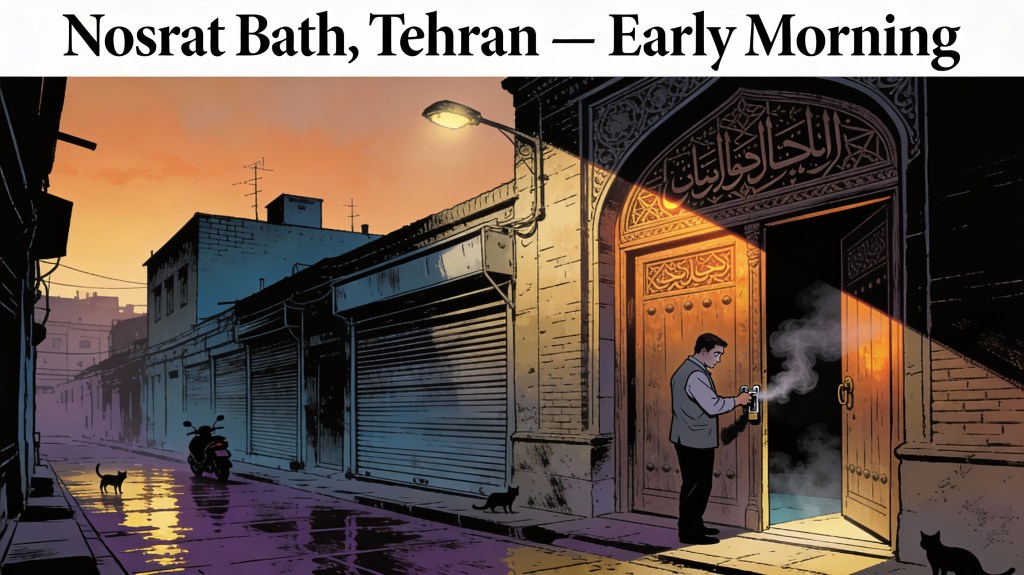
The streets are barely awake when we reach Nosrat Bath. A single attendant in a grey vest unlocks the carved wooden doors, glances at Asdar, and then disappears. Inside, the tiles breathe out a century of heat; steam curls from the marble floor vents, carrying damp stone and old cedar.
I let my scarf slip. Sand falls in pale dust against the dark tile. I kneel by a low basin, turn the copper tap until water rolls out warm and steady, filling the chamber with its slow percussion.
I work the water through my hair first—grit and desert dust spiraling away in the drain’s runnels. My eyes flick to Asdar in the doorway, all leaning shadow, arms loosely folded, gaze fixed. Not like men on the street, hungry and entitled—but like a tether, checking for frays.
A blond foreign woman moving alone in a Tehran bathhouse is a story just waiting to be written. Asdar’s presence is necessity, not choice.
I pour another brass pitcher over myself. Warmth slides down my shoulders, carving away the road, and something inside me loosens with it. Out of the corner of my eye, I can still see him, silent and steady—unreadable but undeniably present.
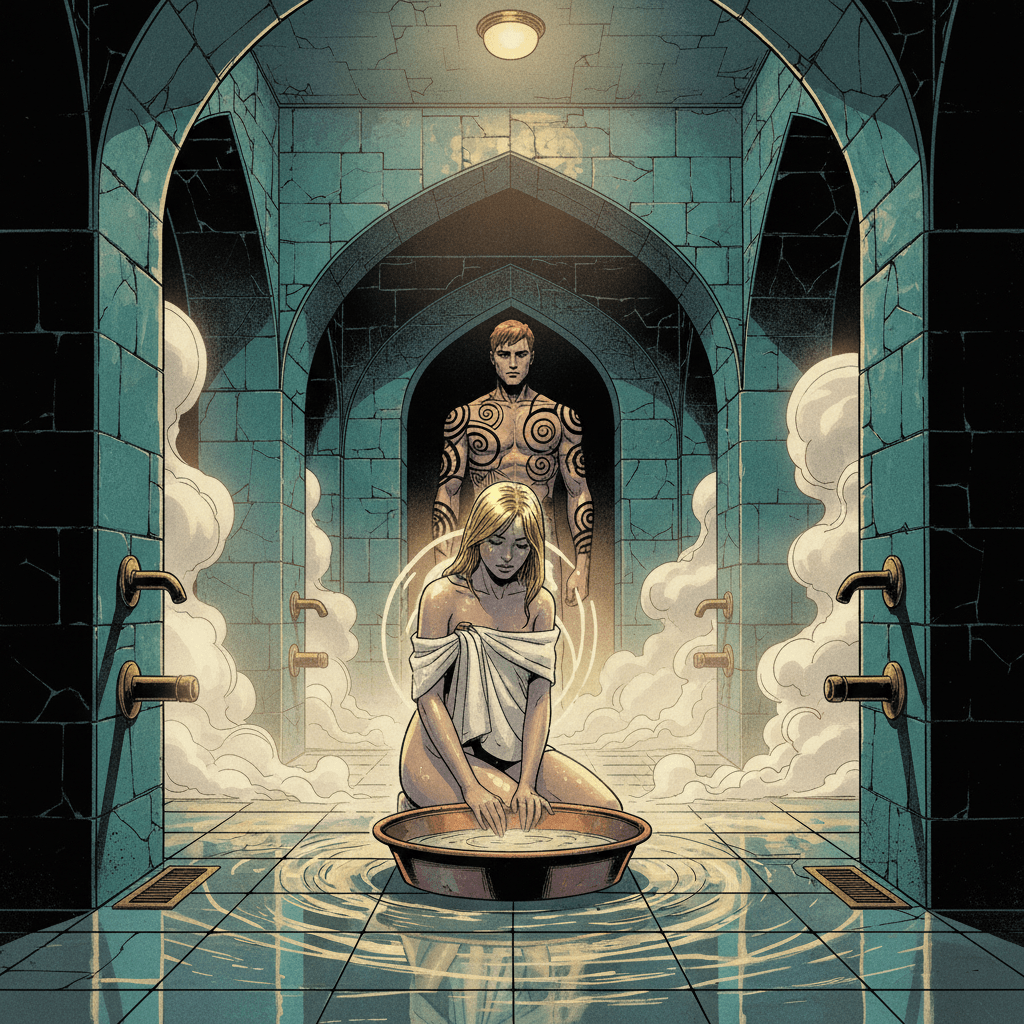
Somewhere beyond the arch, I hear another tap open—the deeper splash of water into a broad basin. I don’t turn, but my ears track the sound: the dull drop of fabric onto stone, the muted scrape of boots pushed aside, the slow, clean rhythm of hands running water over skin.
Asdar.
He doesn’t speak, never hurries—but he’s aware. Always aware. I let the brass pitcher tilt over my hair again, rivulets running down my neck and shoulders. The muted percussion of his own rinsing carries beneath it—the sluice of water across strong shoulders, the quieter drip from hair grown heavy with steam.
When I wring the last foam from my hair and reach for the coarse towel, his washing stops. Stillness, then the soft sound of bare feet on marble.
I sense him behind me before I feel his arms—heat at my back, the faint cedar of soap, skin slick and clean from bathing. He steps in close, his hands anchoring lightly to my hips, the rush of water now falling over both of us. I feel him pressed hard and wanting against me—a jolt, sharp and electric, igniting something deep.
The city outside vanishes. There’s only steam, the water tracing new routes over us, and the measured weight of him holding me. I lean back, letting his hands move to my breasts, my wet hair brushing his jaw.
I can feel his long, strong legs against mine and the eager weight of his hardness, flopped and wanting, pressing to enter. His chest firm against my back, while his hands caress my breasts—slow, assured, sending heat shooting through me. We freeze together in fire, steam and water cocooning every touch and movement.
For an instant, nothing exists but his grip, the slick warmth of our skin, and the raw want that runs between us. My hair falls wet across his jaw as I lean back, inviting the full length of him—every pulse and breath—into the space between danger and desire.
I barely breathe. Heat and fear spike under my skin. What would it cost—one heartbeat more?
And then—an unmistakable sound: the dry, deliberate scrape of a throat by the outer doorway.

The man in the grey vest stands just outside the steam’s reach, his voice pitched low in Persian: “Time. Guidance Patrol, the Gašt-e Eršād are coming.”
The scrape of sandals is closer now, voices sharpened and flattened by the echo off the tiles. Asdar’s eyes are already a mirror—blank to strangers, but I still feel the heat of his hands on my skin, as if the water hasn’t managed to rinse him away.
We don’t rush, but every motion is brisk—precise, because the luxury of slowness is gone. I wind the coarse towel around me, sweeping up my scattered clothes in a single, efficiency-fueled motion. Beside me, Asdar dresses with his usual deliberation—never hurried, each movement deliberate, steady as if he’s donning armor.
I stand there for a breath, eyes closed, wishing I could bottle the last minute and pour it out somewhere, anywhere, without interruptions. Really? Not at him, not even at the gray-vested herald of reality—but upward, to whatever fickle pantheon has decided to make my existence one long rehearsal without the play. What, in all the weavings of fate, have I done to deserve being denied this? Not just this, but heavenly, exquisite, I may never walk straight again, sex with Asdar.
I swear softly, in a language older than the tiles beneath my feet—at my gods, their lesser envoys, and anyone else listening. Somewhere up there, I’m certain, they’re laughing into their sleeves.
“Ready?” Asdar’s voice is quiet, ironed flat for public use.
We step out into the cool, shaded corridor. Two uniformed guards are at the front desk already, faces grave, talking low with the proprietor. Their eyes slide over us—one foreigner, one local—and they linger that fraction of a second too long.
Asdar doesn’t break stride. His hand settles at the small of my back, light but claiming, steering me past as if there’s nothing here to see, nothing to notice or remember.
Outside, Tehran’s early light hits us, all gold and exhaust—the city alive with clattering shutters and the first calls of hawkers.
We say nothing. We don’t even look at each other.
But under the towel, on my skin, the steam hasn’t cooled yet. Before he slips away into shadow, Asdar’s hands linger that breath too long at my hips—a final, wordless claim. Suddenly, the air feels thin, the water on my skin already gone cold.
The market boils—a riot of color and noise. My skin still hums from the bathhouse, head pulsing with half-formed vows to whatever gods refuse cooperation. Saffron ice cream sags in the heat. Pomegranates split and glisten, juices pooling in stained palms. Steam twists up from griddles.
Asdar bargains nearby, voice steady, hands now turning peaches where, moments ago, they claimed my breast. Clean now. Deft, precise. He packs everything for the road: apricots, salted cheese, flatbread that outlasts hunger.
I pretend to browse—a tray of pistachios, their green hidden under shells. All the while, body throbs, lace damp where nipples press, heat pooling low. Gods below—not fair. The city presses in, but my own hunger makes the louder noise: Next time. There will be a next time. No guards, no gods. Only us.
Supplies stashed, Asdar sights someone—Zargari, loitering, vest marked by a sliver of red thread. A silent alarm. I hand off the last of our cash, lips tightening in a line of reluctant amusement. The game is on again, and desire is just one more thing to pack away, for now.
I.Ph.
 The C.O.M.C. Files