
The fire from the night before had collapsed into a ring of muted coals, their last warmth leaking into the cold ground. Mist clung to the low scrub, blurring the line between land and sky. Somewhere beyond the silence, a hawk sliced the air.
They moved without wasted words. Bedrolls bound tight, tents dismantled and folded into shapes as compact as secrets. Every clink of metal, every soft thud of a pack hitting the ground rang sharp in the stillness.
I pulled my scarf higher over my mouth, not just against the bite of the early wind, but because Asdar was watching me. Not openly—in the same way the horizon doesn’t “watch” you, but always knows exactly where you stand. When I misjudged the knot in my cloak, fumbling with half-numb fingers, he stepped close enough that his shadow cut across mine. One deft pull, one flick, and the knot was snug again. The moment should have ended there, but he didn’t step back straight away.
We shared the last tin cup of tea. Bitter, metallic, tea leaves clinging to my lip. I tilted the cup toward him for the final mouthful, and he drank without looking away. Then he tossed what was left into the dust, as if burying the night with it.
The Zargari outriders had already slipped ahead, ghost-shapes against the pale land. A nod passed from Asdar to their lead—one of those glances men use when they’ve traded favours older than speech. The Dom riders kept to the side of the column, not quite in the tracks, not quite out of them. The habit of skirting other people’s roads, bred into the bone over generations.
They mounted. The path toward Tehran unrolled in a thin, pale ribbon lit by the first break in the clouds, an old insistence of hooves and wheels pressed so deep into the earth it had begun to remember the direction on its own. The city would be kebab smoke and saffron, bargaining voices, the press of bodies. But for now, the sound was only the creak of leather harness, the patient clop of hooves, and that quiet tether between us, invisible but unbroken.
Neither of us said it aloud, but both knew: some part of this morning would travel with us all the way to the capital.
Approach to Tehran
By midday, the land stopped keeping its secrets. Gone were the shallow gullies and hidden tracks the Zargari liked, replaced by an old caravan road that bent toward the capital like it had been carved there by centuries of insistence.
For the nomads, it was a compromise—too public for their liking—but the only thing worse than showing themselves was turning back. They tolerated the open stretch the way one tolerates bad weather: by enduring it in silence and committing it to memory later.
The smell of the city seeped in long before the walls appeared. Woodsmoke, tanneries, the fat and spice of street grills. The closer we came, the thicker the traffic: donkey carts sagging under pomegranates, merchants swathed in sun-faded reds, a pile of carpets strapped to a mule so wide it brushed passing baskets of oranges.
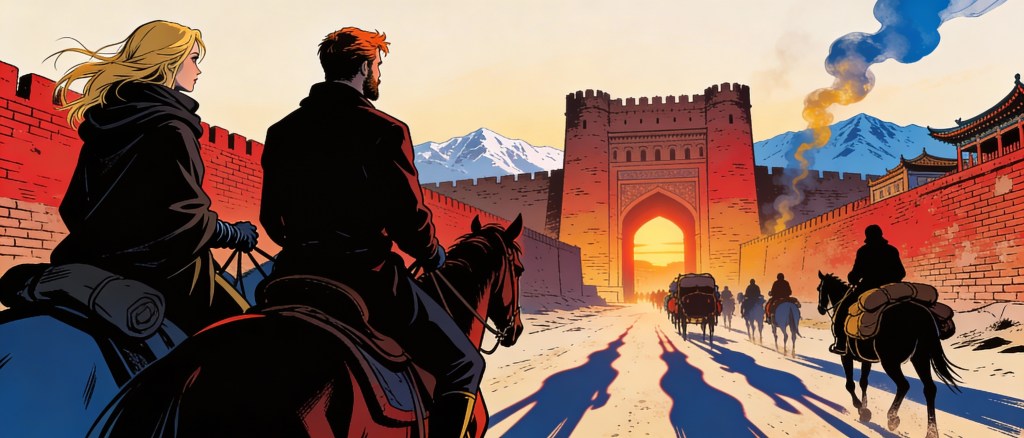
Ahead, the northern gate sat under a strip of cloud-thinned sky, with the line of the Alborz Mountains faint and patient behind it, as if the range were waiting to see who the city would keep and who it would spit back out.
I kept pace beside Asdar. Here, in the open press of humanity, we were just travellers—no lingering gazes, no private murmurs—and yet the memory of the border morning was still there, tucked between us in the saddle-space like a folded letter no one dared open in public.
We crossed under the capital’s northern gate with the Dom riders slipping to the edges, already invisible in their own way, while the Zargari took on the posture of hired guards. Inside was tumult, roar and colour—a marketplace shouting over itself, saffron mounds and spice heaps flaring in the corners of vision while skewers hissed over charcoal—and somewhere between a tea vendor’s steam and the call to prayer, Tehran swallowed us whole.
I.Ph.
 The C.O.M.C. Files