
“ENOUGH!”*
My breath stops. That grunt—familiar. The blindfold is torn off in one motion. Light stabs my eyes. I blink, heart hammering, searching the crowd for the shape behind the voice. For a beat, no one moves—Romani faces flickering between suspicion and relief, Azerbaijani bystanders holding back. Somewhere in the tangle, I know the wolf has shown himself.
The first thing I notice, even before Asdar emerges from the circle of Romani men, is the music. Not the literal notes — just the way voices rise and fall, argued in two or three tangled dialects, as if every conversation here could tilt into singing.
I shouldn’t be surprised. The Zargari, these Persian Romani, are woven into the very fabric of Iranian folk music. Even when music was outlawed, when the doors of dance and joy got slammed shut by priests and censors, this group kept the pulse beating, threading rhythm through generations and border provinces. North Khorasan, Mazandaran, Sistan and Baluchestan: everywhere music survived underground, you find Romani blood at the heart of it, the living keepers of melody when everyone else risked silence.
I catch flashes of what I’ve read — Roma as storytellers, cultural memory‑keepers, not just here but in every country they settle. In Iran’s darkest years, when joy was suspect and celebration was seen as betrayal, the Persian Romani still played, danced, and laughed. They cradled what the Persians feared to lose: the informal, the illicit, the memory-song of the country’s soul.
Somewhere, a story flickers from Ferdowsi’s Shahnameh — a memory nearly as old as the language. Bahram Gur, king and judge, offers Romani folk wheat, cattle, and donkeys, hoping they’ll farm his land, become the workers and slaves he imagines. But they consume the wheat and cattle, ride the donkeys away, and instead of labour, spread music and laughter through the country. Not failed agrarians, but joy‑bringers, weaving celebration into corners where pain and discipline claimed most.
“Girl, stop analysing, you are abducted, not contracted for a TED lecture!”
Now, as I stand in this borderland, with Asdar negotiating in Romāno and Zargari dialect, I feel the past tumble into the present. Here, recognition means more than a bribe or a forged identity. It’s a contract to let the Roma step out of centuries of stigma and claim their role as the lifeblood of Iran’s folk art — not outcasts, but honoured guests.
The wolf cuts the deal, turning Bahram’s legacy sideways: not to erase the old jibes and wounds, but to rewrite joy as something everyone needs, especially in years when music is nearly lost.
The circle tightens. The men nod, halfway between suspicion and welcome. Asdar gives me a look — half reassurance, half challenge — and I know he’s rearranged the chessboard here. We’re not just crossing a border; we’re crossing into history, into the territory where music is a survival tactic, and storytellers are the keepers of whatever comes next.
I lift my chin and let the rhythm carry me forward.
For right now, at least, the wolf’s deal holds. And the songs that saved Iran from its own silence run through our veins as we step out into the new night.
I try to smooth my tangled blond hair, fingers working through knots as if appearing less wild might earn me answers. But it only makes things weirder — every face in the circle is staring at me, some curious, some respectful, a few grinning as though I’ve just stepped off a moon landing.
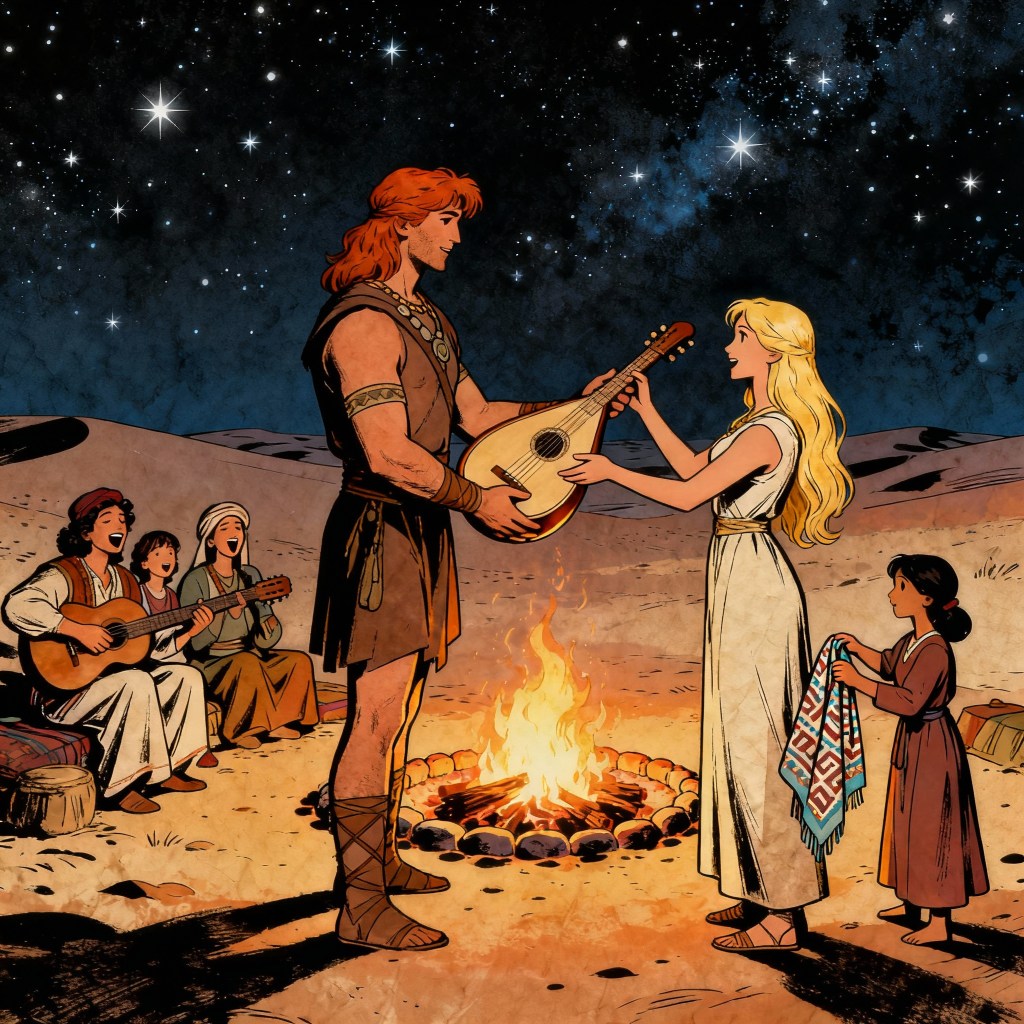
Then a small woman moves forward, her dark eyes bright, her hands gentle as she holds out a sjal — patterned, handwoven, with edges flickering orange in the firelight. She waits, and only after Asdar gives a subtle nod does she press it into my hands.
“What in the fresh hell…?” The words come out louder than I mean, sardonic reflex crackling through the adrenaline.
Asdar, always inscrutable, answers from the shadows. “It’s courtesy. Protection.” His voice is low, threaded with a kind of private amusement. The Zargari glance between us; the old men nod as if this exchange alone means the ritual is working.
I let myself spout off — can’t help it. “You do realise no rituals are needed to persuade me, right? You’ve got my attention. No need for mystery scarves. Unless we’re prepping for a musical number — in which case, at least teach me the moves.”
The small woman laughs, a melody that soothes the edge off the adrenaline but doesn’t make me any less restless. Someone else gestures for me to sit, legs folding cross-legged near the circle of fire. The warmth hits my shins first, then my hands, as I wrap the sjal around my shoulders, more for comfort than ceremony.
“All these stories about outsiders being stubborn,” one of the Zargari men says, “never mention how much noise you make when confused.”
I flash him a grin, biting down the urge to ask if mockery is part of the folk tradition or just a borderland speciality.
It’s time for explanations, for info — and I make it clear.
“Alright. You’ve swept me across a border, tossed a sack over my head, and dropped me here like a lost donkey in a Shahnameh tale. So, can anyone please explain what’s going on before I start composing ballads about Romani abductions and anthropologist existential crises?”
I.Ph.
 The C.O.M.C. Files