
The Coffee Tightens
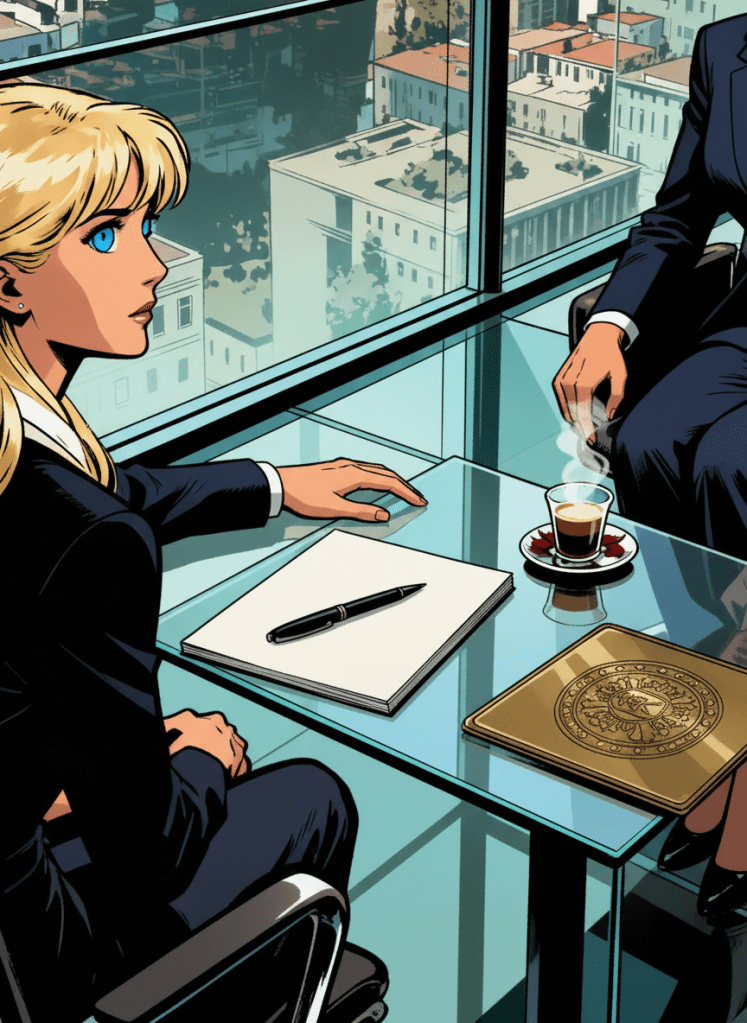
Burçu’s spoon traces deliberate, silent circles in thick coffee. Her gaze is fixed on the swirling grounds, as if they might condense themselves into the neat bullet points of a diplomatic cable.
“Since the EU accession dream ended,” she says, “Türkiye’s rewritten its own rules—always in motion between West and East, between hard muscle and soft invitation. Africa is the new proving ground. Everyone who arrives gets noticed.”
I listen, letting her voice thread through my notes. Somalia flickers in my memory: the kinetic rush of Mogadishu’s port, shaah tea and dusk, Berbera’s coast stretching out toward promise and peril. Here, stories of progress and threat are woven tight; my file on Somali tourism is less travelogue than network map: Turkish bases, schools, mosques, commercial corridors, and whose hands rest on the real switches of influence.
When Burçu glances up, there’s calculation in her pause, as if she can sense exactly which confidences I gathered myself, and which spilled from the lips of others.
“Tarmo tried to run his own pattern there,” she murmurs. “Sandi became his agent: her face, her references, her skill for moving unseen. It worked… until Ankara ran the numbers and decided the risk was theirs, not his. That was the cutoff—quiet, sharp.”
The news isn’t public, and her careful cadence suggests this is not the version that will ever appear in a press release. The planes, the cultural centers, the NGOs, the deepening web of cash and coordination—it all fits. My notes mesh cleanly with the faint lines in Burçu’s voice.
“The President saw the risk?” I prompt.
She nods, gaze steering momentarily toward the skyline.
“His team did. Somalia’s new tourist horizon and cautious reforms—those are more than symbols. If they falter, all the corridor work ends up exposed. You don’t let an outsider run ops in your centerpiece project. Not anymore.”
I let the implication settle. This isn’t just the soft power of Turkish schools and charities, or the hard power of special forces. It’s how both are braided and guarded, the message unmistakable: Tarmo was excised not for love or loyalty, but to protect the sovereign game. Sandi is just the collateral, pinned between an old architect and a state with no patience left for broken rules.
Burçu sets her cup down, quietly but with emphasis.
“If you’re here to work,” she says, “know which currents carry you—and what can drag you under. Tarmo’s problem is ignoring the undertow.”
Her candor chills the air between us. Already my mind is running numbers and pathways: the reality of Sandi’s risk, the hard nature of Burçu’s warning, and the calculation that will define whose story survives to next week in Istanbul.
Rewriting the Stakes
Burçu’s voice is level, every word polished but weighted with iron beneath the silk.
“You should understand: Ankara did not simply decide Tarmo was a liability. We have declared him our adversary.”
I do not interrupt. There is gravity in her diction; “adversary” is not bureaucratic shorthand but a judgment, crisp and considered, that signals the pivot between tolerated risk and direct contest. I watch that word drop, leaving a ripple in the silence between our coffee cups.
She sits back slightly, gaze unwavering.
“He moved in Somalia as if he could run an entirely parallel corridor,” she tells me. “Not intersecting. Not integrated. Istanbul does not ignore that. In Libya, in Somalia, at every strategic bottleneck, we sometimes tolerate competition if it strengthens our route. Tarmo’s play was different—he seemed convinced his version could replace ours. That’s not how our city, or our strategy, works.”
I recall my own notes from the Horn: bases and hotels doubling as listening posts, cultural initiatives tagged with both Ottoman nostalgia and twenty-first-century reach. Sandi was meant to glide between these worlds—a face that floats in every room, a name no one would flag. She was his fulcrum, his knife point for subtle leverage.
Burçu continues, fingers folded tightly:
“We do not allow unsupervised operations in our space, and certainly not those serving a rival. In Africa, we’re past defending our interests—we are now expanding them. If someone tries to unravel our weave, we treat them as we would any sovereign rival. We have negotiated, built, and invested for years. The margin for risk has closed.”
Her candor is surgical—a clean line is drawn. For Tarmo, this is not exclusion. It is strategic opposition, deliberate and escalating.
“So you stopped him,” I say, voice low but firm.
Burçu’s lips curve, an approval, or perhaps a warning.
“We are still stopping him. And anyone standing too close when the borders redraw will feel the pressure. In this city, in this region, we do not confuse mercy with patience.”
The conference room feels tighter, the city’s sunlit panorama behind her now cast in sharper relief. All clarity, no shelter.
I.Ph.

 The C.O.M.C. Files