
Back to the Hotel
By the time I drift back toward the Pera Palace, Istanbul’s sky has sunk into velvet indigo and the Bosphorus exhales with the sharp tang of salt and iron. My camera is heavier now—the weight of images is memory pressing into my palm.
Dust follows me to the hotel’s illuminated façade. I’ve walked miles, worn the market into the seams of my boots, and traded questions with men old enough to recall Ferries before bridges, their voices crackling like gramophones. From them I gather only fragments—names faded to myth, streets erased from modern maps, muttered warnings of “outsiders asking questions that belong to the dead.”
Vendors grinned for my camera or turned their shoulders away. The city’s shadows kept careful company—three, maybe four—old tactics: a ballcap exchanged for a hood, a phone angled to fake conversation, a shuffle that never quite merges with the crowd.
The hotel’s neoclassical front glows—a beacon against the city’s churn. Crossing the threshold feels like surfacing; light pools like honey on marble, crystal catching secrets in its facets. Evening guests drift in pairs, laughter small and tired as the scorch of a final cigarette.
I let the camera finally rest. Street vigilance peels off my shoulders. My room is sanctuary—cool marble, historic proportions, silence thick as velvet. I strip the road’s wariness, bare feet against antique tile, and press my forehead to the glass. From up here, the night hums—a distant pulse, market noise diffused, the empire’s residue curling with the smell of the river.
Hunger blooms. Not for answers, not now, but for something warm, set before me, ordered with intention. Downstairs, in the dining room, I choose a table at the edge of the light.
Dinner is ritual: the aroma of roasted lamb and lemon, cumin ghosts still clinging to my skin. Between slow bites, I jot field notes—what the old men let slip, where their eyes flicked, the code in their silences each time Sandi’s name rose.
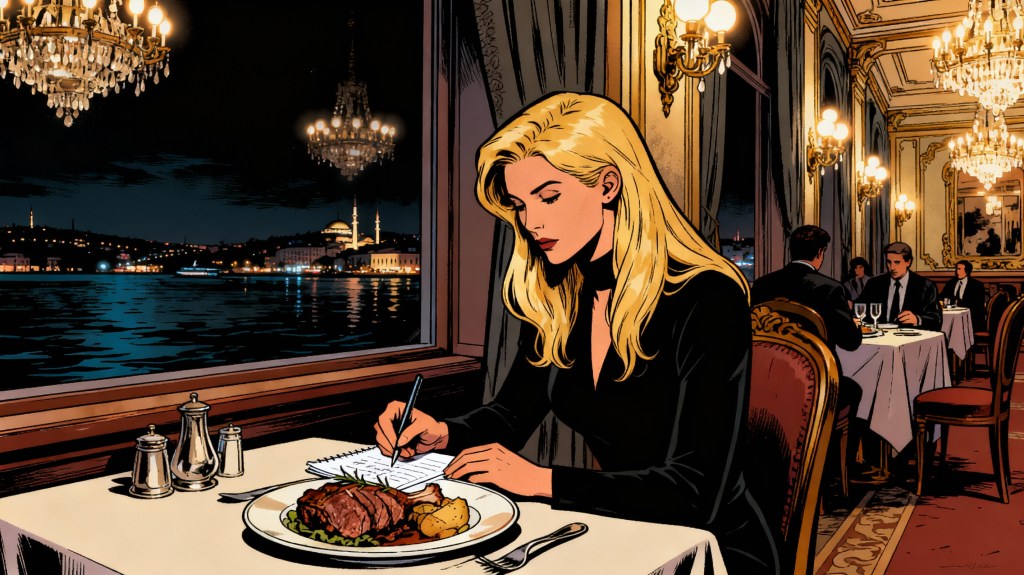
Steam curls upward, caught in the chandelier’s glow. My first mouthful—anchoring, earned. Miles away in the city’s labyrinth, Sandi is a secret, and the pattern of my movement has already marked me as her kin.
Tomorrow, I chase the story again. Tonight, I eat, watch, and allow Istanbul to believe I’ve stopped working—because this city is most honest when it thinks you are only living.
When the plates are cleared, I let the city go on without me and take my notes upstairs.
The Knock
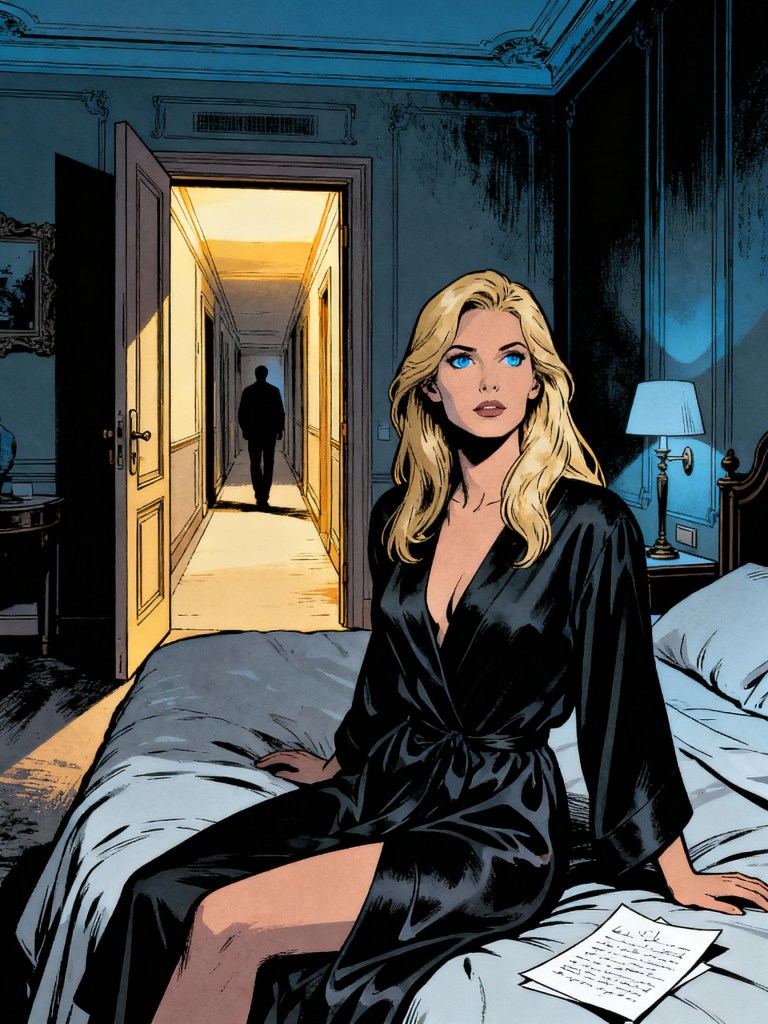
The plates have been cleared for nearly an hour when three soft knocks scatter the sweet rhythm of after-dinner solitude. Istanbul hums through the high windows—distant sirens across the Golden Horn, faint jazz from a terrace below.
I’m splayed across the tall bed, silk sheets tangled, notes half-read under my arm, the night stretching out with the patience of old marble.
The knocks again—precise, patient, not the fumbling politeness of hotel staff.
I’m upright, silk robe whipped from the antique chair, cool fabric a shiver as I knot the belt at my waist. Light from the corridor glances off the chandelier’s fragments; the old parquet clicks beneath my bare feet as I pad across the room.
When I open the door, it’s Karim. Hallway shadows bruise his shoulders, but that sentinel stillness radiates from within, as if the Pera Palace itself was waiting for him to appear.
“I shouldn’t be seen talking to you,” he murmurs, voice thick with unslept hours. “But you should know I’m close by.”
His green eyes take in the room—robe, bare legs, notes splayed on the coverlet. Professional, appraising, but not untouched.
For a breath, my ancient reflex wants to pull him close, bridge the space between; to be, for a flicker, two bodies in defiance of the city grinding on around us. But memory cautions—the intimacy would cost more than comfort, and I’m not ready for that ledger.
So I nod, voice low.
“I know you are. For now, that’s enough.”
Karim lingers, chin tilting—a soldier’s reassurance. Then he’s gone, melting down the corridor, leaving only a trailing trace of cologne and secrets.
I close the door, lean against the lacquered wood, let the silence resume its weight.
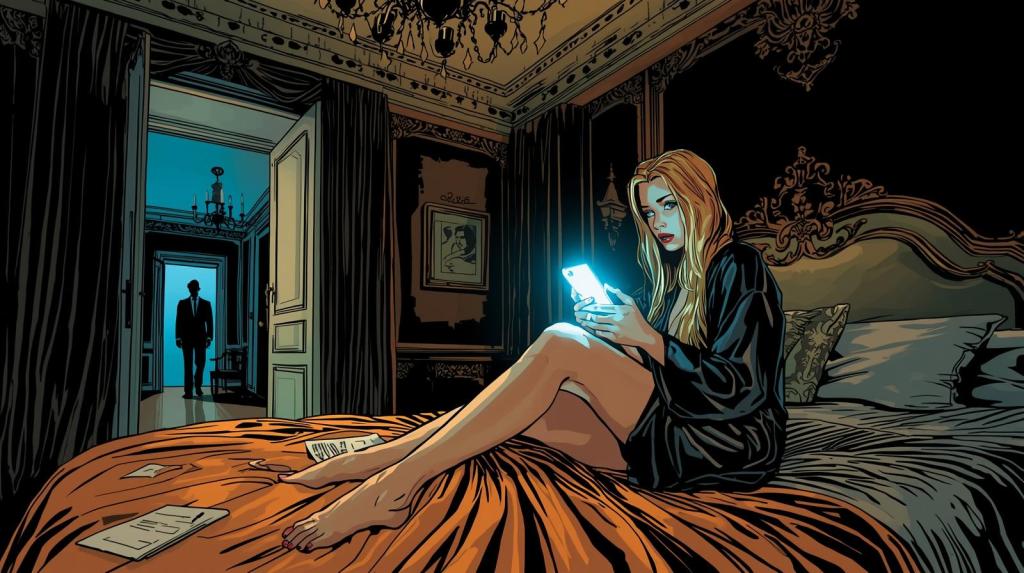
Bed again, the silk now familiar and cooling, muscles soft as the city’s night murmur. The lamp is within reach when my phone rattles across the table—a buzz sharp and unnerving, cutting the breath of midnight.
I groan, roll to one side.
“Is it impossible to have a quiet evening in this era?”
The phone thrums again. A name glows on the screen—one that drags my mind mercilessly from rest to arena.
I let it ring out—once, twice. Istanbul, midnight, and after this day, I’ve earned the right to a sliver of time untouched.
But the call redoubles, cadence insistent, almost petulant. I let it pass, training my will on the hush.
A minute later, a text:
If you don’t pick up,
I’ll answer your phone myself.
I’m in the hotel, Elena, and a door never stopped me—
Nor will Karim.
His game—threat, promise, dare—prickles along my nerves. I picture Karim outside, perhaps arms folded, jaw tight, the one man in Istanbul with boundaries I’d trust—except when ghosts and rivals command the door.
I tap back, the reply sly, precise:
Give it a rest.
If you’re breaking in, at least bring dessert.
Phone set face-down on the covers, I’m not sure if I want the next knock or the next lull.
This city, this dance: intrusion and invitation, all stretched through the long museum-hush of The Pera Palace.
Let the story try me, let him try the lock, I think.
But as the phone’s light stirs again, I realize: I am smiling. Wary and wicked. Alive.
Author’s Note
A confession: for this Istanbul chapter, I pitted two AI image generators against each other in a graphic novel cage match. The first, channeling Mazzucchelli/Miller noir, gave me Elena in shadows—alert, unseduced, very much her own narrator in a city of secrets.
The second image came courtesy of Canva. Despite all my careful instructions (“moody! noir! narrative tension!”), what I got was… let’s say less “urban fantasy danger” and more “sultry socialite waiting for room service.” Elena looked ready for a perfume advert, not a plot twist.
So, readers—I need your eye. Which image actually fits the mood? Which Elena do you believe belongs in this story, and which one should be escorted off the premises by hotel security? Drop your verdict in the comments or—if you’re feeling zesty—suggest what you would change to get the atmosphere right.
Consider this a highly unscientific but deeply entertaining poll.
I.Ph.
 The C.O.M.C. Files