
Bazaar’s Buried Bargains
Ekrem absorbs the city’s tempo: he doesn’t lead, never lags, our paces matched in wary choreography. Each intersection is a puzzle—faces to read, gestures to decode, laughter hiding calculation.
We slip into the low-lit lanes behind the Spice Bazaar, scents thickening—cumin, rosewater, amber, sweat. Saffron drifts on the air, echoed by the ghost of empires cut into the limestone arches of the old caravanserai just ahead. Every shadow could shelter a watcher; every open table surfaces a secret deal.
Ekrem halts beneath a lamplit archway, the neon sign above fractured into half-letters. He drops his voice.
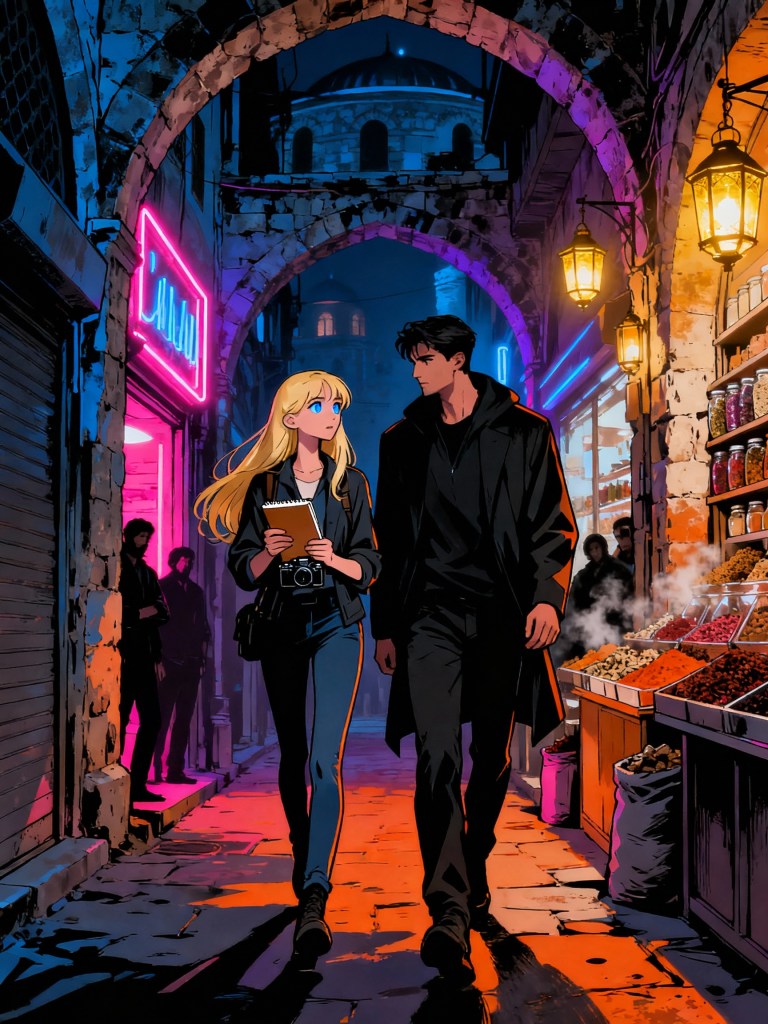
“Sandi’s being kept off the grid. A ‘safe’ apartment—a cell, really. Her value is in what she knows, not her comfort. No ransom demands. No theatrics. Just the silence of leverage.”
He studies the alley, eyes flicking for signals.
“The fixer running this isn’t sentimental—people are currency, not players. Tarmo used Sandi to test the fault lines, didn’t warn her: Istanbul’s first language is trade, second is debt.”
We edge closer to the market’s heart. The air feels congealed with cardamom, exhaust, and rose. Market lights throb against the ancient walls—Balkapani, one of the caravanserais where honey and secrets were once traded by torchlight.
“Burçu can push on the diplomatic front—she’s boxed in. DEİK won’t risk the stage in this drama. You’re the invisible third hand: the one that gets things done before daylight and headlines collide.”
A merchant sizes us up, nods once. Ekrem leans near, words feathering the border of caution.
“First step: tail those who shadowed Sandi: a fixer, a go-between. The ones who trade in whispers, not signatures.”
We move, pace matched in adrenaline. A tram grinds past, bells jangling, boat horns moan from the Golden Horn, the whole city pressing closer with every turn.
I take mental notes, discipline layered atop adrenaline:
Sandi: impulsive, always one move too bold—reduced now to a bargaining chip for someone sharper than she guessed.
Burçu: infinitely resourceful, but allergic to taking the burn herself, smoothing edges while never risking her own skin.
Tarmo: culpable by absence as much as action.
Ekrem is no friend, but in Istanbul, trust is what outlasts luck. Cobblestones and shadow, sidesteps and second glances—here’s where my real work begins. Not as the anthropologist who writes detached, but as the restless woman who shadows the city’s arteries, ready to barter memory for movement, risk for meaning.
“Where do I start?” I ask, words sharpened for negotiation.
Ekrem nods toward the dim space behind the bazaar.
“We ask those who watched Sandi and counted profit by her presence. No need for repeats—these answers only come clean the first time.”
He offers a smile, thin as a gaslamp flicker.
“Istanbul always answers, Elena. The only question is—what will you give?”
His dare hangs between high facades, but something recoils. Istanbul’s logic is recursive, but I refuse to let a fixer’s hand define my research, not with Sandi’s freedom at stake and every move a calculated gamble.
I excuse myself, voice neutral steel.
“Tonight, I want to see the city unfiltered,” I say, sliding away into the gathering dusk.
“Real fieldwork means feet on the ground, not whispers over chessboards.”
Ekrem accepts this—his glance is understanding. Istanbul’s codes aren’t learned in mirrors but walked, step by uncertain step.
Back in my room, Pera Palace marble cool against my palms, I braid my laces tight and double-check the camera’s battery. My notebook—blank, hungry—waits for fresh clues, for the messy, coin-bright knowledge found only in fragments: eyes, gestures, rumours strung beneath lanterns, mosaic, neon.
CYcrds strategies, distilled to streetwork:
I walk out alone, camera and notebook anchoring my hands, posture calibrated for observation.
Faces become text; vendors, custodians of oral footnotes. Each observer is weighed—distance, gaze, and mystery marked like coordinates.
I linger by tea sellers, listen to the melody of deals in the market’s air, mapping how language moves through hope and hustle.
Between quick photos and half-legible notes, I measure the pressure in the city’s veins—curiosity, coin, the inevitability of information traded back to the invisible hands.
Some watchers drift away; others persist, dull with patience or intent. My own vantage grows sharper, tuning to the eddies and crosscurrents—places where Sandi’s ghost might flicker, where Ekrem’s web would never suffice.
This is my element: the city’s raw story, mapped with footsteps, not just questions. Tonight, every clue starts as an observation.
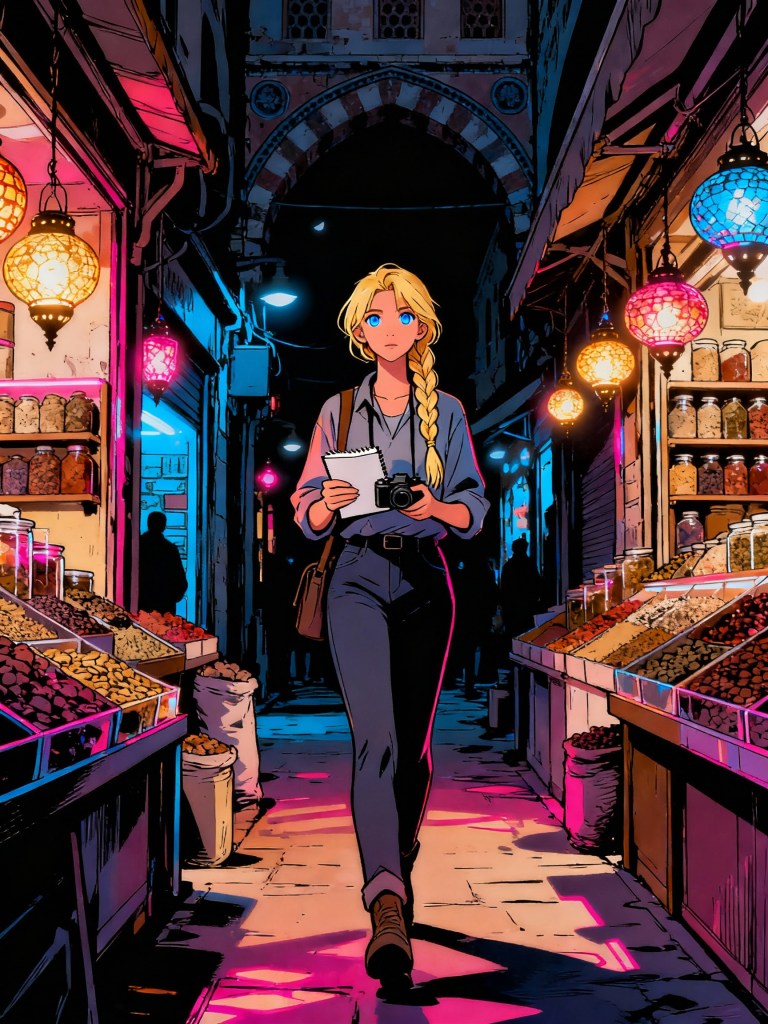
Pera Palace’s legacy—first elevator, first electric lamps, first to host the world’s most dangerous secrets—lingers at my back. But the real story is out here: dusk, footsteps, the urgent hush before midnight’s next bargain.
I.Ph.
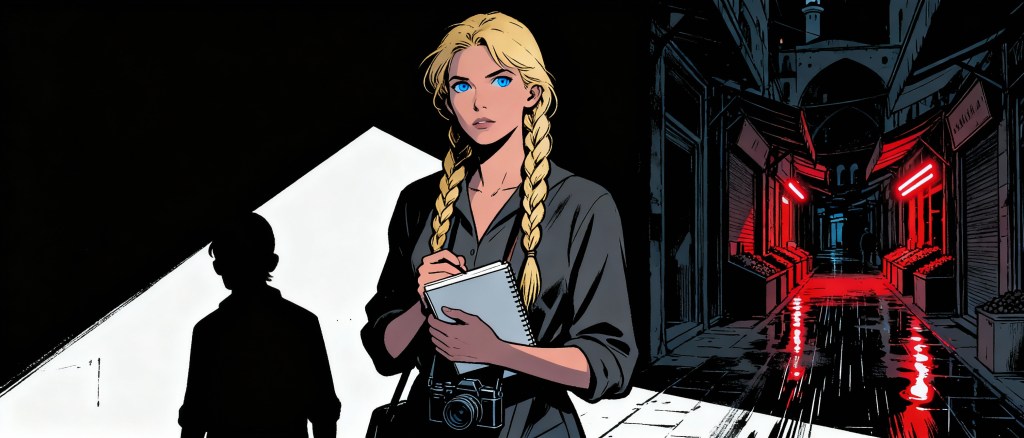
Author’s Note: On Visual Style and Mood
When telling a story like Elena’s: rooted in suspense, fieldwork, and the pulse of an ancient city—the visual language matters as much as the written one.
Some of the images so far I have employed a classic comic book style, characterised by bold colours, rounded lines, and a clean, bright energy. Others have drawn on the shadowed, expressive look of Mazzucchelli or Frank Miller, leaning into noir with high-contrast lighting and a moodier, more atmospheric palette.
Both styles offer something unique: one welcomes readers with liveliness and colour, the other invites them into the depths of the city’s mystery and ambiguity.
Which visual style resonates more with you for this story?
Do you prefer the bold clarity of classic comics, or the darker, noir-inspired look that reflects the tension and intrigue of Istanbul’s nights? Your preference will help shape the visual narrative.
Let me know your thoughts in the comments—I’m eager to hear which atmosphere draws you deeper into the world of The COMC Files.
May harmony find you.
I.Ph.
 The C.O.M.C. Files