
Book of Burned Bridges
The Heathrow arrivals hall is a fluorescent dawn after so many nights of myth. I stand still just past the immigration gates, letting the static-pated crowd flow around me—families, suits, tourists blinking at arrival boards. I am unaccompanied: Tarmo had cajoled, pleaded for me to board his Zurich-bound jet, but I’d just shaken my head, too tired even for irony.
“I need time. Just—let me breathe London alone,” I’d told him, voice gentler than I intended. He’d tried to press a car, a bodyguard, a suite at Claridge’s.
I’d taken the black cab instead, cradling my battered satchel on my lap as if it still pulsed with river water and last night’s wildness. Tarmo’s messages ping—even now—but I let them stew, unread.
London, when the cab spits me out by my townhouse, is grey and humid, the air smelling of diesel, toast, and river. My feet strike the pavement with purpose, but there’s a tremor beneath every step: exhaustion, awe, the shock of clocks resuming. I unlock the door, inhale the familiar scent of home—old books, ground coffee, pine soap. The quiet is absolute.
I don’t unpack. I drop my satchel by the door, kick off my shoes, and stand in the centre of the room. A shaft of city sunlight fingers the dust, catching my reflection in the glass. For a heartbeat, I look for wolf-shadow, but find only myself: fifty, lined, wild-haired, alive.
My phone rings—once, twice, then again, notifications tessellating over one another.
First, Sandi: brisk and bright, her voice always two steps ahead— “Elena, you in? Just say you’re somewhere with running water and tea. The Zurich team’s collective blood pressure depends on it. Call me after you’ve slept, or I’ll cut the wifi to your building.”
Bartek’s message lands next, softer, threaded with worry and that unmistakable Polish lilt: “Boss, is it you? I saw the newsfeed—don’t answer if you’re sleeping. Or if you’re dancing on a rooftop. Just… let us know you’re back among mortals.”
Then Karim, worried but concealed, “Habibi, you alive? I’ve got your mail pile, two suspicious couriers, and a bottle of “Perepelka” Vodka. Say the word, I’ll drop off the only food in London that won’t attack you. Welcome back to the land of the living, troublemaker.”
I sit on the cold kitchen floor, knees to my chest. I let the phone vibrate, allow the city’s eternal hum to cradle my ears.
For a long moment, I do nothing but breathe—processing the taste of freedom, the ghost-hand of Asdar’s promise, the wolf quietly coiling at the root of my spine.
I will answer them. Not yet. Not until I’m ready to thread my story into the world again. For now, I listen: to the static of city traffic, to the faded growl of my own memory, to the space between legend and the waiting, talkative voices of home.
Eventually, I stand. The kettle whistles—so ordinary it feels like magic. I draw my notebook from the satchel and set it by the window.
Outside, London sprawls: stubborn, grey, impatient—utterly unaware of the wolf that, even here, keeps vigil just beyond the edge of reason.
I close my eyes. The kettle’s whistle fades. I’m already gone—back to pine smoke and morning mist, to the last day in the sanctuary when they negotiated my freedom and I said goodbye to a wolf-priest who’d shown me the veil between worlds was thinner than any theory I’d mapped.
I.Ph.
Dear Reader,
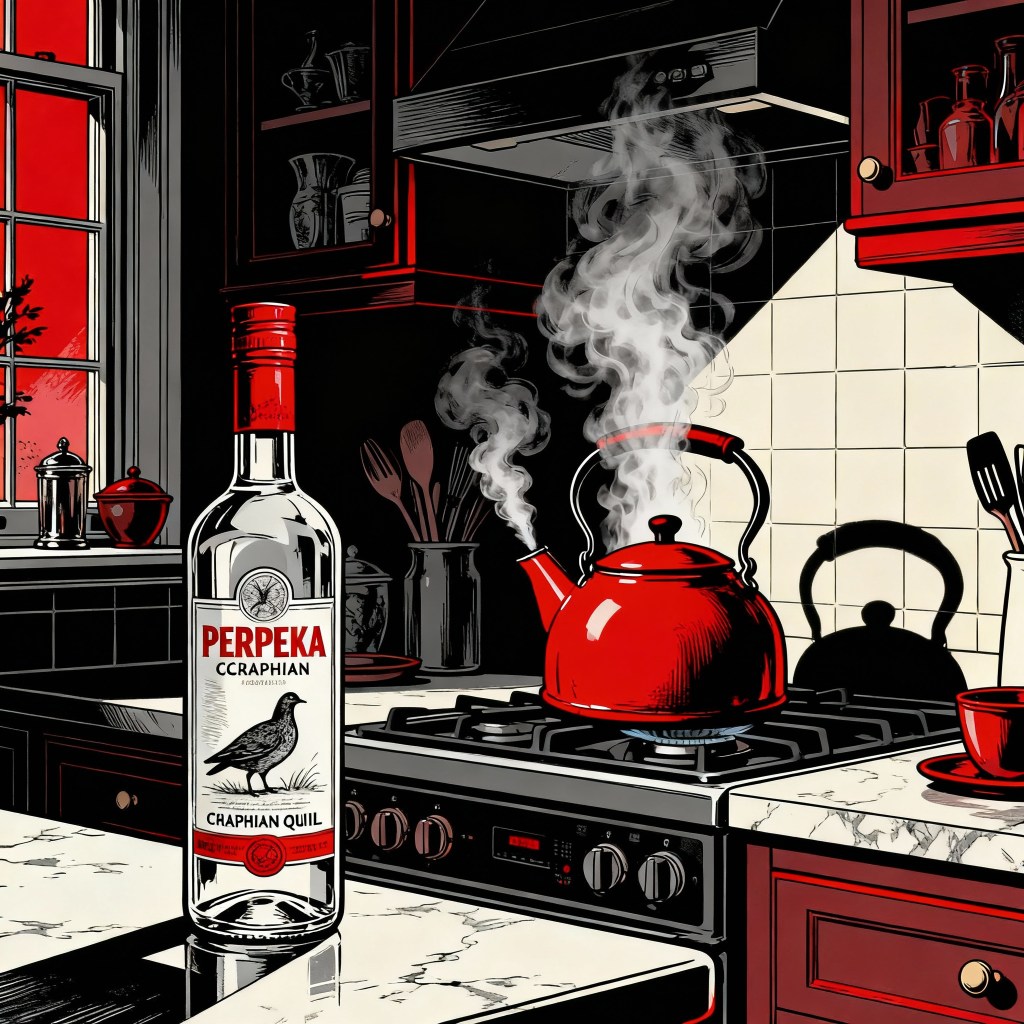
In honour of this decidedly noir chapter—where shadows accumulate faster than plot points and absolutely nothing happens except atmosphere—I made an executive decision: if the narrative refused to move, I’d fetch reinforcements.
So I went out and bought a bottle of Perepelka Carpathian vodka, complete with quail egg and blade of grass suspended like a talisman against narrative paralysis.
If Elena’s story insisted on stalling over unresolved tea and mounting dread, the least I could do was meet her halfway—with quail-filtered spirits on my counter, negotiating forward motion through sheer sympathetic magic.
Consider this a libation to my story’s recalcitrant pulse: Carpathian wit in a bottle, procured specifically to coax momentum from ambience. And if the next chapter finally moves—you’ll know the secret wasn’t craft or discipline, but vodka and stubbornness under London lamps, and the knowledge that sometimes atmosphere is the plot.
The quail egg remains suspended. So does Elena’s patience. I’m doing slightly better.
I.Ph.
 The C.O.M.C. Files