
Outside, the first bells ring through the valley, signalling not only another day, but also the pressing weight of what lies ahead.
After breakfast, I slip on my jacket and gather the day’s documents:
CYcrds identification, clearly visible
fresh grant letters bearing European emblems
a thick folder filled with signed permissions from museums, schools, and council offices—thanks, naturally, to Hasna’s tireless midnight admin magic.
Our cover is watertight because she never lets anything slip. Another email pops up on my phone—it’s Hasna again, reminding me:
“Living Memory Project: request photo access to Maypole rites today, coordinate with the city museum for oral poetry interviews. Your municipal contact in Satu Mare expects you by eleven.”
I forward the details to the group; we nod in silent agreement.
A ping from Mrs H underlines our protocol:
“If questioned on the route, present the full partner list with official EU logos and the grant agreement—never equivocate, always act as if everything is above-board and done in service of European heritage.”
Carrying field recorders, cameras, and visible notebooks, we leave the warmth of the kitchen behind. Sandi and Bartek linger a moment—sharing one last private touch—while Karim and I step into the brisk air, tension and memory twined close together.
We thread our way east, keeping our journey as public as possible. I film new boundary fences studded with trilingual warning signs while Sandi composes shots of a towering Resistance monument glinting crimson over a hillside. Bartek trades half-flirtatious, half-professional banter with local market vendors, and Karim photographs everything—bilingual shopfronts, uneven cobbles, the column of a war memorial weathered by time.
At every stop, I’m careful: museum visits, open-air markets, even a quick meeting with an elderly poet in Oradea. Each encounter is recorded, signed, and stamped to verify the legitimacy of our project. There are brief questions from police—more curious than hostile—and I present our documents as Mrs H instructed, unhurried, perfectly confident.
By the time we reach the edge of Transylvania, our group has become a seamless machine: alibi established, trust earned, and an unbroken chain of images, recordings, and conversations linking us across the shifting map—proof that we are precisely what we say. In the glint of morning sun, for just a moment, I allow myself to believe in the safety of being seen, and the strange power of the old stories we carry into new lands.
The road from Satu Mare slips into evening and secrecy. Rows of poplars guard the lanes, farm fields shine with late light, and old manor roofs peek above tangles of wild roses. We pass a checkpoint marked by new barriers and nervous paramilitaries, all thick boots and sharper accents. Karim slows the van. I count the heartbeat pulses as our IDs are examined, Mrs H’s crisp EU grant letters visible in my lap.
The border agent hands my passport back, his eyes unreadable. “Tourists?” he asks, voice flat.
I smile, projecting harmlessness, and show him a binder stamped with Cyrillic, Hungarian, and Romanian seals. “We’re European researchers, fieldwork for CYcrds Living Memory Project. Partnered with the local museum, the Cluj archives, the Oradea council—” My voice steadies even as my stomach clenches.
He lingers, flicks his gaze to Bartek and Sandi. “You look tired for tourists.”
Sandi flashes her camera and shrugs. “Too many maypoles, not enough sleep.” Bartek grins, lifts his notebook as proof.
That seems to satisfy him—the barrier lifts. But as we roll forward, the silence inside the van turns tight as wire.
Ahead, the GPS hums out the route to our supposed contact point: a crossroads flanked by abandoned railway cars and a villa gone half to seed.
Mikael’s message scrolls across my watch: Checkpoint schedules changed. Avoid meeting at the planned time. You are under observation.
Karim meets my eyes in the mirror. “Do we risk it?”
I shake my head, keeping my voice low. “Let’s circle once. No contact until I see who else is watching.” I type to Hasna. “Notify our update to the council—delay our arrival. Tell them there was a detour for another oral history interview in Brăila. Buy us an hour.”
Sandi leans forward, her earlier good cheer gone. “Something’s wrong, Elena. This doesn’t feel like field nerves—this feels like everyone knows we’re coming.”
I force a smile that doesn’t reach my bones. “They do. And Tarmo… he was sold out by someone who knew the routes, our schedule, maybe even our project.”
I look at each of them steadily. “From here on, trust no one who hasn’t bled with us. If a councilman’s smile hangs too long, if a policeman stands too straight—assume the worst.”
Outside, the villa glows faintly golden in the dusk, but the windows are empty. The only movement is a stray dog scurrying past the weeds. My senses bristle as I watch the cross-currents of this place—layers of loyalty and territory, a land where borders and allegiances are always negotiable.
I type quietly to Mrs H:
Increased policing, schedule irregularities. Probable leak. Are there movements around the manor or reports of local council security shifts?
And to Mikael:
Are any of the paramilitary faces known? Is it safe to wait? We’ll take the long route and circle back on your word.
Bartek checks the back seat, his voice low. “We can still turn off toward Cluj or double back to Satu Mare.”
I consider it, the stakes settling cold and clear in my chest. Tarmo gambled on loyalty along a border famous for its shifting allegiances—now I see what that means up close.
As the sky turns indigo and the first bats flit over the fields, I call the next move: “Slow. Watch for anyone doubling back on us. Phone lines only—no wireless. If we’re shadowed, we split and rendezvous at the fallback safehouse Mikael sent us. No heroics. We keep the story clean, the papers visible, and if they want memory tales, we’ll give them a folklore epic they won’t soon forget.”
Inside, my fear and purpose burn equally bright: this is what the border extracts—a price of trust, a test of every story you claim, and the cold mathematics of survival. And somewhere out there, Tarmo is waiting for rescue or reckoning.
Tonight, Transylvania holds both.
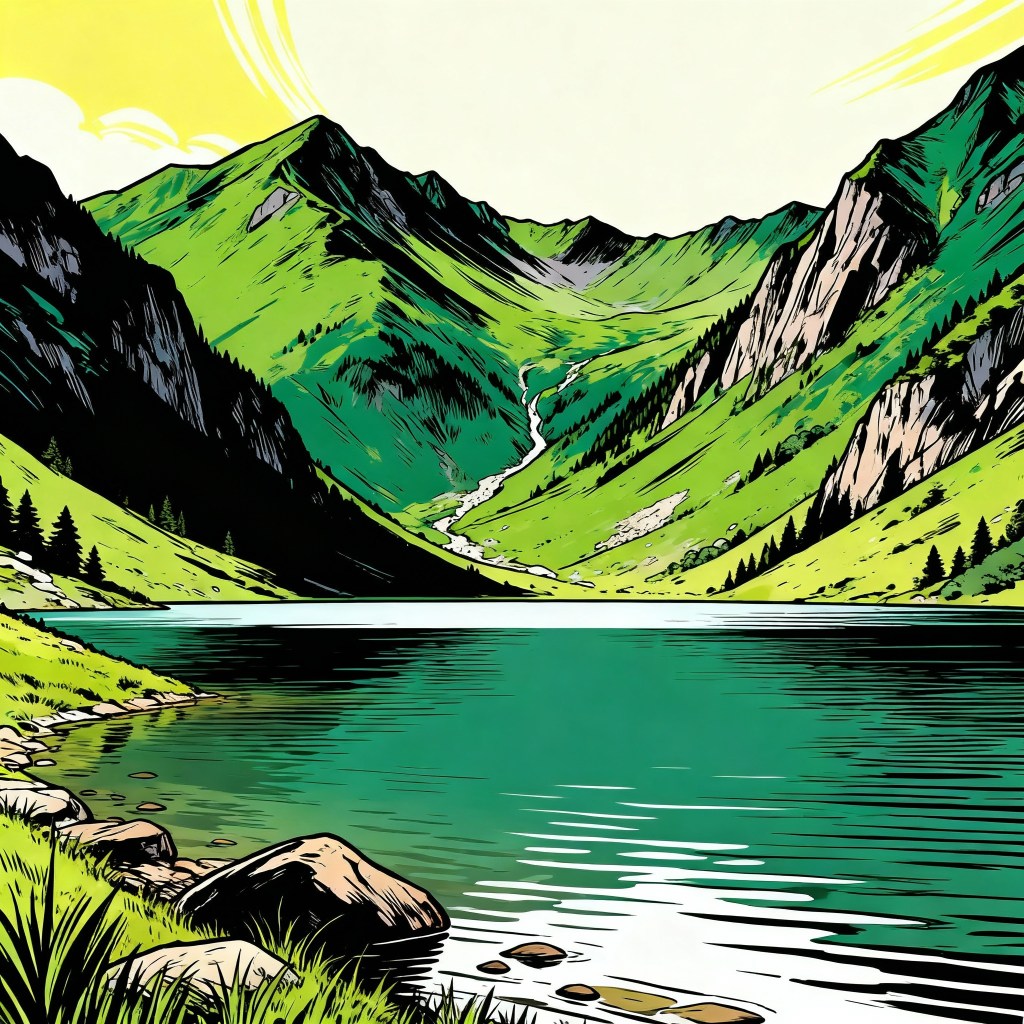
Lake Țarnița
The air is sharp with pine and the cold mineral tang of lakewater as we crouch in the musky stillness, dawn bleeding slowly over the ridgeline. I scan the treeline, my nerves stretched tight as piano wire. The old estate sprawls before us—eighty thousand square meters of rough, half-wild property wrapped in swirling brooks and dense forest, broken only by a handful of shuttered outbuildings and a manor crouching in the trees.
Sandi and Bartek whisper, peering through a gap in the brush toward the two guards, bored and slow below the crumbling terrace. From beyond the curve of the lake comes the faint, orchestrated whine of a hydro jet—Mikael, right on cue, making for the small stony inlet hidden by pines. If all goes right, he’ll slip ashore unnoticed.
I take a steadying breath, then set about my work. The lake air is icy on my skin as I slip off my jacket, fingers working fast. I unbutton my blouse, tearing it at the shoulder and hem to create a panicked appearance—deliberate, uneven, the fabric gaping. I adjust my clothing to complete the disguise, tucking away what I can, then swipe dust and a little mud along my cheeks and collarbone, wincing at the cold grit.
My hands dive into my hair, twisting it free of its knot and roughing it wildly about my shoulders, pale strands falling tangled down my back and into my face. I press two fingers into my upper thigh, just enough to leave a bruise and affect my gait.
When I limp out of the shadows—a woman alone, dishevelled, almost undone—there’s no fieldwork smile left in me. Only fear and a thin, trembling hope as I stumble toward the guards, hair wild, blouse torn and open, my voice breaking as I barely manage, “Ajutor, vă rog… Please, I need help…”
It isn’t acting; adrenaline makes every heartbeat true. Their attention snaps to me instantly—shock and wary curiosity warring on their faces.
I clutch my side, forcing myself to be small and vulnerable. The older guard moves first, lowering his weapon, suspicion tangled with the urge to help. He shouts for the other to keep watch and steps forward, just as I sway—half-collapse—drawing ever closer.
I catch Bartek’s shadow moving in my peripheral vision, silent and sure, and I know the signal is given. I keep whimpering, eyes wide and glassy, clinging to the role. Only when the guard is nearly within arm’s reach do I catch the glimmer of Karim’s shape behind the outbuilding—coiled, ready.
History may have made women bait for decades in these valleys, but tonight it is my idea, my turn. I let the tears come, limping and shaking, every sense straining for the moment violence will turn—this time—decidedly in our favour.
As they size me up, I see it in their eyes: disdain shading toward amusement, certain I am alone and out of place. They don’t notice Karim moving behind the rain barrel, nor Bartek passing low along the fence. I keep their attention, gesturing frantically, pushing a folder of stamped permits and EU papers toward the older guard. He grumbles, flicking through the forms, utterly missing the near-silent rush of footsteps behind him.
A scuffle—swift, a gasp and a sharp crack—and Bartek and Karim subdue them with ruthless efficiency, securing wrists and silencing them before any warning can be shouted. I keep breathing, staring skyward for a split second, before Sandi appears at my shoulder, a ghost in the mist.
Together, inside the shadowed manor, she and I slip through the echoing halls—old wood creaking, dust motes dancing in slats of sun—calling for Tarmo in barely a whisper. Every quick glance, every hush of shoe on stone could be a trap or a freedom. And through it all, my blood thrums with the knowledge: this time, I am the bait—but also the hunter, walking point for the ones I love.
While the men secure the way back and radio for Mikael’s fast, silent approach, Sandi and I search—room to room, hope flickering with every door. And whether Tarmo waits chained like a relic or hidden in old fear, I will not leave this borderland until history is rewritten on our terms—this time, with our own rescue.
Author’s Note
The rescue was supposed to bring relief, not riddles.
But when Elena steps into the heart of the operation, nothing is as it seems. Why isn’t fear in his eyes? Why do the shadows feel closer than ever?
With trust unravelling and every answer birthing a new question, Elena must decide: in a game played in whispers and double-bluffs, who is truly in danger?
Find out in the next chapter, where no one is quite who they seem.
I.Ph.
 The C.O.M.C. Files