
As we cross the border and descend into Oravská Polhora, it feels like rolling into a hush that belongs to another century. The mountains behind us fade into blue layers, their silence trailing into the valley. Here, the land flattens into gentle, green pastures, edged with those distinctive low, flat back stones—some pressed into fence-lines, some half-swallowed by grass, all weathered to a dark lustre. I brush my fingers over one as we park, feeling the cool, ancient surface—each stone a chapter of survival, marking out gardens, boundaries, memories.
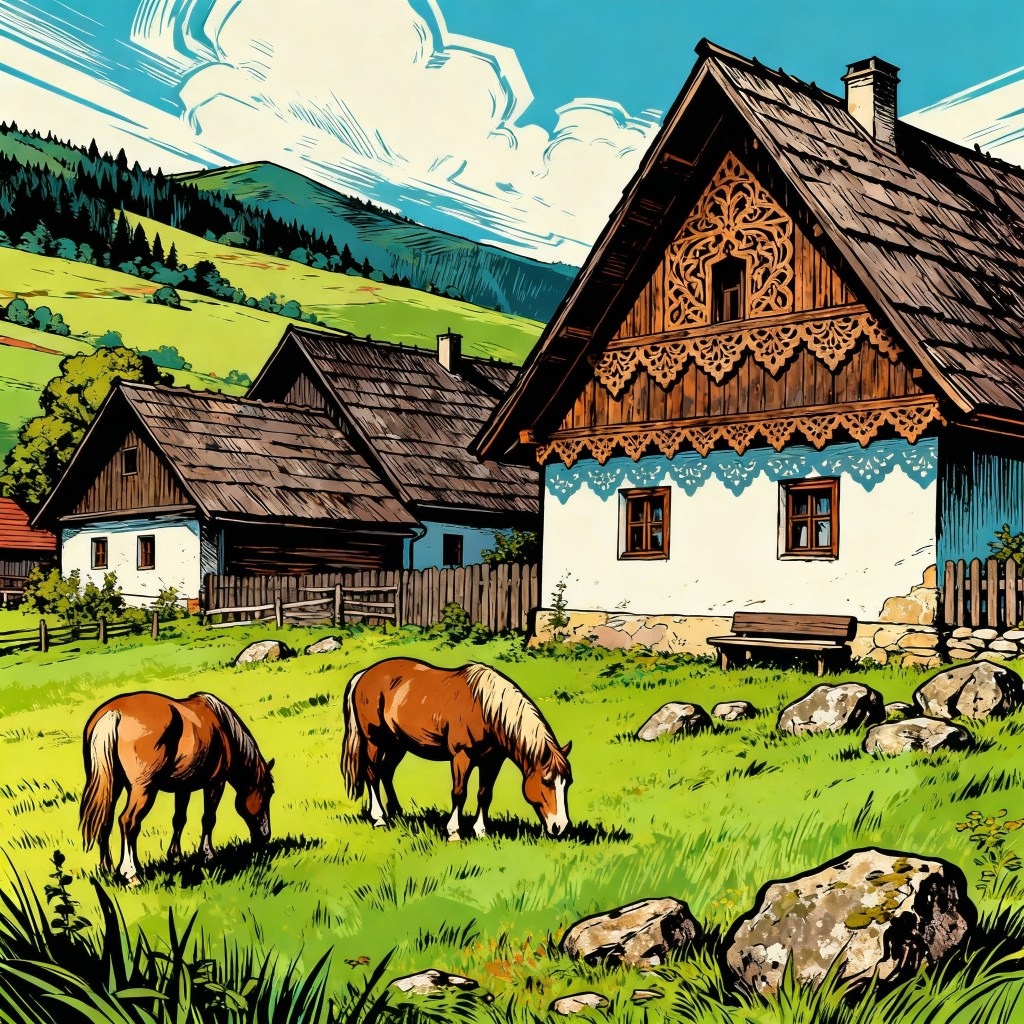
The village houses gleam with quiet defiance against the morning sun. Steep timber roofs hold the last of the night’s dew, their edges ornamented with hand-carved wood lace. Haflingers graze beneath fruit trees in neat back yards, the fence-posts leaning at odd angles, draped with growing vines. The walls are cream, pale yellow, or smoky brown; window boxes burst with geraniums, red and pink flaring against the slate. Some porches bear faded icons or wooden sunbursts, and everywhere, stacks of firewood are so meticulously arranged you sense they’re as much a statement as they are necessity.
We step out, stretching limbs stiff from the drive. The air is fresh—earth and water, yesterday’s rain still shimmering on the leaves. The smell of wood smoke clings low to the ground, mingling with a faint aroma of baking rye, tangy and warm.
A battered notice board near the village square draws my eye. Hand-lettered signs announce weddings, lost animals, and local announcements. Pinned in the centre, a printout in bold type relays today’s news:
“Námestovo did not receive financial support. Around 30 million euros will come to the Orava region for sewage infrastructure. The Ministry of Environment has approved funding from the Environmental Fund for the first 14 municipalities to begin construction of sewage systems.”
Sandi reads it aloud, wryly: “Guess civilisation is arriving, one pipe at a time.”
Bartek grins, “Orava’s always lived half in the past—maybe the pipes will finally bring them all the way into the present.”
Karim traces the old stone at his feet with the toe of his shoe. “With landscapes like this, who can blame them for wanting to hold on to something old?”
I tuck the news away in my notes—proof that even here, amid all this quiet beauty and folk memory, change is trickling in, reshaping the bones of the place. But for this morning, at least, Oravská Polhora holds us with its charms: the tangle of wooden eaves above, the hush of local gossip swirling beneath, and the hopeful, stubborn rhythm of life inside this patch of the Carpathians.
Stepping out into the sunlit village square of Oravská Polhora, we take in the melding of old world and new ambition—slate-roofed cottages nestle against grassy slopes, the low, flat back stones marking out narrow lanes and hidden histories. Porch rails groan under the weight of spring geraniums, folk icons glint above freshly painted doors, and everywhere are signs that tradition is prized: neat woodpiles, faded lace curtains, icons weathered by hope and prayer.
In the centre of the square, a motley group of village officials lingers beside the notice board, discussing the future. The printout still flutters, its message stark:
“Námestovo did not receive financial support. Around 30 million euros will come to the Orava region for sewage infrastructure. The Ministry of Environment has approved funding from the Environmental Fund for the first 14 municipalities to begin construction of sewage systems.”
Sandi nudges me, her gaze flicking between the anxious local faces and the van gleaming with European plates. I smooth my jacket and approach with practised diplomacy, Bartek ambling at my side—his presence radiating both comfort and curiosity.
I introduce us as representatives of CYcrds, outlining our ongoing European heritage project. “We have substantial EU funding set aside for supporting regional initiatives that couple cultural memory with tangible improvements in quality of life. Our interest is in collecting stories and mapping the living traditions of Orava, but we know modernisation—like sanitation—is part of a community’s future too.”
A hopeful silence hangs between us.
The village headman, an older man with calloused hands and sharp, assessing eyes, leans in. “You help with this—talk to Brussels, Vienna, maybe—maybe Orava keeps secrets and finally gets decent pipes. One necessity for another need.” His words carry the weight of promise and barter—ancient currencies in new clothes.
We exchange contact details, assurances, and the names of regional officials. As Sandi snaps a photo of the group and Bartek shares a joke in halting Slovak, Karim quietly notes the handshake—each side taking the other’s measure, possibilities sparking in the spring air. In this borderland, memory and modernisation are always in negotiation. Today, perhaps, we’ve just brokered something vital in both directions.
The contact secured, we linger just long enough to taste the fragile hospitality of Oravská Polhora. In a low-ceilinged kitchen warmed by a wood stove, the village headman pours plum brandy with a steady hand, the amber liquid catching the light like liquid fire.
Sandi samples the sharp warmth, her eyes flickering with both relief and respect. Bartek tucks into a slab of smoked sheep cheese, nodding approvingly at the tangy bite. Karim studies the pattern of carved wooden cups arranged on the rough-hewn table, eyes distant but attentive.
I exchange a brief, earnest look with the headman. His nod is slow but sure, a silent pact sealed in the shared ritual of drink and offering. A local woman slips in, pressing a small talisman into my hand—an embroidered cloth worn smooth, a promise of protection whispered through generations.
„Opatrne na ceste, nech vás Boh ochraňuje.“
“You must travel carefully,” she murmurs with a glance toward the door.
Time presses like a weight. I glance at my watch, feeling the pulse of urgency return. It’s time to move.
We rise, voices lowered but warm. Promises to keep lines open and help when needed. Outside, the village basks in soft, late afternoon light—the shadows stretching long, as if aware our brief moment here is already folding into memory.
Back in the van, engines murmuring once more, I close my eyes for a brief second, the talisman heavy in my palm. We’re on the road again—with less certainty, but with a spark of hope lighting the way.
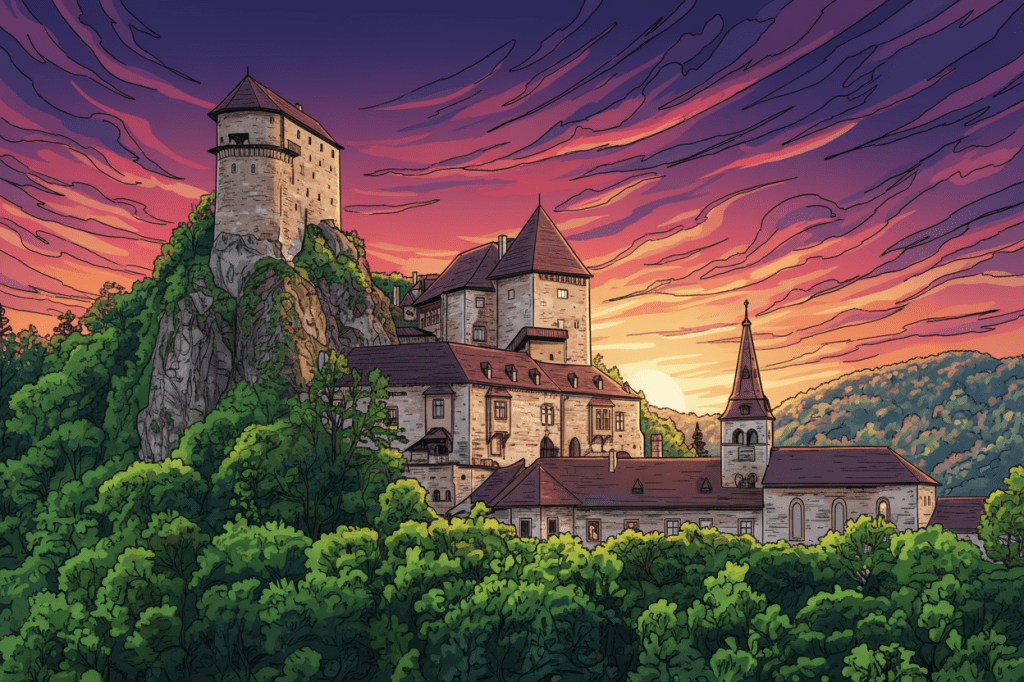
As we head into Dolný Kubín, the flavour of old Orava fills the air—steep-roofed houses lining cobbled streets, the broad band of the Orava River splitting the town’s heart. Elena, Sandi, Bartek, and Karim pause at the city’s historic square, the pulse of the Orava region and its living memory.
They stop first at the Orava Museum of P. O. Hviezdoslav, a distinguished institution dedicated to preserving the region’s natural and cultural history. Elena soaks up the curated artefacts—sheaves of embroidered linen, a wall of old tools, the scent of book mould in the Čaplovič Library’s vaulted halls. Fieldwork is easy here: Sandi snaps photos of schoolchildren sketching local statues, Bartek chats idly (and flirts) with a museum guide, while Karim jots notes in a journal stamped with the CYcrds logo. A quick visit to the Orava Gallery, set in a 17th-century county house, offers modern Slovak art alongside centuries-old icons—ideal material for their public archive and social media cover.
The team enjoys a brief open-air lunch of bread, sheep cheese, and poppyseed pastries, bathed in mountain light and the hum of local dialects.
All is bliss until the satellite phone starts to beep. We all stare at it. Karim hands it to me, and I answer.
“Elena?” Mikael’s voice comes through crystal clear but urgent. “Tarmo’s missing near Lake Tarnița. Last contact 18 hours ago. I think they—”
“Who’s ‘they’? Mikael, where are you?”
“Can’t talk long. Get there fast. Someone’s tracking our calls—I have to ditch this phone.”
The line goes dead—not static, just sudden silence.
All eyes are on me as I lay down the phone, my mind racing from sheep cheese and folk art to captivity and international borders. Sandi’s camera hangs forgotten around her neck. Bartek has gone completely still. Karim’s pen hovers above his notebook, as if the scholarly work we’ve been doing suddenly belongs to another lifetime.
Lake Tarnița. Romania. A day’s hard drive through mountain passes, assuming the borders cooperate.
I.Ph.
 The C.O.M.C. Files