
“Where the Strawberries grow under Fir”
The van rattles along the narrow pass beneath Babia Góra. My notebook trembles on my knees as the forest smears into stone ridges, sky low and restless overhead. My thoughts spill out before I can tame them.
“Elusive men like Tarmo don’t stumble into trouble,” I murmur, more to the mountains than the people in the van. “They choose it. For all those billions, he needs the edge more than the safety. He left Mikael, maybe, just to remind himself how it feels to be a player again—not only a king locked in his own silence.”
From the mirror, Bartek’s eyes find me. His snort is low, flat, carrying none of the mischief people mistake in others. It’s weight, not play.
“Eh. The rich, his kind… they never sleep good unless something is breaking. Business. Woman. Blood. You think you can keep hands clean, but pff… always you scrub at stain you cannot see.” His Polish accent thickens the vowels, steady, worn down like stone against water.
He shifts his shoulders, not with flourish but the practical roll of a man used to long roads.
“Tarmo, he goes back into field because who else will touch this shit? Maybe old friend is now enemy. Maybe he has debt no paper will settle. Or maybe…” His pause is heavy, not sly, but knowing. “…maybe, Elena, he runs from what he cannot hold in Warsaw, Tallinn, London. Something he cannot order. Cannot pay to disappear.”
His chin lifts toward the window, the mountain hunched in its age, unmoving, vast.
“Men like that—they return to sharp end now and then. Just to check they are not finished. Not already in grave.”
Sandi peers back over her camera, curiosity in her voice. “That’s a brutal way to check you’re alive.”
Bartek shrugs. His face is solid, unreadable, built from silence rather than teeth. “It is only way that counts.”
The hush in the van is heavier than before, the forest pressing inward, close. I let his words seep through me, their truth not sharp but blunt, buried deep like something moving under stone.
Sandi leans her head back against the seat, her camera resting in her lap. The hush has settled heavy over us, but she won’t let it close.
“Or maybe it’s not just about adrenaline,” she says, voice softer now but steady, unflinching. “Maybe the hardest thing for men like him is facing the people who knew them before the titles, before the walls of security. There’s no place to hide then—not even behind your own legend.” She flips through her photos absently. “Men like Tarmo want to be seen, yes—but only on their terms.”
Karim tilts his head, always measured, always composed. “Or perhaps it is control,” he offers thoughtfully. “In boardrooms, Tarmo shapes the world with contracts, with signatures. But here?” He gestures faintly to the road winding beneath the mountain. “Nothing bends for him. Not the stone, not the weather, not his luck. Perhaps he craves that—the humility. The reminder that every so often, the world pushes back.”
Their voices settle in me, the words drifting through deeper currents. The van’s engine carries us forward, but my mind clings to the edges of their thoughts.
For all the stories I’ve gathered about exiles and sovereigns, I wonder if Tarmo himself knows what it is he runs from—whether it’s hunger for what still feels raw and genuine, or the ache of having once desired something with his whole being, and lost it.
Sometimes, I think, it’s the not-knowing that keeps a person in motion. That fragile hope: that just beyond the next border, in the shadow of the next cold, unforgiving mountain, what you’ve been chasing might finally stand still—or else let you rest.
I close my notebook for once, letting silence fold around me. The Carpathians breathe their steady breath across the glass—the mountain’s weight resting like a hand on my shoulder, urging me forward into the mystery.
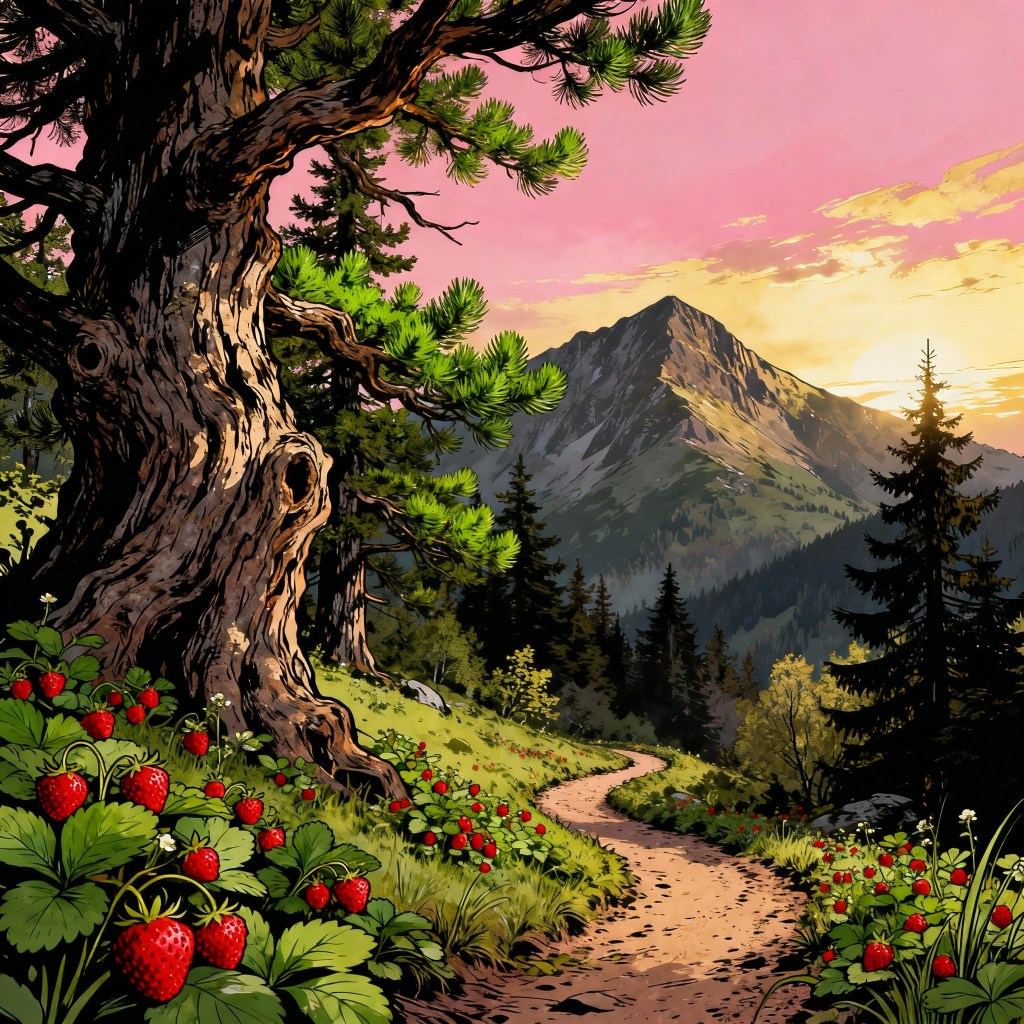
The van slows as the road curves near a clutch of ancient firs—their trunks thick, gnarled with secrets only the forest understands. Bartek brings us to a halt beside a narrow dirt path, wild strawberries dotting the verge, pale blooms struggling up through spring’s chill.
We spill from the van, our limbs stretching, the ache of travel dissolving with the breath of fresh air. Sandi moves with a resolve that’s both graceful and restless, slipping behind one of the broad pine trunks. I catch the soft rustle, her quick glance, the subtle beckoning to Bartek—all signals exchanged in a language older than words.
It’s a ritual I recognize: the tension that simmers between companions pressed together by circumstance, the collision of urgency and need. Bartek follows, his steps deliberate. I see them only in fragments—Sandi’s fingers trailing along his sleeve, his hands gentle but certain at her waist, the angle of her head, exposing her throat to his mouth. Their bodies find each other in a moment stolen from the logic of our journey; their closeness is furtive and raw, the negotiation of privacy against the watchful eyes of the world.
Anthropology teaches me the patterns—how intimacy carves out its own space, how even among danger, the body insists on its rebellion against isolation. I note the way their contact holds both longing and comfort, how breath and skin negotiate survival alongside desire. I let myself witness, not intrude; the ethics of distance hold me back, even as curiosity edges me forward.
The forest absorbs it all, rendering their stolen moment into myth—fire against the cold calculus of flight, a reminder that even here, even now, flesh stakes its claim.
I glance up, sensing a subtle shift in the air—a drawing away, a silence layered with urgency. With practiced grace, I let their privacy endure. My focus turns deliberately back to the task at hand, fingers moving fast as the day’s destination and our next cover story take shape, line by careful line.
Karim lingers at my side, eyes darting toward the thicket that has swallowed Bartek and Sandi. He catches my attention, offers a sheepish look, some gentle apology, as if embarrassed at the longing reflected in his own gaze. But my hands stay busy with notes, my mind on logistics—the route, the cover, the quiet necessities of survival.
I know what draws Sandi and Bartek together here—their bodies choosing what their minds are too wary to name. I see it in fragments: Sandi open and urgent, letting Bartek’s presence claim her, his solidity anchoring something wild in her. She’ll say later it’s only adrenaline, the pressure of the unknown, but I know better. Here, under these old trees, stripped of audience and artifice, the truth is sharper than any story.
She wants him entirely—the risk, the laughter, the mythic force in him, and the way he offers himself now, without question or hesitation. For a moment, Sandi loses her doubts, lets some primordial force rise up to meet whatever he awakens in her—a clash of Baltic storm and Polish earth, god and banshee.
I imagine her final wild thought as she gives in: Let the world wait. I am alive.
Beyond their moment, outside the pulse and hush of the forest, everything else—Karim’s quiet yearning, my relentless notetaking—recedes to static. There is only sensation, the bite of spring, the truth of touch. Two bodies tangled in worship, unafraid of flesh, reminding each other what it means to be present, to be claimed, to survive and burn all at once.
We climb back into the van, the spring air thick with the unmistakable trace of sex—rich and sweet, refusing to be ignored. Bartek drops behind the wheel, smirking without apology. Sandi slides in beside him, cheeks still flushed with a kind of unguarded joy. For the first time in days, the tension binding us seems looser, as if they’ve managed to slip a little lightness into the dark weave of our journey.
Karim, determined as ever to be decorous, devotes himself to the radio dials with exaggerated concentration. I watch him out of the corner of my eye; his manner is so pointedly respectful it almost makes me snort.
Catching Sandi’s gaze in the rearview, I can’t help but smile—quick, conspiratorial, a flicker of true sisterhood. There’s a silent ‘good for you, girl’ that rises in me, honest and unforced. They’ve taken something bright for themselves in all this tension and anxiety, and even with everything uncertain, I’m glad for them.
From my bag I dig out a packet of wipes and, feigning as much subtlety as the cramped space allows, pass them back to Sandi with a nudge.
“Trust me,” I murmur, letting my eyebrow arch just so, “you don’t want to explain that sort of field sample at Slovak customs.”
Sandi chokes back her laughter, biting her lip, her eyes shining with relief and wicked gratitude as she tucks the wipes away.
“You’re an angel, Elena,” she whispers back, and for a second, mischief smooths away all her shadows.
The engine hums back to life, Bartek throws us into gear, and we roll forward into the lush, green-lit world—our little secrets carried behind us in the swirling air, the road ahead uncertain but, if only for this moment, shining a little brighter.
I.Ph.
 The C.O.M.C. Files