
Miro’s Study, Pre-Dawn
While Sandi laughs with Miro in the kitchen and Bartek juggles van keys, I slip away to the painter’s cramped, brush-splattered study. Miro’s old desk, littered with half-filled sketchbooks and the stub of a turpentine bottle, becomes my operational field.
My movements are concentrated for the task: shoulders tight, gaze sharpened, each motion trimmed of excess. Hands are steady, but between phone calls, I absently rub my forearm—a private gesture for chasing worry from my skin, almost like brushing off bad omens.
First, to Mikael—thumb hovers on the dial, pulse fluttering as static fills the line.
I stand by the open window for air as Mikael’s voice comes low and clipped:
“Elena. Situation’s bad. Tarmo’s running solo near Orava. Informant Hric compromised. Locals tense—border enforcement up. Your only shield is cover: fieldwork for CYcrds, funded by a pan-European cultural grant. Assume surveillance. No direct line to Tarmo—fallback protocol only. Understood?”
She scribbles notes in a coded hand, fingers smudged with turpentine—a silent promise to herself as much as to Mikael.
Next, Mrs H:
My posture becomes even more upright, almost combative or that of a reprimanded ballerina.
“Deploy all legal and council paperwork now. Local authorities in Zywiec and Orava must have summaries and grant letters by noon. Ministry delays are unacceptable. Leak our work to the local press if necessary—heritage project, memory archive, university partnerships. This is not a drill.”
I tap the table rhythmically while Mrs H’s calm voice affirms each order.
Then Hasna:
The message is brisk, lips set in a nearly invisible frown as she types:
“Activate all backup travel kits and photographic series. Field logs for Silesia and Carpathia must be live in the archive. Prepare evacuation plans for all border scenarios—secure vehicles and safehouses on both sides. Ping confirmation asap.”
With the machine running, I exhale. For a moment, knuckles white on the desk, counting my breaths as the morning chills my cheeks. The familiar fear is there—I carry it like a second passport.
Out in the Hallway, the Briefing
Gathering my team—Sandi, Bartek, Karim—just inside the tiled entryway. Miro, sensing gravity, wordlessly hands out black coffee and eases out of earshot.
My voice is even, composed; meeting every gaze, relying on my own resolve to be quietly infectious.
“We have new intel. Tarmo is in trouble near the border—caught in a failed handoff between our Slovak contact and a rival group. We can’t reach him directly; communications are likely under surveillance. Our only safe cover is as CYcrds researchers—anthropologists, photographers, recovering regional traditions for a pan-European memory grant.”
“Our paperwork will be waiting along the route. If anyone asks, we’re conducting interviews, collecting stories, and mapping oral history for the EU’s digital archive. I’ve had legal cover and documentation activated. Do not deviate from the script with authorities. If we’re separated or things turn, we snap to fallback protocol Three—regroup at the nearest secure location.”
“Karim, you’re point with logistics and comms. Sandi, focus on field documentation and public face—camera always visible, notes open. Bartek—driving and local liaison. All of our photos, interviews, and even our questions must reflect the official story. No heroics, and above all, no freelance communication with Tarmo or local law.”
I let the instructions settle, my tone softening.
“I know what’s at stake. No one moves alone. If you have doubts, say so now. Otherwise, we go as one team—for Tarmo, and for each other.”
An old clock ticks. Outside, the first thread of sunrise pulls the world pink and gold. Bartek runs a hand along his jaw, nodding with grim understanding. Sandi offers a tight, encouraging smile and checks her camera batteries. Karim’s eyes flicker, quick and calculating, as he shoulders the communications gear. Steam rises from their coffee cups; somewhere beyond the windows, a distant tram rattles against the morning quiet.
Southbound Out of Silesia
We leave behind the gloss and glare of Sandi’s German car, trading prestige for practicality. Miro’s borrowed van creaks with the effort of a thousand previous journeys and one too many Barbakan sausages crushed into its carpet. The house recedes—a white speck in the swelling green—while Miro waves with both hands, calling after us about cheese and postcards and never trusting a man who paints with clean brushes.
“You go! Och—but remember, Elena, postcards! Or bring me back Slovak cheese. Real cheese, not German plastic, eh?”
Driving out of Bielsko-Biała, Bartek finds his pace and humour.
“Relaks, professor. We only find mountains and wild sheep, yes?”
There is no rush, only the tense patience of those who know the value of not calling attention. Sandi opens the back windows and breathes deep, camera close, snapping photos of fields just beginning to steam in the rising sun.
“And maybe a witch or two—this Babia Góra, what’s that legend again?”
“We’re tourists now,” Karim announces from the back. “CYcrds field team. All for the memory project. Every stone, every story. Poland’s living folklore!” He catches my eye in the rear-view mirror, grinning.
Sandi becomes all observation, watching the world with quick, appraising glances. I watch how he leans forward at village crossroads, clocking every chapel, every faded signpost, every suspicious pair of eyes. True to cover, I launch the first “interview” with Sandi on modern memory and borderland myth, scribbling notes that would look innocent to any prying police or local eccentric.
The road through Szczyrk is a ribbon pulled through green valleys, the town’s ski lifts dozing in off-season fog. Locals gossip by the bus stop, a young girl in a swirling skirt chases her dog across the square. She flashes a gap-toothed smile and calls out: “Dokąd tak ładnie?” (“Where to, so prettily?”)
Then she offers a fragment of a folk song, a verse about mountain witches that makes Bartek snort with quiet delight. I jot it down, smiling in reassurance.
Żywiec—a bigger town, haunted by its brewery’s sweet, bready perfume—offers traffic and quick tension. Sandi insists we stop for “research photos.” A man with a barrel chest and oil-black hair eyes our plates before answering her questions about the town’s bridge, launching into a local story about floods, saints, and lost sheep. She records everything, offers him a chocolate bar from her pocket, and he laughs, waving us back on our way.
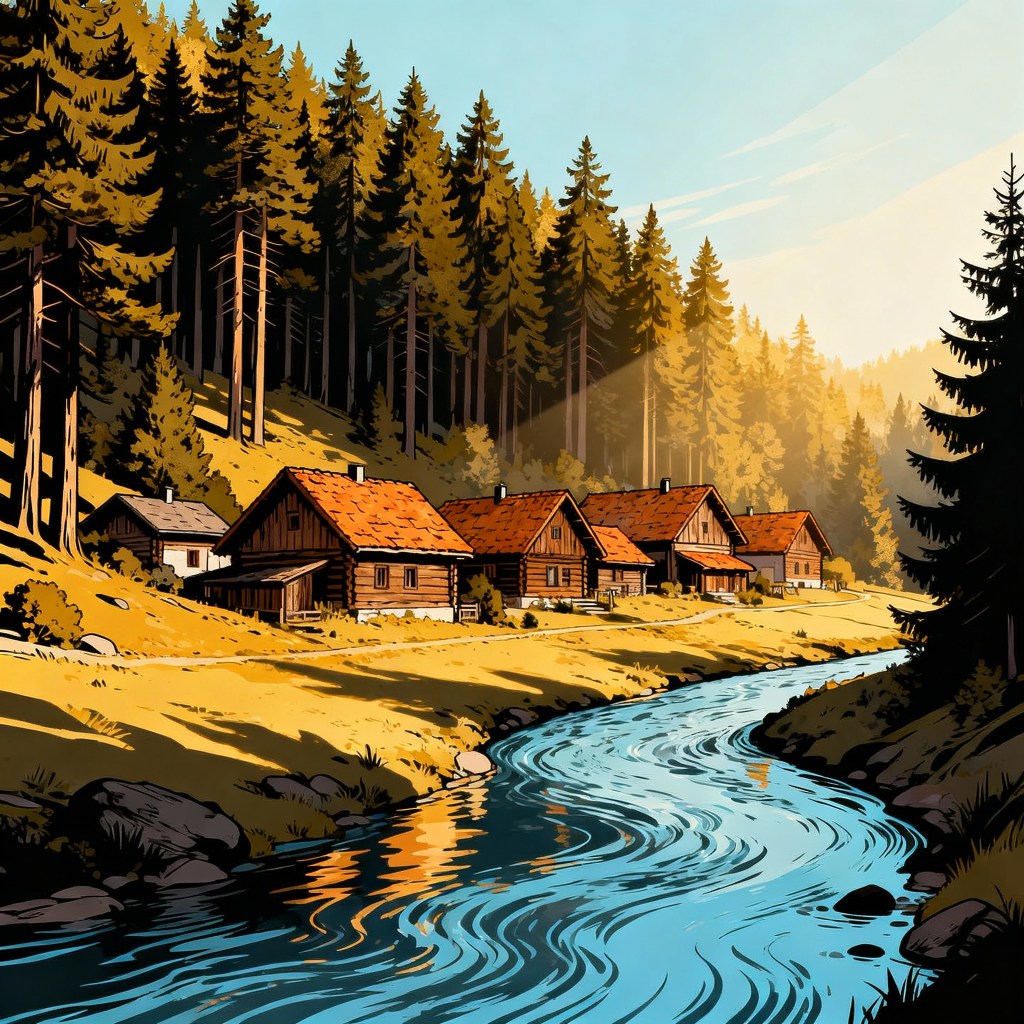
Outside of town, the fields flatten. Węgierska Górka is a clutch of cottages pressed against pine and river, the bunker museum silent in mid-morning. Here, a grandmotherly woman, broom in hand, eyes the van with bemused suspicion. Sandi approaches, camera in hand, and the woman unleashes a steady stream of local Silesian:
“A wy skōndże? Bo nie wyglōndocie na tutōjszych. Turisty, co? Ale z takimi aparātami, kto wie…” (“Where are you from then? You don’t look like locals. Tourists, huh? But with such cameras, who knows…”)
Bartek answers with perfect comedic timing: “Tak, turyści. Robimy zdjęcia i piszemy o zwyczajach, legendach… badania terenowe!” (“Yes, tourists. We are taking photos and writing about customs, legends… field research!”)
This defuses any concern, making her laugh and pat his cheek for luck.
“A, badania! Teraz wsio chcą wiedzieć! Ale na Babiej Górze niech was nosa nie poniesie! Tam baba czaruje, mgła kręci, a niedźwiedź swoje drogi ma. Tu się śpi spokojnie, a tam… lepiej uważać!” (“Ah, research! Now everybody wants to know everything! But don’t let your nose lead you astray on Babia Góra! The old witch weaves spells, the fog swirls, and the bear has his trails. You sleep soundly here, but up there… better be careful!”)
I capture the cadence of her words, sensing something ancient and protective in their veiled scepticism—a warning wrapped in folklore, delivered with a smile tinged with genuine concern.
Approaching Babia Góra
We press on, the van slowing as the hills steepen, the road narrowing and curling ever higher. Babia Góra looms now, blue-grey and veiled in cloud, folklore and foreboding woven into its very name. The town thins, the silence grows dense.
At a roadside pullover, a local farmer, boots thick with mud, nods in our direction. He points at our notebooks and cameras, then gestures toward the path leading up the swollen green slope.
“Ej, turystki! Widzicie tę górę? Tam się nie żartuje. Mgła spada jak zasłona, niedźwiedź ma swoje tropy. A ta baba… stara jak kamień, zła jak burza. Lepiej zostać na dole.”
(“Hey, tourists! You see that mountain? No joking around there. Fog drops like a curtain, bear has his trails. And that witch… old as stone, mean as a storm. Better to stay below.”)
His warning is clear even before his words, full of local idiom and wary goodwill: tourists are welcome, but the mountain keeps its counsel. He shifts his weight, studying our faces with the careful attention of someone who’s lived long enough to recognise trouble.
“Młode jesteście. Myślicie, że wszystko znacie. Ale góra ma swoje prawa.”
(“You’re young. Think you know everything. But the mountain has its own laws.”)
Back inside the van, windows fogging in the damp air, Sandi murmurs, “People here actually live their legends, don’t they?”
Bartek, hands steady on the wheel, grins at her through the mirror. “Every mountain is its own country. Every story is a map. Don’t wander off, nie?”
The van climbs, bumping and shifting, the border not yet visible, but already felt—a subtle press of history, anticipation, and things left unspoken.
I hold my pencil still, notebook in hand, and look out at the rolling hills and tiled rooftops of villages already receding behind us. The farmer’s words echo with something deeper than folklore—the weight of generations who learned to read the mountain’s moods. I wonder what legends our faces might inspire in the stories told after we’ve passed, and which border we will truly cross tonight.
I.Ph.
 The C.O.M.C. Files