
“Between Vodka, Weed, Heat and Warning”
It’s only after we’ve ditched the snarled avenues of Katowice—streets shivered with suspicion, every window a blind witness—that I let myself breathe. My reflections haze behind the car window: haunted tenement facades collapsing into their own shadows, the twilight river clutching secrets, and that peculiar, slanted lake like a wound refusing to scar over, holding more memory than reflection. Katowice is a city for forgetting and being forgotten, if one’s careful.
Bartek, however, is not one for nostalgia. He hustles us out with barely a backwards glance, citing “practicalities”—the kind of passport deal that never quite smells legal, the invisible ledger of debts and dangers. Security, he claims, but his urge to escape is as much metaphysical as logistical.
So we trade the city’s iron embrace for the rolling throat of hills that rise above Bielsko-Biała—Poland’s unkempt borderland, half-mountain village, half-worn bohemian myth. It barely registers as a destination; more a pause between misfortune, a rumour of sanctuary.
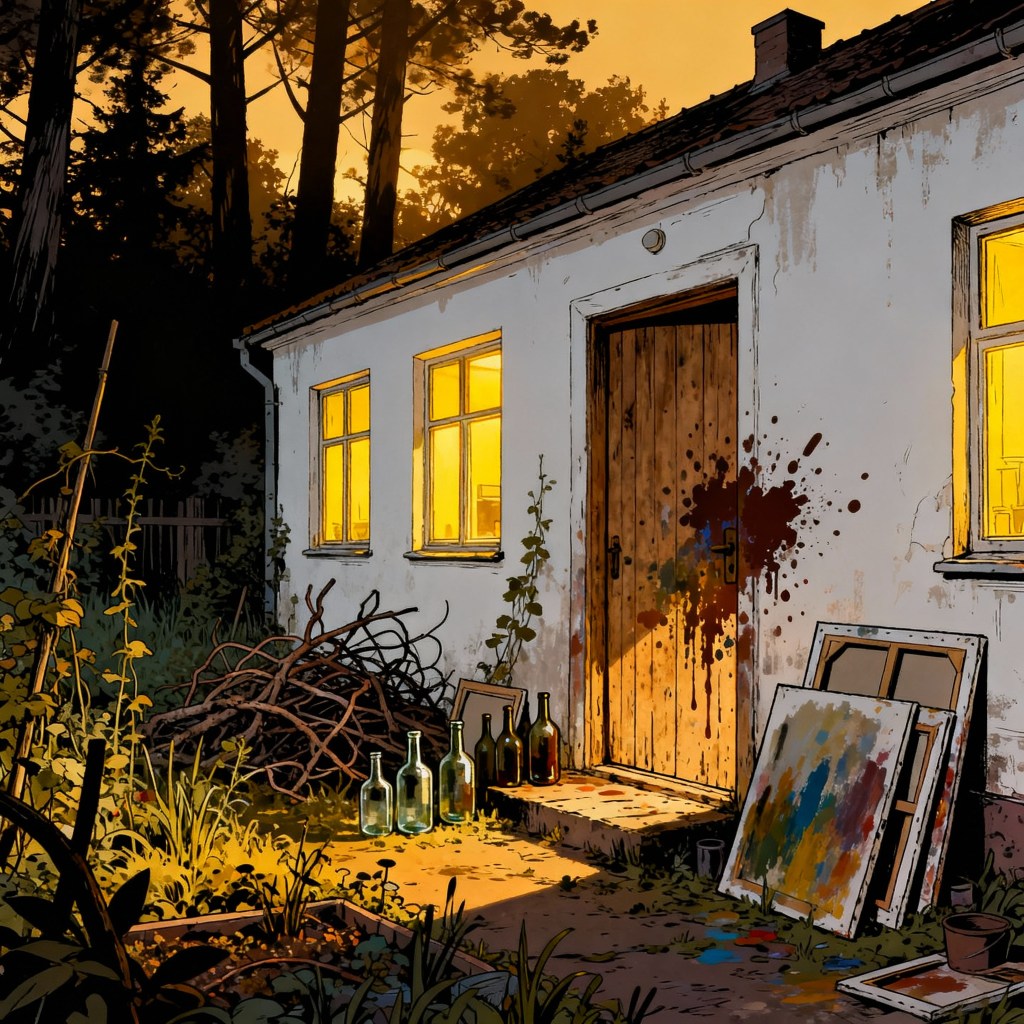
We arrive after dusk at Miro’s white house, nestled just shy of the woods. Light pours from the windows, yellow and unwavering against the encroaching dark. You feel the radiance before you see him.
Mirosław Biały, painter, friend, sometimes mirror. Born in 1966, he learned his first lines at the Lublin School of Fine Arts, then chased restless dreams through a Danish graphic academy. I remember those years in flashes: letters streaked with sketches, praise so honest it could scald, questions as blunt as the knives he used to mix pigment.
Then Miro Biały bursts out from that almost-hidden white house as if he’s forgotten how to close his own doors. Painter, madman, patron saint of every stray and half-finished canvas from Silesia to Krakow. The corridor is a quagmire—colour, clutter, bottles of vodka sweating in the hearth’s afterglow, sacrificial bread and chopped pickles and wrinkled sausage on the table. The reek of patchouli and sour smoke lurks in every couch cushion, in the fur of the disgruntled cat who rules the kitchen.
Inside, the rooms are dignified but not precious, white-walled and sunlit by day. Canvases everywhere. It’s unsettling, almost comic, how many bear my face. Me caught at twenty—lips bitten from too much tea. Me at thirty—blurred and bold in a fugue of indigo. Recent versions—wary, searching. Miro claims he never paints the same soul twice. The multiplying selves unsettle me, as if each painting remaps the boundaries of who I am.
Dinner unfolds like a slow opera, each note deliberate. Sandi marvels at the cheeses; Bartek studies the wine with the same calculation he gives the exits. There’s vodka—no Polish night without it—and enough fresh bread and roast beetroot to suggest Miro hoped, or feared, we’d stay the week.
Miro demands stories, so we offer them, each as outlandish as the last. Bartek, emboldened by drink, slips into old jokes so local they resist translation. Sandi laughs in a key I’ve never heard. I study the choreography—the passing of the bottle like a minor holy relic, the way we all keep half an eye on the windows even as we feign relaxation. Danger glimmers just outside, never quite erased—only rearranged.
The studio, thick with the musky breath of oil paint and coal dust, closes in behind them. Sandi glances at the wall, uneasy at the rainforest of Elenas gazing down—then is pulled back to the far simpler mystery of Bartek, chest pressed to her back, breath hot against her neck.
Bartek’s hands, calloused and sure, slide beneath her blouse. “Forget them,” he growls. “Tonight isn’t haunted unless you want it to be.”
She lets him turn her, studies his face—the sated predator, the barely-leashed pagan. Her lips curve with a wry smile: “There’s always something watching, Bartek. Miro’s ghosts, your gods, my shadow.”
Bartek laughs low, unashamed, already working the button on her jeans. “Let them watch, then. Maybe they’ll learn something.”
He leans down, capturing her mouth with a kiss that is deep and possessive, tongue tangling, fingers relentless in their rhythm. Each stroke winds pleasure tighter until, on the brink, he stills, looking down with a tenderness tinged by something darker—a weight of memory, a question of future.
“Sandi,” he rasps, brushing her hair aside, “I meant it. I would sacrifice everything for you. Even this devil’s freedom.”
She’s undressed him before, but now—caught in the blue dusk and the reckless edge of flight—she hesitates, fingers resting against the rough waistband of his trousers. His body is a wildland, muscle beneath ink, and the promise there is unequivocal. When she draws him out, a flash of wicked humor dances through her mind: Well, this would make a good excuse if I ever need one.
His member, heavy and ready, makes her catch her breath—not embarrassment, but greedy anticipation. She quirks an eyebrow, meeting his gaze. “You do realise men have started wars with less.”
Bartek, flushed and half-grinning, props himself on his elbow. “I’m willing to surrender—no negotiation.”
She laughs—low, fierce, hunger sharpened—sliding down to meet him in the half-dark. Bartek stirs a particular hunger inside her. Her palms rest at the line of his waistband, feeling each breath. There is no mask, no border here; just her hands and his waiting body, muscle taut beneath skin inked with old bravado and new worship.
She frees him, savoring the shape and weight, biting back a laugh—equal parts mischief and triumph. Gods, he is beautiful like this: utterly willing, wanting, trusting her lead.
She murmurs again, eyebrow arched, “You do realise men have started wars with less.”
He grins, surrender blooming in the dusk where his mouth drifts over her shoulder. “I’m willing to negotiate terms—preferably naked.”
The air between them is tight as a coiled spring, anticipation crackling. She sinks down—mouth and hands greedy, worshiping his heat, mapping old territory anew. Sex is rough, urgent—teeth at his throat, laughter bright in her own. She rides him, his hands clutching her hips, gasping her name between reverence and ruin.
After, tangled together, Bartek’s hair wild against the sheets, he strokes her spine and speaks with a cracked, aching seriousness: “I’d give it all—my badge, my gun, my damned soul. Name it.”
Sandi lets silence settle, picturing the blue dusk and ache in his voice, her fingers sliding over the tattoo on his flank. Untangling just enough to keep him guessing, she grins: “Don’t start counting your sacrifices, Bartek. I only let trickster gods in my bed if they make me laugh. And you—” her hand slips low once more—“just barely qualify.”
Miro and I talk, and talk: stories tumble out, half in jest, half confessional. Miro’s laughter is as generous as his canvases, and the house suffuses with his peculiar warmth—each guest for a night, woven into the story of the house. Outside, the garden whispers through open French doors; the lake’s faint shimmer glimpsed through the trees, promising a pause from the world’s demands.
Beyond the garden, the lake sprawls—silver and sullen under the moon—while foothills loom, indifferent, ancient, as if we’re guests at a festival long ended. I am present, yet apart. My body stirs spoons in weak tea, voices compliments for the food, but my mind collects haunted glints of glass, unfinished brushstrokes, the tattooed hush before someone dares the unsayable.
The last laughter fades into corners of Miro’s white house as guests peel away—some drifting to the kitchen for vodka, others already claimed by sleep. With practised subtlety, Miro corners me in the studio doorway, turning the brass handle with paint-splattered fingers.
His English, rugged and embroidered with Polish vowels, is as vivid as his presence. He gestures at my scattered, unfinished portraits. “Och Elena…” His grin is round-cheeked, eyes bright below madcap brows. “When I say, ‘come always,’ I mean—you. Not…” He waves a dismissive brush. “Not your team… young Arabian stallion and your security man, Pan with gun… and feisty Finnish Sandi—she make nice mess, yes?”
He laughs, a musical, open sound, and mimics whisking, painting. “I make good food, vodka, maybe cake! Always for you. For talk, not…work.”
I smile, fond and faintly apologetic. “They’re company, Miro. Life’s complicated now. You know why I travel this way.”
His face crumples and smooths, childlike and shrewd. “Och, Elena, always complicated. But you—” he points, trembling brush, “—before, you laughed in my kitchen. You walked alone in the garden, early. Not always so busy—with politics and ghosts…” Another laugh trails off, softer. “I paint you because you never stay in one memory. So many faces.”
Leaning in the doorframe, paint-stained shirt untucked, his eyes crinkle with sadness and understanding.
“I am—old fool, maybe. I wanted a friend, not adventure story.” He shrugs. “But you come. That’s enough—I forgive your circus.”
I touch his arm, squeezing gently. “You have me, Miro. Even if it’s only in pieces, sometimes surrounded by chaos.”
He laughs again—soft, forgiving, och-Elena laughter. “Is how I paint, yes—little pieces. Always together, for you. If you come alone, maybe I create a big portrait—one of peace. Do you think I can?”
It’s here, in this absurd little limbo—between the vodka and the weed, caught in the alchemy of late-night mountain air, classical music, and shabby domesticity—that clarity comes. Suspended between absurdity and nostalgia, laughter and lies, we become ourselves: fugitives, lovers, witnesses, pilgrims at a table built from the wreckage of better plans.
Tarmo’s face suddenly flickers through my mind: fierce, elusive, irresistible as winter sun on old ice. Then, just as suddenly, unease. Tomorrow, the business resumes; tonight we borrow joy and pretend the world isn’t closing in. I resolve: bed.
As Miro’s snoring echoes down the hallway and I linger in his chaotic, paint-thick space, my mind drifts—sideways to Tarmo, not forward to tomorrow’s trouble. There’s always a part of me, no matter the city or the company, that glances back for him. Nostalgia wraps my ribs—a longing for the rare hours we weren’t dodging shadows, when Tarmo’s presence protected and provoked at once.
But beneath the warmth, a thin, sharply spun twine: worry. Even here in Miro’s sanctuary, suspicion gnaws. Tarmo is in over his head—or maybe, for once, his heart. Distance never erases the sense I might someday read his name in a coded cable or casualty list, reduced to a footnote. I wonder if he ever aches for me, or if, for Tarmo, forward is always the only way left.
I retreat, grateful for clean white sheets and the darkness behind velvet curtains. Karim lingers at the hallway’s edge, our eyes meeting briefly—he senses my intent and melts away to wherever he watches, unseen.
When the house’s quiet is total, adrenaline still pumping, I pull my coded satellite phone from my backpack: a cold, comforting weight. Muscle memory guides me through the encryption; I tap out Tarmo’s protocol, chest tight with an ache pretending to be resolved.
The signal takes longer to lock. When the line clicks open, it’s not Tarmo’s rough baritone—it’s Mikael: steely, precise, and unmistakably on edge.
“Elena. Mikael.”
Static hangs between words.
“Tarmo?”
“Not here. Incident: Transylvanian border. Details, can’t say.”
Pause. His hard voice, then softens a fraction.
“He alive. You, careful. Eyes everywhere tonight.”
Another beat, voice rough but gentle at the edges:
“Elena, trust me, I call. Soon. No worry. Tarmo Old school. Hard to kill.”
I.Ph.
 The C.O.M.C. Files