
“Forgery and Framework”
Yet as mentioned before, rest is for the wicked.
There’s barely time for the river’s pink hush to fade from my mind before the world crashes back in. My encrypted phone vibrates—three quick pulses, Mrs H’s signature. One last echo of river-light before everything snaps electric.
I step away from the window as Warsaw’s ghosts recede, river haze replaced by the cold blue glow of her avatar. “Listen up, Elena,” Mrs H says, her tone brisk as ever. “CYcrds is all hospitality this week, and you are the gracious anthropologist queen. Don’t forget, your panel is on cross-border digital resilience. Make nice with the IT crowd—Katowice is crawling with them, and the Poles adore a clever integration story. Sandi is your fixer now, not your shadow. And Bartek, well, treat him like an unofficial sponsor. Questions about the local tech councils, outsourcing, the postgrad pipeline—I’ll forward the full list. Fly the flag, love. Be visible and invisible, you know the drill.”
As I tap a quick reply, another alert flashes—Hasna. Her encrypted feed crackles onto the screen, all underplayed urgency that prickles my nerves: “Elena, you’re eyes and ears for more than just a think tank. UNESCO’s flagged flows through Gdańsk and Katowice. Migrant networks, Ukrainian women, anyone slipping below the radar—find their routes, get names, keep Karim in your loop. The usual brass won’t protect them or you if Putin’s people sniff this out. Remember, no digital traces, and only trust what Bartek can verify.”
The packets arrive in two streams—conference schedules and city maps from Mrs H, encoded warnings and operational lists from Hasna. Between them: instructions to perform, protect, and surveil, all while pretending this week’s purpose is only academic. I scan both lists, pulse quickening.
Katowice, then, with all its glass towers and alley grit, coded invitations blinking at dusk—no longer just a waypoint, but a chessboard set for moves no one will admit are in play. I zip the files, pack away last traces of Warsaw’s myth, and ready my lines for a new kind of stage.
The lights flicker. Curtain rising.
Katowice greets me with a hammered heart—a city reinvented in glass and wires, but haunted still by stone and shadow. The collision of architecture unsettles: the kung-fu glass panels of Spodek, neon glow at Rondo Sztuki, stubborn brick arcades of Nikiszowiec, all jagged among steel and LED reflections.
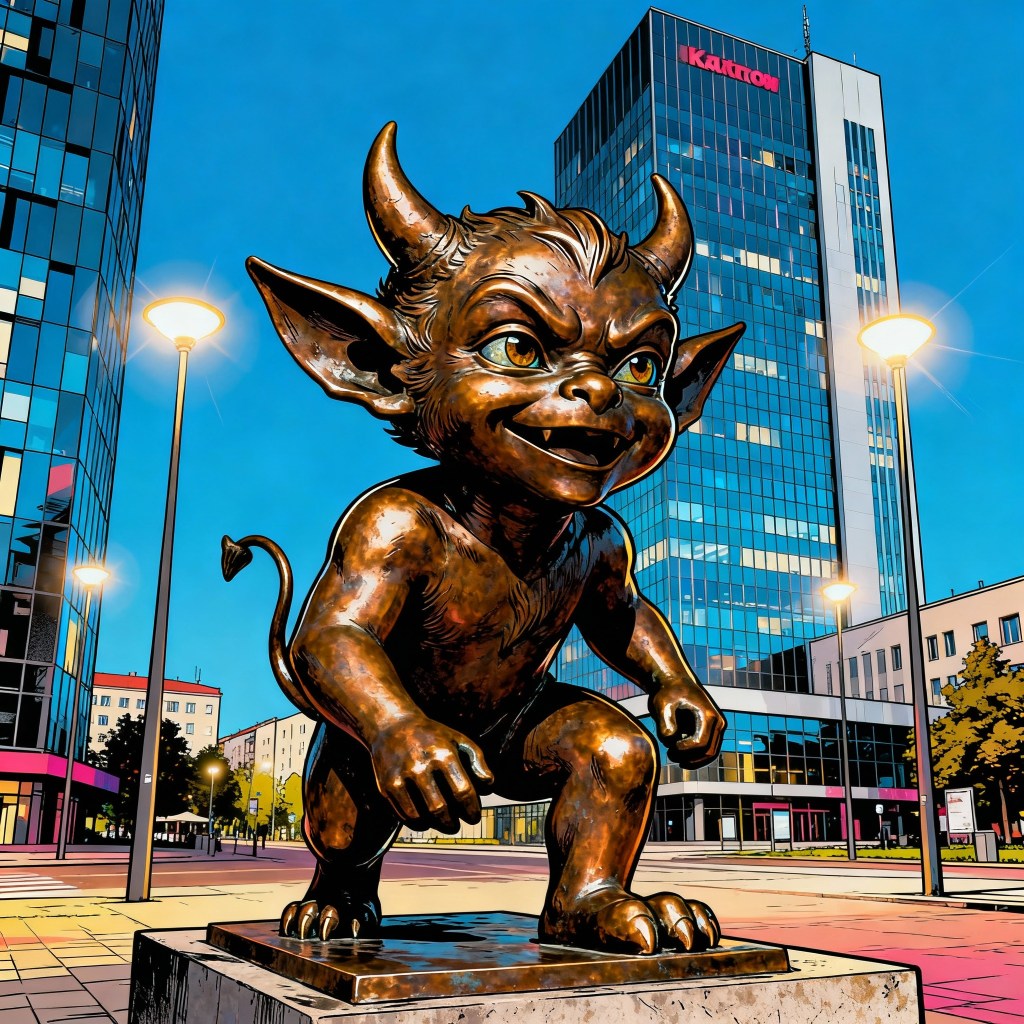
Bebok figurines scatter through the streets like breadcrumbs from Slavic legend—sly little bronze creatures, part demon, part city mascot. Each one frozen mid-mischief on a bench, a station railing, or even perched above the hotel lobby couch. Sandi pauses to snap a photo of the Wanderer Bebok, suitcase in tow—a traveller much like ourselves.
The hotel is slick, all industrial chic and coded access, but friction surfaces at check-in. Mrs H has prearranged twin beds for me and Sandi. Bartek, grinning under his man bun, gets tossed with Karim, though the glance he throws Sandi doesn’t escape me. The receptionist, flustered by foreign names and Mrs H’s precise instructions, fumbles for comfort. I note the bebok magnet on her desk: mischievous luck, or a warning.
Upstairs, the evening strains. Sandi orbits Bartek with a denial so transparent it ought to be ceremonial. “It’s only logistics,” I deadpan, catching how her eyes linger past Bartek’s door. Karim, pragmatic, shrugs: “We follow orders. Then we improvise.”
By midnight, improvisation finds us. Sandi slips out—a whispered exchange with Bartek, and suddenly Karim is booted. He knocks gently on my door, bebok shadow winking across the hallway carpet. “Your hospitality is required,” he says, mock-formal. I gesture him in, quipping, “No harm, no foul—just don’t snore like a coal train.” Karim laughs, settling on the spare bed.
For all the city’s surveillance, its ghosts, and shifting alliances, we find comfort in rearrangement as much as strategy. The beboks watch from their posts—impish, patient, waiting for the next bit of legend to ink itself on these Katowice nights.
That night, Katowice steams beyond the hotel glass, neon bleeding into drizzle, the city’s edges etched with bebok shadows. Sleep is shallow, a thin membrane: so I drift, half-waking, through a dream as sharp and metallic as the tracks we crossed that morning.
Perun appears: copper-bearded, shoulders broad as any oak, thunder lacing his words. He stands astride the skyline, hammer blazing, and the beboks scatter from his gaze like leaves in a storm. “Not all doors open to daylight,” he warns, voice rumbling through my bones. “Watch where you place your trust. Not every hand here is what it seems—and some roots twist deeper than any border.” His eagle drops from the clouds, shadow sweeping the city’s edge, and for a moment, it seems all glass and brick are cracked by the force of his prophecy.
I stammer back questions in a language older than memory—Slavic roots, fragmentary, tangled in lightning. Perun shakes his axe and flings it, bright and echoing, toward the horizon. “Steel yourself, Goddess of portals and keys.”
Suddenly I’m awake, pulse stumbling, the hotel shadows thick. Karim sits up, green eyes searching mine, concern sharpened in the muted early light.
“What language were you mumbling?” he asks, voice low—not intrusive, but rather a thread pulling me back from myth to flesh.
I swallow, shivering. “Old words. Warnings.” The edge of Perun’s command still burns behind my ribs.
Karim’s arms become harbour, bracing and gentle, and as I fold into him, the tremor ebbs. He doesn’t make a move, doesn’t press for closeness beyond what’s needed—a restraint that is both balm and puzzle. I wonder, in this coil of adrenaline and sudden comfort, if his gentleness disappoints me, or saves me. For now, safety is enough.
Outside, Katowice stirs, thunder muttering overhead—and somewhere, in the city’s restless heart, the beboks are still watching.
University Panel, Silesian University
I perch halfway up the lecture hall—neutral ground, faces below, exits mapped. From here, status arrays itself: professors knotting the front, students spreading out in nervous bands, curiosity graded by rank. The panel debates “Artificial Intelligence and Social Resilience.” Most of it is posturing: buzzwords ricochet off false acoustics while the city’s real vulnerabilities pass unchecked. Half-performance, half-thesis defence, I log the choreography for later field notes.
Sandi slides a program onto my knee, a student’s name ringed in black ink—one who’s been asking uncomfortable questions about surveillance. She’s slipped right back into ethnographer mode: informant, or simply another over-curious catalyst. Behind, Bartek tracks the crowd, arms folded, reading the field site in real time.
I sketch kinship diagrams in my notebook: who holds court, who signals allegiance. When Q&A opens, I lace a question about trust and monitoring systems—watching for who flinches, who parses the ambush. When “integration” lands, I jot: whose signals carry, and whose rituals are we serving?
Karim, consummate diplomat, pivots to migrant needs. Sandi nods. Bartek allows himself the faintest of grins.
CitySpace Face2Face, Business Incubator Mixer
Mrs H introduced me as an anthropologist and founder, all “cyber-resilience and migration” for the networking crowd. The incubator is equal parts English, Polish, Ukrainian, and start-up hunger. Territory is marked in accents: English, the lingua franca, Polish founders forming tight knots, migrants looping the room’s edges.
Waiting for espresso, I surveil the landscape: who’s new, who’s nervous, who code-switches to survive. Sandi melts into a group of migration-app founders. Bartek works the perimeter: more herder than participant.
A man in a polyester suit slides me a card: “CYcrds? Our system tracks migration patterns. Useful in certain… situations.” His speech is trained, but the grammar and tech jargon betray ambiguous loyalties. I accept, face settling into professional interest.
Sandi, low: “Flagged. Moscow’s signals are stronger than his handshake.” Our glances tangle—coffee is kinship, even here. Bartek is quick: “Take the card, but not his coffee.”
Walk in Nikiszowiec
Late afternoon, brick towers, laundry lines, the old city’s raw skin. I walk alone, reading patterns: students trading gossip by the curb, a girl in a battered shirt recounting border loss, hope stitched between grievances. This, too, is resistance, Silesian myth and politics looping hand-in-hand.
A Bebok statue slouches nearby, half-smirk in bronze shadow—a watcher, city mascot, silent sentinel.
Bartek approaches, tracing graffiti tags and encrypted wifi IDs. “Old city, new codes. Masks are sometimes safer than faces.” I nod, chronicling gestures, exchanges, masks: here, honest signals are precious currency, performance survival.
“Sometimes the mask’s all that’s left,” I offer. He inclines his head, agreement quiet as dusk.
Conference Centre, Breakout Session
Panels stack up: “Digital Talent Pipelines.” “Cross-sector Innovation.” “Migration as Opportunity.” Every session is ritual: greetings, coded intros, micro-boundaries. I mine the crowd for unscripted exchanges—a nod between rival HR managers, a surge of attention at the phrase “talent pipeline.”
Karim finds a young Uzbek mathematician, quietly weaving Hasna’s network. Sandi accosts me at the elevators, late and raw: “Don’t you ever feel like we’re the only ones not pretending?” Her mask is slipping at the edges.
I tap my badge. “Isn’t that the point?”
She laughs—a short sound stretching to the ceiling tiles. For a moment, the performative shudder of the day slips, and I’m simply myself: anthropologist, player, observer. Tonight, the masks hold, but only just.
False Names, Real Borders
Katowice greets me the last morning with a cold metallic slap—new tracks, glassed-in stations, banners for “European Capital of Science” flapping above a current of students and researchers. We slip through the crowds, our little band—Sandi’s posture loose but watchful, Karim hulking and restless, Bartek leading the way, his stride purposeful and oddly comforting, the flash of his man bun making him look like a Slavic trickster god in street clothes.
I keep a hand on the satchel at my hip as if that will keep my shape from dissolving entirely. Fake papers always scorch in my pocket—a security, but never a comfort. There’s a sour taste in my throat every time I approach a checkpoint. Today is different, though. Today, the forgery is only a bridge back to truth.
We find the fixer in the back of a dim café: all shadows and condensation. She looks exactly as I hoped: ancient, orange-coated, intent on her knitting and not on us. Bartek introduces us softly. Sandi stands just close enough to intercept trouble. Karim keeps his hands visible and his voice low. The exchange is quiet and deft. The fake Dutch passport slides across the table, followed by a far older, worn-edged document: the real one, at last. My fingers tingle as I fold it into my coat. No names are spoken. Babcia Zofia is already humming to herself, the next skein of yarn beginning to unravel.
I stare at my new-old passport, the crest and language both shield and semaphore of who I am—at least, officially. But it’s more than legality now. In this age, citizenship is a geopolitical performance: you’re Dutch, or Polish, or something else, but above all, you’re a symbol, a playing piece on someone else’s board. The Kremlin flings out passports like bait for propaganda. Border states issue new citizenships for demographic leverage. Even Mrs H’s “Global Talent” visas are careful currency, every passport another signal, a declaration of belonging you may or may not feel in your bones.
Bartek cracks a joke about how his own credentials have so many stamps they look like abstract art. I laugh, unexpectedly and grateful. There’s warmth in the way he anchors himself, the way he glances at Sandi—not just measuring the room, but the heart as well. I see her glow a fraction, and it’s contagious.
We step out into the drizzle, neon reflections pooling on wet stone. I watch as the water beads on the passport’s red cover, absolute, unambiguous, for now. The relief is visceral. The fear recedes, just an inch, leaving behind room for something like hope. I think about the people across this continent—trading names and allegiances, watching leaders weaponize citizenship as both gift and threat. About Russia’s millions of passports flung at occupied cities, about people who never wanted a new nationality but found themselves rewritten by decree.
I’m luckier. I have chosen, at least for today. And in this city remade for science and renewal, maybe I can begin again, too.
Bartek catches my eye, hands in pockets, cocky and irrepressibly beautiful in the heavy Katowice air. “Ready, Dutchwoman?” he asks, and I know he means more than the question. Sandi nudges me playfully; Karim rolls his eyes but beams.
I slide the passport into my inner jacket pocket, close to my heart, and follow them out toward the busy plaza—shivering, maybe, but walking forward anyway. If borders are performances, I choose this one with intention. For the first time in months, I feel like I’m moving not just away from danger, but toward myself.
I.Ph.
 The C.O.M.C. Files