
“Rites, Rituals and Backlash”
Warsaw wakes restless and silvered under an early rain. Markets fill, trams jostle, and from my hotel window, the city’s rooftops shimmer like scales in a river’s dawn. I linger at the glass, recalling the story of Wars and Sawa—the fisherman and the mermaid who, in the city’s soft heart, shaped it with their unlikely love.
“This is a city born of dualities,” I murmur, watching the Vistula’s slow, patient flow. “A place where hunted becomes hunter, where every legend has its shadow.”
Sandi is already up, shoulders drawn tense. The phone on her dresser lights up with another encrypted call. I catch snatches: Finnish, tight and urgent tones—Kalevi, barking warnings, frustration worn thin. Each conversation leaves her more brittle. I offer coffee, feigning nonchalance, but her eyes are far away, stranded between Helsinki’s invisible pressures and the realities here in Warsaw.
I slip out before breakfast, boots echoing on wet cobbles, and let myself vanish into Stare Miasto. Moving through Old Town feels like stepping through a fable. Statues glisten under drizzle, mermaids carved and cast in every square. I find the brass Sawa near the market, water pooling around her tail, trident raised toward some distant threat. I imagine her watching over the city—a protector, or perhaps a reminder of what’s lost when we let others write our stories.
The Legend
There’s a story they tell in Warsaw, one of kings, fishermen, and the beginnings of cities.
They say that long ago, King Kazimierz Odnowiciel travelled upriver by boat, led by the scent of home-cooked food wafting from a lone hut on the banks of the Vistula. Drawn ashore, the king found a humble couple—Piotr the fisherman and his wife—who welcomed him without question and fed him from their modest table.
During the meal, the couple confessed their trouble: they had twins but no priest to baptise them, and the king’s gold, offered in thanks, was gently refused. Their worry was not wealth, but blessing.
So the king took it upon himself—he stood godfather to the twins atop a hill, naming them Wars and Sawa. He promised the fisherman lordship and foretold that someday a great city would rise here, carrying their names as one: Warszawa.
The lesson is simple enough—sometimes a city is born not from conquest, but from hospitality and faith. And when the powerful give, it is the humble who shape the world.
The Operation
By noon, I’m busy with my cover and lover: CYcrds, with its digital armour, endless passwords, and the thinly veiled British chaos that Mrs H orchestrates from her office above the Thames. Her voice on the encrypted chat is crisp and sly: “You’ll need more than an alibi, Elena. Helsinki’s watching you and Sandi with both eyes.”
The plan is reckless, but we’re running out of safe moves.
For distraction, I lean on my oldest friend, Marina—the one with a knack for making headlines, who coughs blood. Together, with Mrs H’s blessing, we orchestrate an international academic incident right in Helsinki: a controversial research leak, deliberate enough to ignite outrage in the Finnish press and spark debates in Parliament.
Hasna amplifies the gossip from Brussels, suggesting corruption and espionage, until the scandal billows wide enough to force attention away from Warsaw.
The backlash is swift. For all his self-importance, even Kalevi must answer to his own masters. I watch from a Warsaw café as Sandi’s phone rings—another call, but this time, her features blur with relief. She listens, then closes her handset, lips parted in disbelief.
“He’s leaving,” she whispers as I join her. “Kalevi—he’s called back to Helsinki. There’s been… something at the university, the Ministry—he’s needed.” She exhales a shudder, some of the grief finally leaving her posture.
But even freed from his immediate oversight, Sandi isn’t whole. SUPO’s shadow lingers. “A trail doesn’t vanish,” I remind myself. “It only dives deeper—like Sawa herself, disappearing beneath the river, singing warnings to those who listen.”
Bartek arrives as dusk pinks the riverbanks, his gait all confidence and local strength, strapped, codes in his eyes. With a single handshake, the balance shifts; the Poles will not be muscled out, not by Finns or anyone else. With Bartek beside us, I sense the city’s old protections knitting tight around our plan.
Back in my room, I sit with Warsaw’s myths—the stories that shape and shield. I remember the legend: when the city is threatened, Sawa will rise from the Vistula, defending Warsaw tooth and fin. Today, my defence is not scales or trident, but myth and memory tangled with strategy. I think of Sandi, free for now, of Mrs H in London spinning new webs, of Bartek’s presence shoring up our odds. And of myself—neither mermaid nor fisherman, but something in between, swimming through new legends in the making.
The city quiets as midnight comes. I stand at the window, whispering thanks to the river, to Wars and Sawa, to the stories that guide the lost and hunted home.
Clearing Winter’s Ashes
Sandi’s Perspective
There’s a scent in the Warsaw air that smells almost like hope—river wind and the whiff of burnt bread from the stands on Krakowskie Przedmieście. I’ve managed another morning pretending, another new beginning. The sting of Kalevi’s betrayal and abandonment still hurts, but truth be told, it was just a mask slipping. I’m still in the game. CYcrds likes its ghosts, and I like being one, especially now that the light is changing, everything in motion again.
Bartek stands half a head taller than Karim, broad in the chest, wildness flickering at the corners of his smile. There’s a sense, at first glance, of some ancient shepherd reborn—mischief braided through sharp blue eyes, a confidence as old as the city beneath our feet. The ghost of a faded tattoo winds his wrist; old scars blur into tanned skin. Most of the detail blurs in the crowd, yet Bartek draws eyes, laughter, and choices the way others draw weapons.
He watches crowds with the reverence of a man trained to interpret threat and opportunity, posture easy but never inattentive—always alert to exits, faces, the invisible map of street and story. If he is the wild god of this place, he’s traded pipes for lockpicks, old songs for silent boots—a Pan for the era of wiretaps.
I can’t decide if he unsettles or reassures me—maybe both. When he glances my way, wind tossing a single strand loose from his tied hair, he winks: camaraderie edged with dare, as if inviting me to claim a patch of myth on these shifting banks.
Bartek is insistent—today, he leads us into Polish tradition. “You and Elena, both of you, need to see life, not just code and corridor,” he says, all teasing warmth. Every glance in my direction jolts my heartbeat like a dare I want to accept.
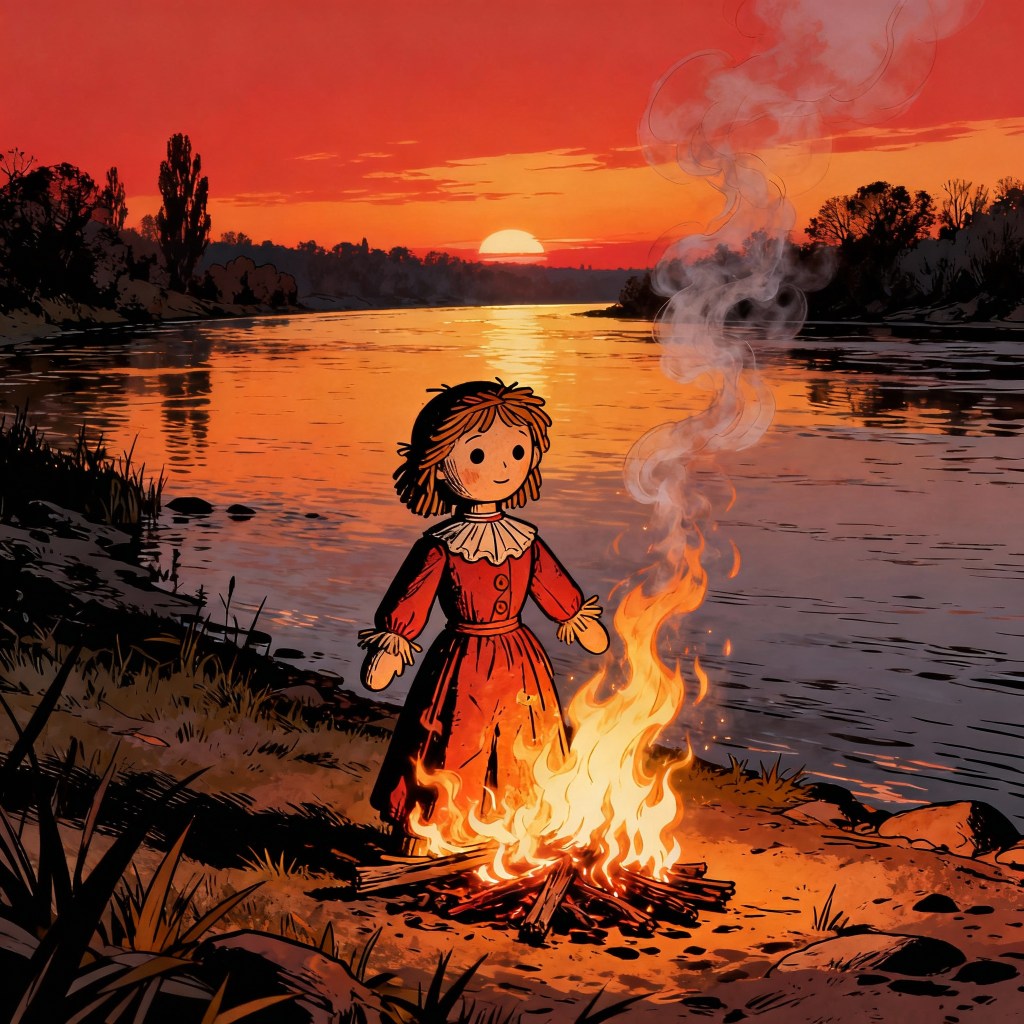
We walk along the banks of the Vistula, where Warsaw stirs with families and old traditions. Someone’s built a Marzanna doll—flaxen hair, gaudy skirt, straw shaped to carry winter’s ghosts downriver. Elena lingers on the edge, coffee in hand, watching everything and nothing, slowly letting the layers Helsinki forced upon us slough away.
Children chant, pots clang. A girl in crimson sets match to straw; the Marzanna’s features blacken and curl. Bartek translates, voice low, a grin blooming: “It’s a way to say farewell—winter, famine, loss. Set it alight, send it downriver, and hope spring’s brave enough to come.”
I join the crowd, drawn forward as ritual and city blend—Bartek’s laughter loose as he helps a small boy shield the flame from the wind. He is of this place, bridging folk myth and the sharp present, the kind of man you want at your back when the season turns.
“Elena!” I call, and together we watch the children hurl what’s left of the doll onto the river. Ash floats before sinking, dragged by the Vistula’s current, leaving hope to bob downstream.
Beside me, Bartek brushes my shoulder. “We do this every year. Never gets old. Next winter always comes—but so does spring.” For once, no games in his voice—just belief, open, simple, and real.
Karim uncaps a thermos of warm vodka, passing it round. The heat blooms in my chest, laughter rising unforced—a rare, true thing. For the first time in weeks, I don’t feel like a ghost in someone else’s story.
As the sun bleeds pink over the water, I realise I am here—now—edge of Warsaw, making room for a new season. Bartek’s hand finds mine briefly when no one watches. I don’t pull away. A new beginning. Let the river take the rest.
Author’s Note
Freedom, sometimes, is less a triumph than a quiet change of weather—a door opening onto unfamiliar ground. Sandi slips loose from Kalevi’s hold, finding steadier shelter than she expected in Bartek’s arms. Even safe, the heart can still travel old routes, mapping its own compass in secret.
Not every escape ends where we once dreamed. But there’s grace in landing somewhere kind, even when a part of you drifts for distant shores.
In the end, the river takes what we offer it: our fears, our worn-out masks, our careful distances. What remains is simpler—the weight of a hand finding yours in the crowd, the sound of genuine laughter after weeks of pretence, the quiet courage of letting spring arrive despite everything winter promised would last forever.
May your freedom be of choice.
I.Ph.
 The C.O.M.C. Files