
“Brewing burying the Bear”
They talk: delicate jabs, laughter too quick for a funereal setting. I watch Sandi glow and falter; she glances back every few seconds, tracking Kalevi among the SUPO delegation. Bartek’s touch on her arm, mid-story, lingers, unclaimed, and somewhere between promise and warning.
I slip between power circles—women who run continents, stiletto heels clicking, languages flipping faster than alliances. I tell the president’s deputy that civil society holds firm; I promise a Ukrainian activist the convoy’s safe passage. Each handshake, every whisper is a negotiation: who will hold the invisible lines after Jadwiecka’s inconvenient death?—the matriarch whose absence everyone here now rushes to fill—and the power scramble already bristling in the cold spring air. Instead, I keep track of loyalties, glances, whispered threats. Who will stand for Ukraine, or for their own brittle peace, when the crowd thins?
I’m supposed to keep my head down, avoid the fallout, and feel the power tension rising with the cold spring air. But instead, I catalogue loyalties, decode glances, log whispered threats. I text Hasna the moment a White House attaché crosses a line, memorise Scarleted Glove’s face as she raises a perfect eyebrow at Kalevi and draws Sandi into her orbit.
By the time the flowers droop and the room empties, the weather has already shifted—rain to sun to sleet, as if the air itself holds its breath for night. I spot Bartek still at Sandi’s side, Sandi’s laughter lower now, Kalevi’s glare burning through their little enclave.
I keep moving—tuned to the dangerous poetry of the city’s new spring, acutely aware that history, sex, and power are never done rewriting themselves.
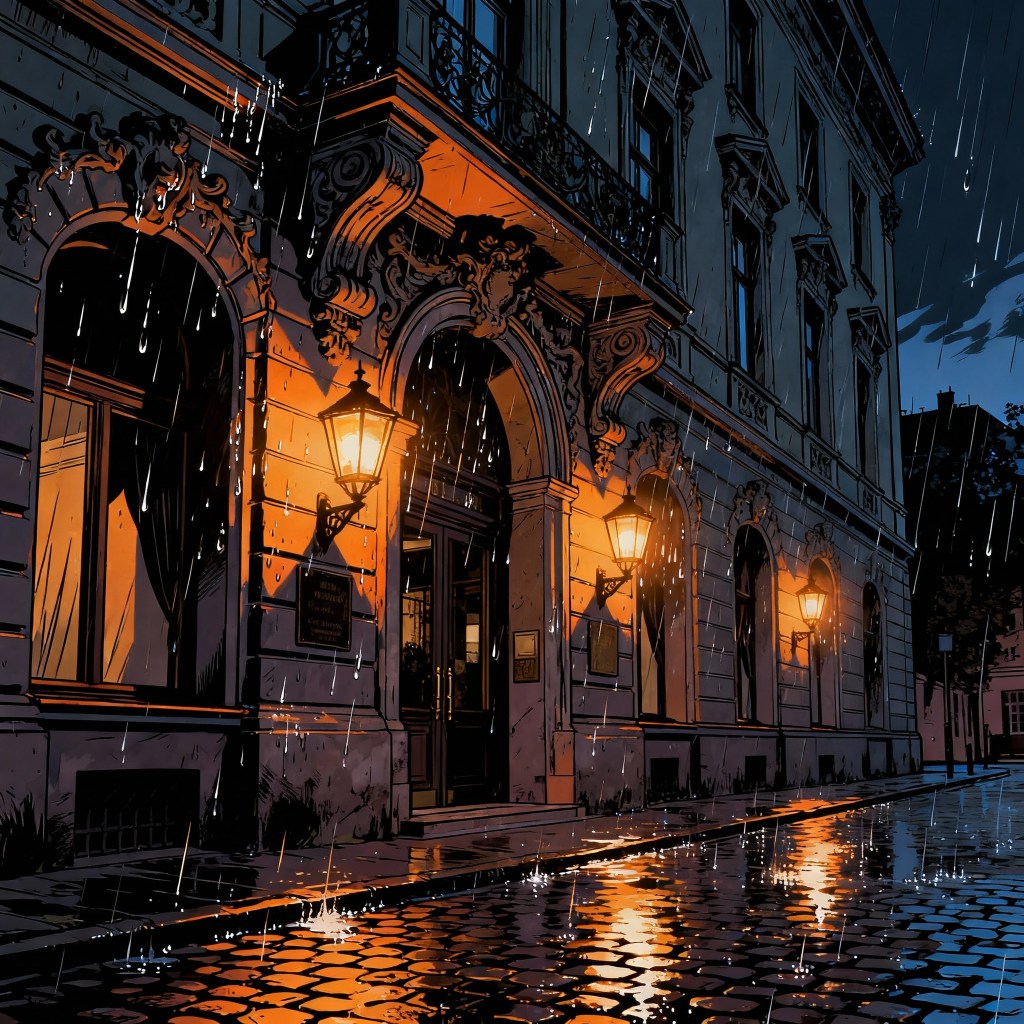
We check in at Mamaison Le Regina, a baroque palace modernized with steel and hush, the kind of place where intrigue prefers velvet curtains. Karim complains about parking but gets no sympathy from Sandi, who delivers clipped politeness to the desk staff like she’s clocking in, not arriving. I hand over my fake passport, counting the minutes until solitude.
Karim takes a single across the hall. Sandi and I, by apparent necessity, land a twin: pale linen, a velvet armchair, a window overlooking ivy, lanterns, the city just out of reach. The air is sharp with new soap and old secrets.
As soon as the doors split us—Karim trailing an exhausted good night—I make for the bathroom and let myself unspool. Funereal black peels away, each layer scraping more bruise than skin. Sandi sits on her bed, back to me, face lit underground-blue by her phone as her thumbs work out frantic messages.
The shower’s all white tile and temperamental heat, darting from scald to chill. I stand under the spray, letting the water be a shield between me and everything outside—the funeral, the unsaid winding in my chest, Sandi’s brittle absence.
Something in Sandi has changed with every call from Kalevi. What was once Finnish warmth is now brittle, laughter honed to a blade by fear or anger. I don’t trust how Kalevi talks to her—too paternal, too soft where steel should be, tangled with guilt but never true accountability.
I close my eyes, pressing my head to the steaming glass. It feels like we’re all being hunted—by Poles, by Russians, by memory. Tarmo stirs under my skin, his name sharper than expected. Not just the fear from the funeral, but the echo of his voice, teasing, warning, fighting, comforting. I remember his hands—calloused, certain—tracing known lines along my waist. A surge of longing pulses through me, a reminder of how easily the body betrays the mind.
I’m suspended between Helsinki and Warsaw, torn by invisible lines, pressed down by Kalevi’s benevolent tyranny. I hate his voice now—the way it softens when he wants Sandi (and me, by extension) to obey.
My thoughts drift—Tarmo’s memory sliding in, turning ache to hunger. The water hides the rest: distance, Sandi’s silence, the world outside. I let my hand slide down, finding small release in memory’s comfort and escape, breath catching as pleasure flickers up my spine. Tarmo’s mouth, the weight of his thigh, the shock of wanting what’s lost. Two fingers, a harder current, my other hand steady against the wall, and I let myself go.
When I emerge, breath slowing, mirror clouded, only Sandi’s restless steps sound from the other room. I cross in my robe and pause by the open window. The city is blanketed in dusk, wet gold, the streets holding their breath at the edge of night. I breathe deeply—alone but for Sandi, a dim, bruised presence in the other bed, her face half-glowing in the phone’s blue vigil.
A coded message pulses in my encrypted channel.
American anticonceptive pills, misdirected and boxed in a Gdańsk warehouse—intended for fire, now hope for Ukrainian women. My job: find a route, make the handoff, trust no middlemen—the wrong touch could burn us all.
Contacts surface and sink: Polish nurses, Ukrainian couriers, a Baltic woman with a suitcase of passports and burner phones. The network waits on me, expecting the right word to slide pharmaceuticals through the cracks nobody will own.
Sandi is changed—alert, haunted, checking her phone, snapping at small things, waiting or dreading that next message. Is it Kalevi, boss turned stalker, voice softening with every “For your own safety, Sanni,” carving her in half between Helsinki and Warsaw? Or Bartek, the Polish man from the funeral? She vanishes too often, returns carrying cold air and frustration, and half-answers my questions about the handoff.
I send my own messages, ready to push the transfer without her if I have to. Ukrainians trust me—just barely. Every step holds risk: border checks, betrayal, Russian eyes.
After midnight, Sandi wakes me.
“We have a problem. Kalevi’s tracing the network. He says what you’re doing is too visible, too personal. He wants me in line, but I can’t keep everyone happy. Not this time.”
I lean into the pillow, tired but resolute. “We make everyone a little unhappy, and do the right thing anyway.”
She nods—doubt dimming her, but faith flickering just beneath. “Tell me what to do, Elena. I’ll follow your lead.”
I feel a plan brewing for Sandi’s freedom: if I align the right conversations and shift the known pieces. I’m nearly bouncing on my heels, grinning and feeling giddy. Hold your horses, Elena, I tell myself. Gods below: what am I, a schoolgirl? Behave, Elena Behave!
I.Ph.
 The C.O.M.C. Files