
“On the Road & Mission anew”
Spring tumbles alongside the car window as Poland balances gorgeously between thaw and riot. Green fields ripple from Gdańsk to Warsaw—birch trees shaking off winter, ditches foaming with white blossom—remind me of a Szymborska stanza: “Even a passing moment has its fertile past.” The poet knew that beneath every surface, absurdity and beauty hold hands, ready to flower by surprise.
Karim, front left, drives as if soundtracking the trip. He hums under his breath, gaze flicking from the road to every new miracle of April. I think back to Dakhla—the desert heat, wild nights, intense love that felt like riding a dragon without a saddle.
Sandi’s up front, glued to her phone like it’s a lifeline or a ticking bomb. Sometimes she shoots glances my way—sharp, accusing, or just measuring how many words she can type before she snaps. “Who knew the serious professor could survive the cougar phase?” I muse silently.
A year ago, I was worrying about which manuscript deadline would kill me first. Now, look: love affairs like train delays, trouble multi-coursed, sexual identity a question I answer with laughter. From young Ciro and his Neapolitan sonnets, Marko and his unrelenting draw, to Karim’s stamina in Dakhla’s dawn and sand, Tarmo’s stubborn refusal to move on, to my own Finnish fury at this trip. Gods, plural, clearly run the calendar of my heart. Maybe I’m just making up for fifteen years without intimacy.
Am I an anthropologist? Cougar? Queer accidental adventuress?
I stifle a laugh, feeling the road rumble beneath me and my whole beautifully ruined heart right along with it.
“I prefer the absurdity of living poems,”
I think, echoing Szymborska, “to the absurdity of not living at all.” All these years, all these identities, fields blurring into forests—maybe there’s no name for what I am, except someone alive enough now to laugh at the way desire and memory and Polish spring all insist on blossoming at once.
I snort softly. Maybe the gods really do intend for love to be messy, complicated, and undeniably fun. Because if this is the price of adventure, I’m all in.
The road hums beneath us. Karim’s reflection catches mine in the fractured glass of the rearview. Sandi’s sighs punctuate her texts, sharp and restless. Out beyond, clouds rush, fields glow gold at their edges. And in this moving frame—absurd and whole—I finally understand: every beginning is only a sequel, and the book of events always opens in the middle.
So I let my smile bloom. On this April road, between thaw and riot, desire and memory roll on—messy, complicated, undeniably fun. The gods aren’t finished with my heart, and I’m not finished with living poems.
For a moment—here, now, reflected and unfinished—life really is enough.
Sandi sits motionless in the front seat, Kalevi’s words buzzing onto her phone, one after another. Even the spring light can’t bleach the visceral sense-memory they summon. Her thumb scrolls, replies.
My phone vibrates in my palm again—another message from Kalevi. My jaw clenches. I read it; anger sparks behind my ribs, but my thighs tense anyway—that old, loathsome anticipation. I hate that he knows exactly what my body does before I do.
He was always obsessed. I saw it in how his eyes tracked me across briefings and meetings—the sharp lines of my shoulders, the taunt of my hips, always lingering on my chest, the shape he called, “perfect for bruises, perfect for bites.” He claimed my breasts drove him mad, small and high: “striped like a girl’s, but with a woman’s fire inside.” Whenever he could, he’d sneak his palm under my shirt, fingers rough and greedy, kneading until my nipples strained under his touch, until I gasped or twisted away. Always, he’d just smile—thumb tracing circles, whispering that nothing, absolutely nothing, turned him on more.
He could read my body: the shallow breath, the heat on my skin, the way my thighs tensed even as my face said no. “You say you don’t want it, Sanni, but your body tells the truth.” If I objected, he’d double down—pulling me close, locking an arm around my middle, mouth hot against my ear: “Let me in. Just let go. You love it—you’re made for this.”
Even when I didn’t want it—even when my mind was a scream or a locked room—my body betrayed me. He’d press me down on his desk or pin me against the cool wall, hands hungry, undoing my jeans, sliding them down just enough. There was never space to refuse. His cock prodded at my entrance, hard, impatient; all I could do was let him in, let him fill me, his hand always clamped over my breast, squeezing, pinching, turning pain into arousal without asking.
He made me come fast, with anger, humiliation, that sick pride whispering at least this was real—at least the wanting, the wetness, the helplessness were mine. Claimed, used, alive, even if rancid after.
Sometimes I hated him. Sometimes, he made me feel no difference between wanting and being taken. After, I’d lie in my sweat, nursing bruises on my chest, nipples stinging, cunt aching—fighting that awful voice: “He knows. He always knows.”
Even now, with his texts lighting my screen, my hand drifts up to cup my breast, feeling that raw, relentless heat. Memory sharpens: his tongue, his bite, the way he’d tug and twist until I whined, until I gave in.
How is it possible to want out and want the memory all at once?
I press my legs together in the front seat, heart pounding, wishing desire were simple. I wonder if Elena ever feels this way—wanted and obliterated, possessed and too alive to run.
I drive with the window cracked, letting Poland’s April seep in: new crops, wet earth, that stubborn green makes you think anything’s possible if you just keep moving east. I watch the world in blurs and reflections—mostly the road, sometimes the way sunlight glances off Sandi’s hair, or how her shoulders stiffen each time her phone hums.
She’s not herself today. At first, I think it’s Elena in the backseat—all her secret smiles and history—but then I catch Sandi’s hand drifting, almost shyly, up to her chest. First, just a brush, then her palm presses slowly and sure, lingering like she’s testing for a secret.
She’s forgotten that anyone can see her. That’s rare for Sandi.
I can’t help but glance—just long enough to imagine old stories. Only a year ago, I spent my days guiding tourists until I started working for Hasna, following Elena. I fell hard and deep for her. Is Sandi thinking of her moments with Elena, the lover she wants so much, but can’t always have? Welcome to the club. I wonder what memory pulls her under, if someone’s voice echoes in her head, if she carries shame or just an old ache.
Can’t say I haven’t been there—half-daydreaming at the wheel, wanting to bridge the impossible distance. But I don’t say a word. I drum my fingers, whistle a worn-out Rai song, pretending not to notice how deep Sandi’s gone—wherever she’s gone.
“All ok, Sandrine?” I toss it out like a joke, eyes on the road, but half of me hopes she’ll say she’s alright.
She snaps back, hand retreating to her phone. “All good. Just a long drive.”
I nod, grinning, and file it away—one more piece of the beautiful puzzle I’ll probably never solve.
Elena coughs behind me. The air in the car is thick with what we don’t say, and what we might, if we ever got foolish or lucky enough.
I watch the birches rush by, thinking how complicated women are, and how lucky a green-eyed stallion is just to orbit them—waiting for one more moment to mount the indomitable one I want.
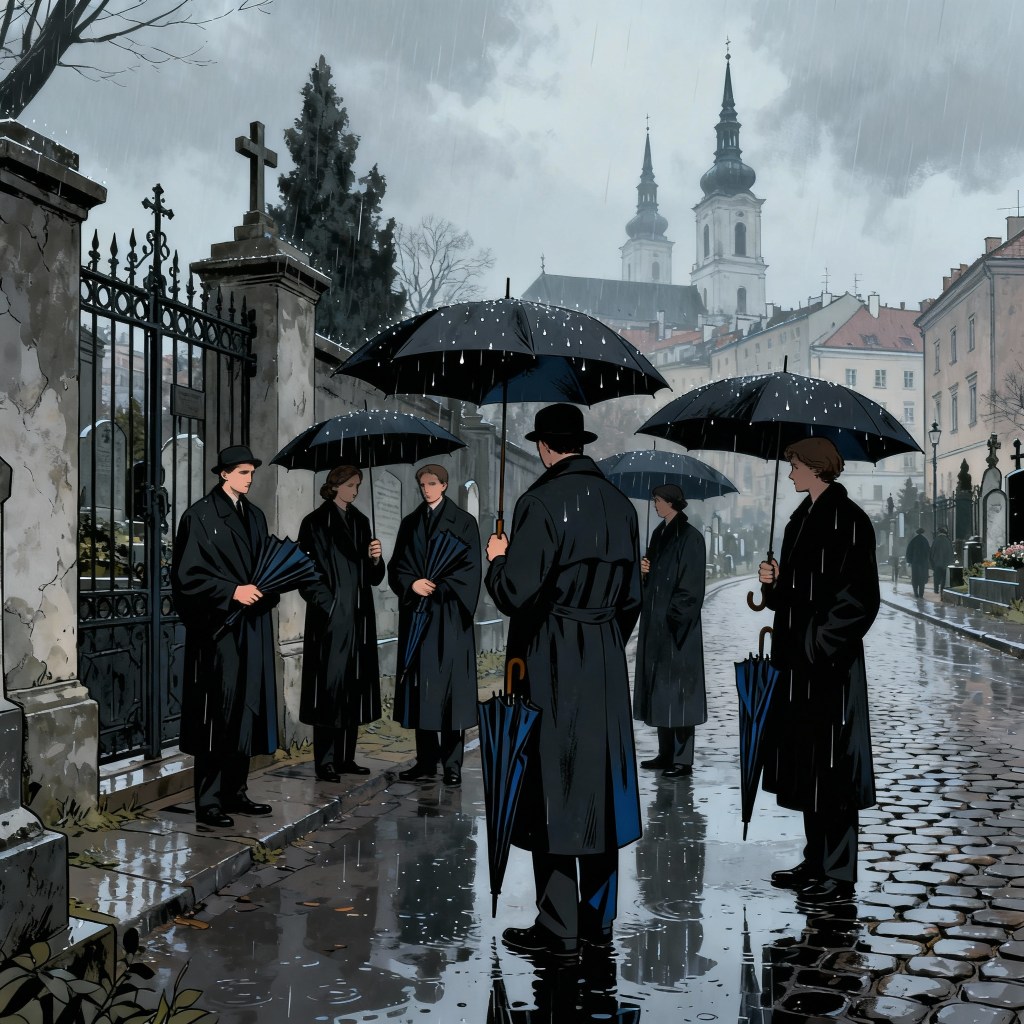
Warsaw greets us with a slap of cold air and high, uncertain clouds—the kind of spring beloved by poets and mourners, promising one thing, delivering another before lunch. Warsaw in mourning isn’t a city of silence, but of old money pitted against new ambition. Black cars cluster along Ujazdowski Avenue, tailpipes steaming in the rain, as if Poland’s entire past has gathered beneath wet umbrellas to watch itself being buried.
The sombre arch of the Jewish cemetery gate: for a moment, I am Pan Doktor Delange, summoned to the city’s cracked heart, briefed on the run by a burner phone ticking with British awkwardness, French flirtation.
Karim, loyal to his comic timing, doesn’t open my car door at the address—an old habit, whether for OpSec or my pride. Instead, a woman from the network helps me out, her elbow under mine, gentle, faintly reverent.
Do they think I’m old, or just carrying the visible fatigue of too much forgetting? For a blinding second, I am both: relic and tool, professor and impostor.
Sandi’s collar is turned up, her lips a hard line; I can practically taste the storm clouds between her and the waiting cohort of men in black wool.
Want to see real power? Watch how women hug at Polish funerals—one arm loose, the other shielding a phone. Sandi is on my right, beads of rain caught on her lashes, posture too straight for comfort. Karim is somewhere behind, managing our shadows.
Kalevi is unmistakable: black wool, a SUPO lapel pin glinting, a smile that bites. His presence makes Sandi taut, her focus knotted. I see the old lines between them: history disguised as loyalty, or something twisted, more complicated, harder to break.
He’s here “for protocol,” but his gaze barely leaves Sandi. Mentor. Shadow. The man who made her career never let her forget it, whose jealousy now sours the air more than the drizzle. She keeps her distance, eyes darting—a dance I know too well. Her phone is silent, but every muscle is tuned for trouble.
Jadwiecka Morawiecka’s funeral is a master class in Polish power theatre.
As the casket is lowered, I shake hands with lawyers, politicians, and three women who will dine with the president tonight and pass Polish law tomorrow. All seem to know me already, or at least know I am someone’s secret. For once, that feels like a shield. Female senators, heads of NGOs, government whisperers—each veiled in black, umbrellas as artful as armour.
Sandi navigates the solemn throng—never more than a step from my side. I wait at the margins, mostly invisible, half-hoping for boredom.
Instead, Bartek appears at the edge of the crowd—blond curls tousled, pale brows arched with a kind of native Warsaw irony. He moves lightly through the funeral’s formality, his jacket too thin for the weather but unimpressed by it, hands thrust in pockets as though he owns whatever street he walks. There’s something effortless about the way he surveys the scene: amused, alert, faintly conspiratorial. His eyes are quick, taking in who’s real and who’s performing; a flicker of a grin at Sandi says he knows both games and plays neither too earnestly.
Bartek’s presence is bright, local, and almost lawless—someone you’d trust with your secrets, but never quite all the way. His conversation is more of a sparring match than a seduction. Sandi’s eyebrows lift, wary and surprised. Her posture shifts, wires tightening then slackening, as if with a glance, he’s reset her nervous system.
Author’s Note
If you made it through Sandi’s existential gauntlet today: congratulations, you’ve survived the emotional Gdansk-Warsaw express: no refunds, but all sarcasm freely dispensed. Today’s chapter is a messy, necessary detour into freedom; Sandi’s breaking out of old patterns, and believe me, she didn’t ask for my permission.
As always, I promise awkward truths, rogue desires, and no magical cures—just a lot of stumbling, fighting, and (maybe) laughing at ourselves along the road. If her journey felt raw, hopeful, or a little too relatable, let me know; bonus points if you caught the gallows humour under the rain.
May you always flow, onwards or sideways.
I.Ph.
 The C.O.M.C. Files