
“The Artery Between”
I wash my hands twice before picking up the phone—ritual, not hygiene. Crossing a river at night is easy compared to crossing back into the currents of my own alliances.
First call: Hasna. She answers on the third ring, her tone clipped, the thrum of a foreign airport in the background.
“Did you make it?”
“Alive,” I confirm. “And working.”
Static crackles—then her voice, laced with dry affection: “Don’t be clever, Elena. You crossed a real line this time.”
“Could be worse. I traded favours for solutions. The women here are serious. In return for their help with Narva, I’ve promised myself as—what?—consultant, accomplice, bridge-builder. All the things that give you headaches.”
A long silence. Finally: “If anything goes wrong, you call me. Not Mrs. H. Not your Viking. Me.”
“Yes, mother.”
She hangs up on my smile.
Second call: Mrs. H. By the sound of it, she’s already had her third coffee and is prepping a speech for the Swiss consulate.
“Elena. Where are you?”
“In Russia,” I answer, skipping the apology. “I need help moving eastward. Quietly.”
There’s a hiss, a flurry of typing, and a sigh heavy with irritation. “You’re a unicorn in a black bear’s territory, you know that? All right. Leave your phone at checkpoint Delta when you move, and collect new credentials at the usual bakery. I’ll smooth what I can. But if the Kremlin catches wind, you’re on your own.”
“Appreciated. And Mrs. H—tell Zurich I’m not defecting. Just making good on a promise.”
A pause, dry as a winter gust. “Just don’t make a habit of it, my dear.”
Last: Tarmo. I stare at his name blinking on the cracked screen longer than I’d like. This is the call that demands not just information, but skin, blood, regret, and anticipation. When he answers, it’s with a sharp inhale—no preamble.
“Elena.”
I steady my voice. “I’m calling because it’s the right thing—not the safe thing.”
He remains silent, but every pulse on the line carries an edge. “You’re not back in Estonia, which means you’re in Russia—and before you start, I’ve done the risk calculations.”
“Let me do mine, Tarmo. I didn’t come this far just to break rules for fun. The women here—Nurgjeta, Ludmila, others—they’re the only reason I might be able to fix Narva. In return, I promised to help them build a network reaching Petersburg. Reciprocity, not recklessness.”
His voice, when it comes, is low and dangerous: “You’re asking me to trust that your intentions count for more than geography. That you’ll survive long enough to keep it.”
“I’m asking you,” I answer, softer now, “to trust me. And to wait. The world here runs on negotiated debts, not declarations.”
He breathes out—a sound weighted with everything they haven’t spoken.
“If you end up in a cage—or disappear altogether—”
“I know,” I cut in, gentle but final. “I’ll call. Or I won’t, and you’ll know.”
Something like a bitter chuckle precedes the silence, but I can almost feel his hand pressed to his face, the old warrior’s prayer for luck he’d never admit to praying for me.
“Be savvy, Elena. Just this once, don’t be naive and be astute and come back.”
I pocket the phone, feeling the sharp freedom of having crossed too many bridges to turn back, and the strange ballast of being accountable to everyone while remaining—finally—entirely myself.
By mid-morning, our plan to slip out smoothly begins unravelling in small, telling ways. At Kingisepp’s grim bus terminal, every ticket window is flanked by rail-thin men in boots and quilted coats, their eyes sharp for the wrong surname, the wrong kind of silence. Sandi casts one nervous glance toward the ID checks and mutters, “Not a chance. This bus ride would broadcast our faces to half the oblast by lunch.” We turn away quickly, shoving our forged papers deeper into coat linings.
After huddling behind the grimy kiosk, we settle on the train—a white-and-silver express, anonymous enough to avoid scrutiny, tickets paid in cash. The ride becomes an accidental classroom in invisibility, all plastic seats and communal wariness. We keep our heads down: I feign sleep, Sandi stares out the window at birch forests streaking past, and Karim, jaw set, reflexively checks the door, memorising every uniform that crosses our carriage.
As St. Petersburg approaches—that heartbeat city, always too grand and too haunted—my hands begin to sweat. The final ten minutes blur together: a nervous double-check of the passenger manifest, the silent, studied choreography of three people who know how to avoid a camera’s eye.
We spill out into the glittering chaos of Moskovsky Station—rush-hour humanity surging around us, the parquet floor thundering with thousands of boots and voices. I breathe in the familiar clamour, automatically cataloguing escape routes and blind spots. But as we pass beneath the domed atrium, something discordant catches my attention—a figure standing too still against the current of movement, eyes scanning the crowd with practised precision.
There, leaning by a pillar, coat immaculate, the buzzcut contradicting the bureaucratic shine, is Mikael. He holds a battered briefcase and wears an expression that is halfway between world-weary and sombre.
His eyes sweep over us—a millimetre’s pause on Sandi’s shoulder, a flicker for Karim, but he saves his silver-eyed gaze for me: one eyebrow up, mouth set in a diplomatic almost-smile.
“Research delegation from Narva,” he says quietly, cold as the river we left behind. “Lost compass. On time, even. Rare.”
His voice is pitched too low to threaten but too precise to mistake. I feel my stomach tighten into a knot, but schooling my face into professional neutrality, I reply:
“We aim to set a high standard for academic exchanges. I trust you’re here as the welcoming committee, not the inquisition?”
Karim shifts closer as if to shield me, but Mikael’s glance says I’m the only one who needs to answer.
“Welcoming committee.” Mikael extends his hand, and the grip carries a message: steady, unmistakably official, full of unspoken warning. He leans in just enough for me to catch the whisper meant only for my ears: “Tarmo sends regards. Instructions. Private discussion required.”
I nod, matching his pressure, old fieldwork reflexes humming. A moment of calculation: when your research trip concludes with an official escort at St. Petersburg station, you’ve either crossed every line worth crossing… or finally found the threshold worth defending.
Sandi tenses at my side; Karim’s eyes go flinty. But I can’t help but smile wryly—war, love, or fieldwork, the trick is always to keep moving forward.
“Lead the way, Mikael,” I say. “Let’s see what the new syllabus requires.”
St Petersburg
The black sedan—something German, armoured, the windows silvered against both street and scrutiny—glides out from Moskovsky station, swallowing us in soft leather and faint cologne. There’s a heavy, practised quiet between me and Mikael. Out there, St. Petersburg unspools with theatrical indifference: a city that has been both wound and witness, doomed and dazzling at every historical turn.
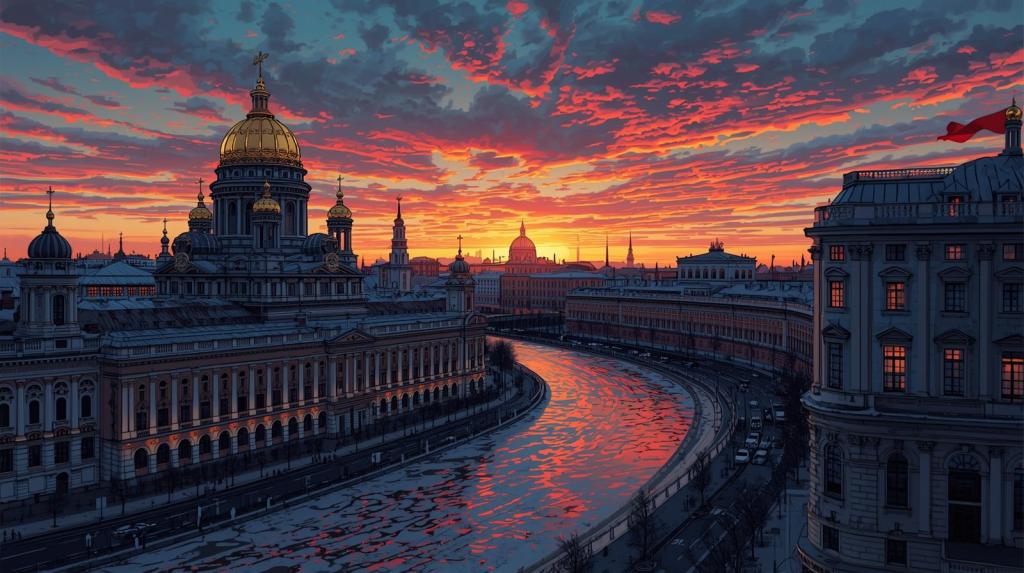
From the rear seat, I watch Nevsky Prospekt blur past—palatial galleries bright with gold, candy-colored churches nestled beside shops peddling nostalgia and plastic icons. There’s the sweep of the Fontanka, ice-crusted even now in late spring, bridging a world that never quite finished choosing between Europe and something far older, sadder, more beautiful.
St. Isaac’s colonnade rises through a haze of melting sleet, the dome half-lost in a sky the colour of old pewter. Soviet box blocks loom behind pastel façades. Everywhere, the city wears trauma as foundation and ornament, palaces wrapped in secrecy, pride, and the slight flinch of perpetual vigilance.
Mikael sits opposite me, hands folded loosely on his knee, gaze comfortably direct. He’s Russian by birth, but cosmopolitan in the way of men who’ve been everywhere under orders and never quite left home. There’s a gentle admiration in the way he watches me watch the city—not predatory, not proprietary; more companionable, the way an old stage manager might regard a clever (if slightly reckless) actress.
He breaks the quiet without breaking the mood. “Few visitors see it this way. Too many gaze upward… at history, at doom, at someone else’s meaning. But you—” his mouth quirks, “—you see the arteries. Spaces between intention and accident.”
I arch an eyebrow, filing it away. Fieldwork, he means, but also something more intimate—a recognition.
St. Petersburg drifts by, sunlight briefly glancing off the Winter Palace, a wedding party huddled for a furtive smoke under the golden spires of the Admiralty. A group of babushki pause at the crosswalk, bundled against the wind, stoic witnesses in the ballet of traffic and deferred dreams.
Mikael’s tone drops, professional: “City’s restless now. Too many promises, few rules. Makes it alive, yes, but dangerous. My job—manage both.”
He turns, pausing, gaze direct. “Tarmo’s investment in your safety, considerable.” There’s no judgment in it, only acknowledgement.
Under his breath, barely audible: “So is mine.”
I laugh quietly, the old survivor’s laugh. “Let’s hope it doesn’t come to that. There are things here even fire can’t remake.”
For a moment, the car slows beneath a row of lamps where the canal splits wide. Reflected in the dark glass, I catch my own face: equal parts foreigner, witness, and something dangerously close to belonging. The reflection holds my gaze—who am I becoming in this city of masks and memories?
Mikael glances out as if searching for the city’s pulse. “Not just following orders.” A pause. “Your judgment. Generally sound.”
I nod—none of this is lost on me.
The city breathes, a living archive of stone and water, and the memory of revolutions. And beneath that, the briefest sense of alliance—grounded more in mutual recognition than in duty or love.
We drive on, dusk falling, the black car just one more secret among thousands sliding across the old bones of St. Petersburg.
Author’s Note
St. Petersburg is what happens when history gets theatrical and politics decides to wear brocade. Writing this chapter, I found myself pinballing between awe and wariness—because in Petersburg, power and beauty aren’t opposites, they’re bedfellows. The city tests its visitors: can you admire the sweep of the embankments while knowing exactly who’s watching from the shadows, or do you blink in the glare and miss what matters?
I send Elena and Mikael across these thresholds not just to stir up intrigue, but out of pure respect for the dance itself—the old game of spectacle and subtext, charm and control. Mikael keeps things brief and sharp for a reason. Elena gets lost in metaphors because sometimes, in Petersburg, metaphor is survival.
If there’s a lesson here, it’s that beauty doesn’t soften the power plays—it sharpens them. Every facade hides a history, every avenue runs two directions simultaneously, and the most meaningful trust isn’t declared, it’s earned—sometimes in silence, sometimes in blessed understatement.
To the city that’s both stage and chessboard: you have my wary admiration. To readers who walk these tightropes with Elena, thanks for not flinching. Power and beauty deserve nothing less than our full attention—preferably with boots firmly laced and eyes a little wider than before.
May you walk in awe and exit with wisdom.
I.Ph.
 The C.O.M.C. Files