
“Between Borders and Buns: Fieldnotes from the Fog”
I find myself ruminating over last night, slouched into the headrest—a tongue worrying a cracked tooth. Tarmo’s heat, spilling into me; the absurd sweetness of his tears mapping silent tributaries down my cheeks. Sometimes I think we’re all just vessels—bodies for sorrow, for joy, for liquids longing to spill. Even the Viking, with his iron backbone, becomes porous after love.
— click —
“Sehr geehrte Damen und Herren, wir beginnen mit dem Landeanflug auf Narva. Please prepare for landing. Уважаемые пассажиры…”
Perfect. Post-coital anthropology to Narva’s tarmac in three seconds flat. Nothing like a disembodied polyglot voice to scrub the salt from your skin. The nose dips, my stomach caves; below, rivers freeze and chimneys smoke—bad habits that refuse to die.
Goodbye, Viking. Hello, border town. Tray tables up, romance down.
The descent into Narva is rougher than memory. The sky wears the same uncertain shade—history here doesn’t trade colours for new arrivals. Still braced against Zurich’s sterile order, I roll my suitcase through glass doors into Baltic summer’s low hum, and there they are—both—like fate, or a rigged experiment in human longing.
Karim waits behind the wheel of an anonymous sedan, engine idling, elbow crooked lazily. Sunglasses veil his eyes, posture pure borrowed nonchalance. When he thinks I’m not watching, he steals glances—fierce, hungry, bright. Green eyes. That rearview stare yanks me back:
— Dakhla, where red sand burned our feet; salt clung to skin at breakfast. The campfires at dawn, his fingers tracing the curve of my spine as fishing boats cut silent paths through dawn’s reflection. “You could disappear here,” he’d whispered, meaning it as a promise.
— Tallinn, steam thick as cloth; a tangle unnamed before circumstance buttoned him into Boden’s Mate. The Sauna on Pikk Street, where he’d taught me the Sicilian Defence between kisses that tasted of cardamom tea. Later, in the narrow medieval alley, we went our separate ways.
— Tartu, passion frozen over a climate-change chessboard. The Anton lobby where he’d cornered me between choices: my freedom or safety, his breath hot against my neck as he whispered his instructions.
Fragments, not a roll call; every glance a half-confession never spoken.
Sandi stands at the open passenger door—file folder in hand, voice business-calm, neat as her paperwork. She doesn’t look at Karim but angles herself just enough to catch him in peripheral vision—a choreography too calculated to be careless. The way she holds her shoulders, the precise distance she maintains from the car door, the methodical organisation of her files—all of it screams former military, or intelligence, or both. She launches into her report before my bag hits the seat.
“We lost traction with the Roma youth quarter last month. Municipal funding froze; at the same time, the NGO withdrew—payroll issues on paper, but I suspect city council pressure. The Kohtla-Järve situation is bleeding over, anti-immigrant sentiment spiking after the factory layoffs. Here’s the new data.” She hands over printouts, ordered too neatly—echoes of the file I devoured at 40,000 feet, but missing the crucial margins where real intelligence lives. I skim for the fingerprints of failure and those subtler signs of divided loyalty. Her accent evades categorisation, too practised in its neutrality; posture immaculate as a Swiss timepiece.
The car is silent, save for the political static humming from the radio—something about EU border policies, the usual rhetoric about security and sovereignty. Space between us dense, charged. Sandi’s tempo is flawless, but there’s iron beneath—every word, every clipped vowel measured, weighed like trust in careful increments. The rearview mirror becomes a kaleidoscope of micro-expressions: Karim’s tightening grip on the wheel when she mentions the Roma quarter, the almost imperceptible pause in Sandi’s recitation when his eyes find hers.
Karim risks a full glance as we cross the Narva bridge, the medieval fortress casting shadows over Soviet-era apartment blocks—a city literally divided by time. His jaw sets, our eyes meet in the mirror—questions crowd his gaze: past, present, Sandi, me, himself. All unsaid, but burning. The bridge beneath us spans more than just the river; it’s the fault line between what we were and what we’ve become.
Sandi’s report pours onward—failed negotiations with city officials who speak Estonian but think in Russian, vanished social workers who’ve fled to Helsinki or disappeared into the bureaucratic maze of EU refugee processing—until she pauses a beat too long over a name I recognise from the side channels. Dmitri Volkov. The name hangs in the recycled air like smoke from those stubborn chimneys below. Our eyes lock in the mirror: a challenge, an invitation, or the first volley in a contest neither of us chose but both mean to win.
In the charged triangle—Karim’s earnestness bleeding into something darker, Sandi’s calculation sharp as Estonian winter, my battered resolve still tender from Tarmo’s unexpected vulnerability—I remember what it is to be alive and unmoored in a city forever straddling east and west. The fortress walls have witnessed centuries of such divisions: Teutonic Knights and Orthodox priests, Soviet commissars and EU bureaucrats, all drawing lines in sand that refuse to hold their shape.
I close the file, catching my reflection in the window: a traveller re-made, observer at her own social experiment, curiosity and suspicion pricking side by side like the dual citizenship that complicates everything here. Outside, Narva castle keeps its medieval watch over a border that exists in four languages, three time zones of the heart, and two incompatible versions of history.
“So,” I say, watching Karim’s knuckles whiten on the steering wheel as we pass a billboard advertising Russian-language schools, “which one of you is going to tell me what Dmitri Volkov really wants?”
Narva rolls by in a wash of late-morning light and concrete. The old city always wore its scars openly, but returning after Zurich’s icicle opulence is whiplash of the best (and worst) kind: faded murals above currency exchanges, kiosks bristling with too-ripe bananas, kiosks that even Tarmo’s money couldn’t improve. Laundry flaps in the brittle air; somewhere, an old tune hacks out of a transistor radio. The buildings have that glorious Eastern Bloc indifference, the stains of old parades and new schemes.
As Karim manoeuvres along pitted avenues toward my “temporary” accommodation—a mustard-yellow monolith huddled among lesser beige towers—I consider my cover story a shield with holes. Alibi and veracity, sure: the anthropologist back to consult on failing social projects and a city everyone wants to claim but no one dares fix. I check my posture in the window’s reflection, already rehearsing sympathy and authority, just enough to pass.
But as we pull up, as I catch sight of the entry hall with its peeling linoleum, I can’t help but mutter (to myself, mostly), Gods below, this is a comedown. Hard not to wonder if Mrs H booked it—her way of slapping sense and humility back into me after Zurich’s climate-controlled excess? Or is this Tarmo’s idea of a statement—”Stay close to the ground, Elena, and remember who you are without armoured glass between you and the world”?
The building’s lobby promises nothing better. Either way, the place is pure time machine: concrete stairwells echoing with every step, an elevator that suggests prayer before ascent. The apartment itself is functional, which means it might survive nuclear fallout if not long-term occupation. I find a bar of soap with Cyrillic letters, two towels (clean but resigned), a fridge full of pickles, black bread, and a single, unconvincing apple.
No marble, no legacy espresso pods, just the faint mineral tang of water, hot enough if you’re patient. My first act in Narva is, as always, shower, recalibration, and novelty shampoo that smells like oatmeal.
I let the shower run until the mirror fogs up, condensation threading down cold tile in a line as crooked as my mood. The water stings—too hot, strangely metallic from old Soviet pipes that grunt their disapproval. Still, I stand under it, half-defiant, bar of cheap soap in hand.
Carefully, I draw it over my arm, pausing at the angry red scar where Zurich’s finest excised the tracker. Even clean, it looks raw—territory reclaimed at a cost. I circle the mark with the soap, wincing a little, then scolding myself for the sentiment. Survived worse. The question was whether I’d survive this.
I move to my breasts, breath hitching just a little. The touch, slippery and anonymous, can’t help but call up Tarmo—his hands, his mouth, that brute-soft hunger knotted somewhere at the base of my ribs. I linger, pressure growing on my skin, and wonder if he’s thinking of me as I am now: naked, scarred, imperfectly free. For a split second, Zurich returns—marble, musk, animal skin, the way his want overruled sense and our bodies filled the fortress with something entirely unsanctioned.
Of course, just then, the soap bar cannonballs out of my hand, skittering across the floor with the gleeful escape velocity of all dropped things. I mutter curses in three languages and bend abruptly to retrieve it. My bare ass meets the coarse wall—a gritty, cold, unmistakably Eastern Bloc caress. For a heartbeat, I’m lodged between recollection and reality: Zurich’s fire, Narva’s rough tile, the ridge of loss running under my skin.
I stay there, bent, amused and slightly ridiculous, the world stripped down to water, linoleum, and the slap of my heart. Then I straighten, soap in hand, back to business. My laughter bounces, raw, around the tiny room. And somewhere between that and the feeling of my feet on scuffed parquet, the familiar giddiness stirs. Not Zurich’s hostage, nor Tarmo’s endangered prize: myself again, the impatient woman who once travelled three continents by train and was only homesick when the tea was bad.
Damp-haired, breathing this bracing blend of dust, road salt, and a little honest mould, I gather myself and reassert authority. Notching a towel tighter, I open my notebook. I order my agenda for the day in crisp script:
- Meet project team—interrogate data, verify failures.
- Coffee with Karim—read between his questions for the ones he won’t ask.
- Confront Sandi—evaluate her neatness versus her nervous system.
- Walk the river. Watch what the locals watch. Relearn Narva in shoes that can get dirty.
- Begin my real fieldwork—because survival is always part research, part theatre.
For a heartbeat, the city’s old charge is back in my blood. Security is thin, history restless, and my sense of self—half amused, half hungry—is almost enough.
Let Zurich keep its quiet tyranny of perfection. Here, amid peeling paint and possibility, I remember how to be all things at once: observer, intruder, agent, and—just possibly—my own woman again.
I step out into Narva’s morning, the edges of everything sharper now—air still holding a tang of old coal, city blocks echoing with a kind of battered cheer. The streets are familiar and not. Vendors hawk questionable fruit beneath banners left over from last month’s parade. I blend, as much as one can, with Zurich still lingering in my bones.
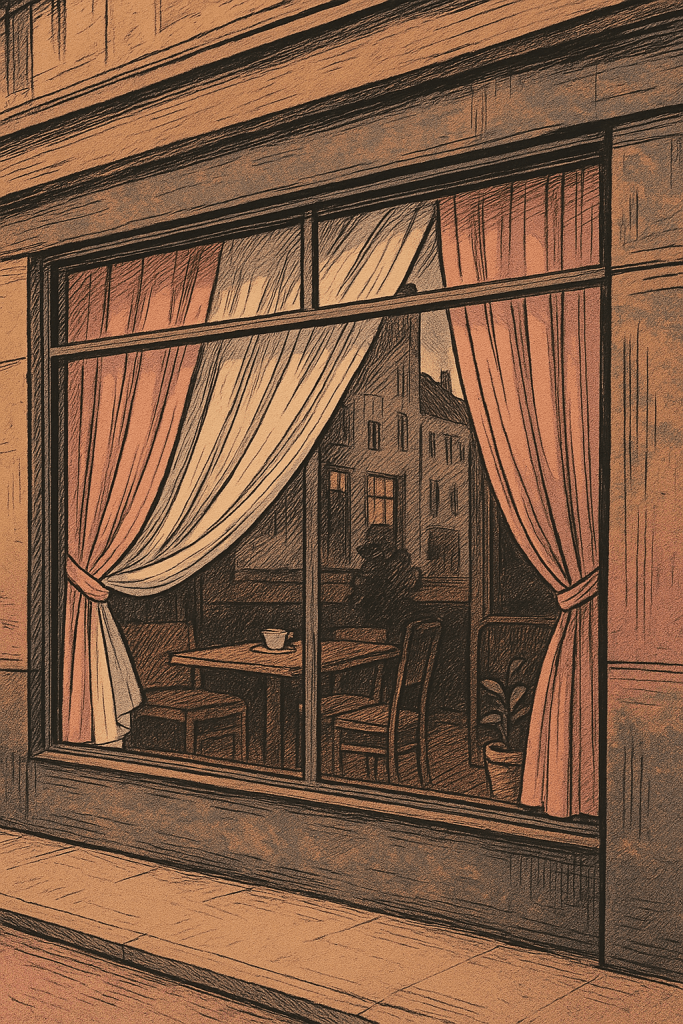
I decide on Kohvik Narva—a favourite refuge for students, grandmothers, and anyone staking out neutrality one cup at a time. The café window is fogged, the sign outside yearning for repair. Inside, the warmth is honest: clatter of plates, a parade of sweet buns exhaling the promise of butter and cardamom. I order coffee that tastes mostly of burnt resolve and settle in, tracing the condensation on my mug, letting the city’s rhythm seep under my skin.
Just as the first sip silences my nerves, I feel it: that prickle at the nape, the old hint of being seen. When I look up, green eyes stare from two tables over—unmistakable even in the haze of morning.
Karim. He sits so stiff it’s almost comic, his hands wrapped tight around a thick-walled espresso glass. I catch a flicker of exasperation flash over his face.
He doesn’t say hello. He leans in, voice pitched low but thick with caution, edged with something personal.
“I’m supposed to be your bodyguard, Elena. Don’t slip out again without letting me know.” His accent sharpens the scold into something more tender, almost pleading.
I smirk, mouth quirking up before I can help it. “Relax, Karim. I needed coffee and something sweet. Unless you’ve got a better idea about where to blend in around here?” He doesn’t answer, just watches me, studying every detail, as if looking hard enough might press all the questions to the surface.
It’s awkward and electric—his caring is a knot of duty, frustration, and something far less straightforward. I’m reminded of those dawns in Dakhla, of the sauna in Tallinn: every look from him is layered, hungry, never quite just professional.
I take a slow bite of cake, watching him over the rim of my cup. “Next time, I’ll text,” I promise, though it comes out softer than intended—an olive branch, or maybe just an admission that, here in Narva, walls are thinner and old selves rise with the mist.
He relaxes, fractionally, and just for a moment, we sit together apart without either of us knowing the script. The café fills with ordinary noise, but at our table, something ordinary refuses to settle—a reminder that Narva, for all its hard angles, still makes room for things unexpected, uneasy, and alive.
Author’s Note
If fieldwork teaches anything, it’s that clarity doesn’t always arrive where you planned—or when you’re properly dressed for it. In this chapter, Elena lurches from post-coital introspection to a Soviet-era shower and out into the rueful light of Narva, learning (again) that reinvention rarely waits for privacy, and that a city’s scars might teach more than its monuments ever could.
Narva reminds us: sometimes, the world refuses to grant us a backstage, and the line between research and exposure blurs until all you have left is your wits and whatever dignity survives the local coffee. The anthropologist—loyal to no side but curiosity—discovers that survival and self-recognition often depend less on finding answers than on outlasting the questions, and on learning to laugh, especially when nothing goes according to plan (as if it ever did).
So here’s the lesson, if there is one: whether negotiating scarred borders or one’s own unreliable heart, don’t mistake toughness for impermeability, or grit for absence of grace. Wit isn’t armour, but it does make a half-decent compass when the maps fade and the instructions peel off the wall—right beside the linoleum.
For anyone navigating a return, a comedown, or just another morning in a city—let this be your permission: improvise, observe, and let the world’s cracked façade glint back something that feels almost like truth.
May the curtains lift,
even if the walls remain scratchy—
because revelation rarely waits for comfort.
I.Ph
 The C.O.M.C. Files