
“I am being hunted by the safety protocols of UNESCO, and we’re landing in Zurich of all places—Tarmo, WTF?!”
He didn’t flinch. “Here are my headquarters too—Amellal Trust Heritage. And I have a house here.” He let the silence linger a moment, then added, more quietly:
“Proximity breeds advantage—the city’s walls are thin, and I prefer to hear the footsteps coming.”
We landed at Dübendorf Air Base mid-morning, the sky overrun with streaks of glare and winter sun. Less than an hour from Estonia if you have friends in the right uniforms and don’t file a flight plan. I didn’t bother trying to memorize runway markers—too busy watching for shapes that didn’t belong through frost-grained windows, the gold mark burning on my arm like some cocktail of ink and surveillance tech.
The ground crew barely looked up as our cargo ramp lowered. Mikael waited beside a snow-dusted limousine, patience concealed by the neutral precision that only comes from years at Tarmo’s side.
He greeted Tarmo with a brief nod and turned to me with professional courtesy. “Dr. Delange. Your personal belongings, as well as your material from Kadrina, are taken care of.”
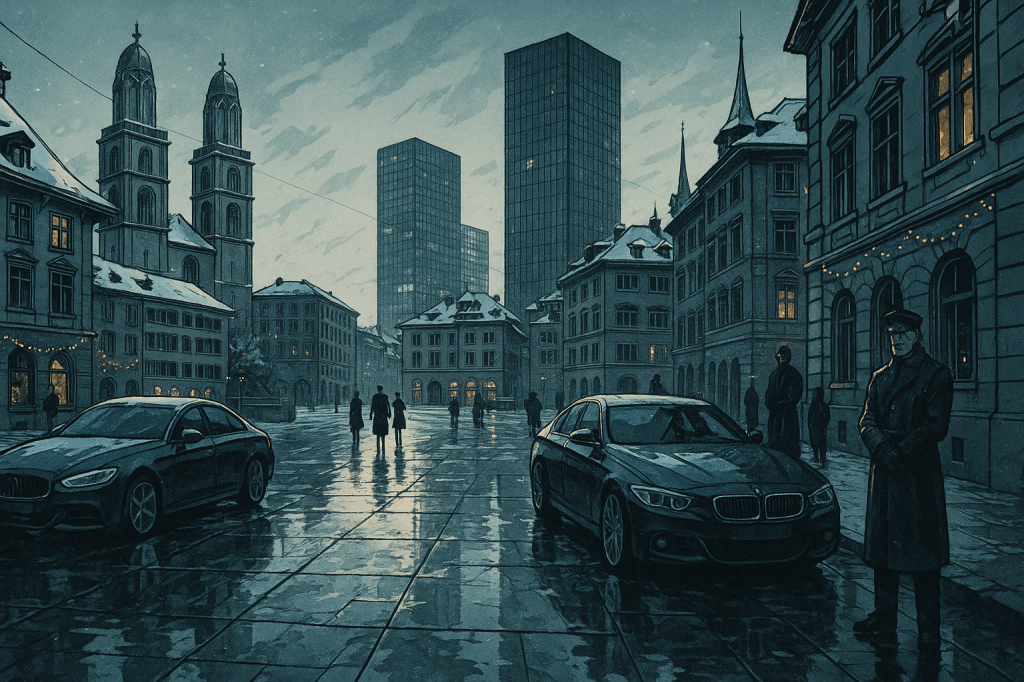
Inside, the car smelled of gun oil, leather, and sandalwood—Mikael’s gesture at luxury. Two men rode up front, another Mercedes ghosting us through traffic. We left Dübendorf behind in silence, highways unfurling through Zurich’s winter-dressed elegance.
Kreis 7. Tarmo’s safe house was less a home than controlled opulence: brutalist lines, pale marble, and a ridiculous hidden entrance. Armed guards stationed throughout, hands never far from their jackets, faces alert. They had their routines—rotation at the gates, gloved hands warming on thermoses, chatter in Russian, Finnish, and thick Zurich dialect that made everyone sound like conspirators. Weapons checked at measured intervals, always at least two in every sightline.
One guard nodded to me, eyes cataloguing my sleeves, my scarf, my posture. No one dared smile. Tarmo’s money bought loyalty that didn’t need warmth.
I could not sleep—weird, right, after being shot at twice in one month and kidnapped, tattooed like an animal. I dozed in fragments, overstimulated, heartbeat skittering behind my ribs. Winter light knifed through tall windows, glinting off marble. My footsteps echoed strangely, catching the guards’ muttered check-ins on comms.
The house cleaner—Swiss, of course—navigated this armed standoff with the unshockable arrogance of a pragmatic service culture older than the Confederation. She reminded me of that nasty safe keeper from Heidi—Frau Rottenmeier!
Business bled through everything. Tarmo’s office was the axis—endless video calls, grim discussions about freight manifests, nods to intermediaries from Beirut, Lagos, Kyiv. Once, I thought he called someone about a wine shipment; it took me half an hour to realize that was code for tungsten. (Tungsten: chemical element, symbol W, atomic number 74—a metal found naturally on Earth almost exclusively in compounds.)
Underneath the calm performance, we all felt it: the air wasn’t quite safe. Paranoia chafed beneath the marble’s chill; every door locked automatically, every window caught reflections that didn’t belong. Still, in the lulls, we tried to act normal—I’d browse a book, watch Frau R polish silver, listen to Tarmo’s inevitable, unsleeping rituals.
Zurich ground us down in its clinical efficiency. Swiss quietness pressed in. I wasn’t sure if I felt more visible or invisible here. Sometimes both, sometimes neither. Mostly, I kept moving, pacing corridors, learning the schedules of threat. Waiting for the next move.
When my phone finally buzzed—in Mikael’s careful hands, after a ritual wipe—I nearly dropped it. “Lisbon,” Mikael said, arching a brow. “Persistent.”
I took the call in Tarmo’s study, half-expecting an emergency. Instead, it was Marina’s voice, all jagged with relief and then weaponized with thirty years of history.
“Porra, Elena! Por onde andas tu, mulher?!”
Where the hell are you, woman?! She didn’t wait for an answer. “Do you know I have been calling you for two weeks? Two. Weeks. Mrs H is answering your damned London number. Telling me nothing. She should take up circus work, that one:’The Human Detour.'”
Guilt prickled under my skin like a lit match. “Marina, I’m—”
But she barreled on, breathless with worry and anger. “First, you vanish, then I try every channel except carrier pigeons. Now Mrs H tells me you’re ‘indisposed.’ Indisposed! What are you—a 19th-century duchess or a hostage?”
There was something almost comforting in her fury. I pressed my forehead to the polished desk.
“If you are dead, I want your ghost to call me by Tuesday, you hear? Elena. Please. Am I talking to you or to some highly trained imposter? Give me something only you and I know. What did you write on the bathroom mirror that night at the Porto anthropology conference?”
Despite everything, I almost smiled. “Eat the patriarchy before breakfast. And you corrected my Spanish conjugation in lipstick.”
“Hmm, it seems too easy. What did I write on your bathroom mirror in Valencia?” A pause. “Ah, hang on, I remember: best 4ever.”
A sigh—part exasperation, part relief. “Good. So I am not talking to a Swiss clone. Now. I want to know: are you safe, are you sane, and are you letting that British matron pull strings on your behalf? Because if not, I am getting on a plane, business class, and raising hell in Kreis 7.”
The image—Marina with her reading glasses on a lanyard and a joint between her fingers, storming into this fortress—made the dread soften for one long second. I gave the mildest summary I dared.
“I’m…safe, for now. Zurich is—what you’d expect. Tarmo is fine. Mrs H’s concern is—strategic.”
A low grunt. “I am not an idiot. Listen to me: I don’t care how cold, secret, or Scandinavian your situation is. If you disappear on me again, I will bring every academic gossip and every Fado singer in the city to your doorstep. And you love me too much to risk that.”
I exhaled, grateful, ashamed, and—briefly—almost whole. “I promise, Nina. Soon, I’ll call you from somewhere with better wine and worse manners. Stay furious for me.”
She laughed, warm but edged with steel. “Always. And Elena—next time, answer the damn phone.”
The line clicked off, carrying her warmth back toward Lisbon, leaving only the echo of friendship that no regime of paranoia could quite erase.
After I hung up, the study felt colder than before—an institutional cold that went into the bone. For the first time since Soodla, I let my hands tremble. Not from fear, exactly. Shame, fatigue, longing. I missed her, hell, I missed normality! The way Marina’s voice—frayed with laughter, anger, history—had burst through the static drew up memories I’d been too busy to chase away: afternoons in Alfama bars, conferences where our solidarity was always half mischief, half manifesto.
I caught my reflection in the glossy desk: eyes rimmed raw, every line drawn sharper. I wanted to call back, to assure her (and myself) that I hadn’t vanished into the realm of the tactically dead. But all I could do was press my palms together and try to remember breathing techniques she’d made fun of while chain-smoking.
A measured cough behind me, then the faintest click of the study door. Frau R appeared, holding a tablet to her chest, hair arranged with the kind of care only Swiss widows still practice. I almost embraced her.
“Difficult call, yes?” Her tone was flat, not unkind. She set the tablet aside, watched me in that way she has—clinical, detached, masking some deeper concern.
“I hope you did not promise your dear academic friend anything… rash.”
I managed a brittle smile. “Only that I’d call her from somewhere less antiseptic. And that I’m not dead—unless you’d prefer me to keep up the performance.”
Her mouth twitched, barely. “Dead people are a management problem. Living ones are unpredictable, but they pay dividends.” She stepped closer, voice low. “I did not intend for her to suffer anxiety. But you know the stakes. We are one error away from becoming a case study in how not to manage a clandestine operation.”
“Marina is not a liability.” That, at least, I could say with conviction.
“No,” Frau R said. “But love of any kind is. Friends are vectors, as surely as old men in old wars. Be careful, fraulein. Today’s goodwill is tomorrow’s pressure point.” Her eyes softened a fraction. “Still, you should eat something and get dressed. Tarmo is arranging a briefing.”
She left as quietly as she’d entered, the door hissing shut behind her—leaving me alone with the weight of her words. For a moment, I debated ignoring the summons, but routine has its uses; I let it steady me, forced my feet to the kitchen on the promise of strong coffee and the possibility of silence.
Later—much later, when even Zurich’s armored nights surrendered to dawn—I found myself drifting toward the guest wing with my burner phone. I called Marina’s number, knowing I wouldn’t speak: just needing her voice on the recorded loop, a tether to somewhere sunlit, a reminder that paranoia isn’t the only language left to me.
Meanwhile, in Lisbon
In bright, rain-polished Lisbon, Marina navigated her office in socks, fingers tapping out the unlock sequence on her laptop. She fired off rapid Portuguese emails to Brussels and Paris, her tone brisk as hail. One voicemail to an old student in Geneva: “Don’t make me wait—call me back. It’s about a mutual friend who’s gotten theatrical again.”
She lingered on a photograph of Elena from 2007—ink-stained sleeves at our favourite Rock café, laughing mid-anecdote. Before the research grants turned murky. Before Elena learned to speak in careful silences.
Now, finding the breadcrumbs left during their brief call—Zurich, just enough context, Tarmo’s shadow unmistakable—Marina triangulated the facts filtering through academic circles. Whispers about the Amellal Trust, location hints surfacing in encrypted messages. The kind of patterns she’d learned to trust during twenty years of following money through shell foundations.
She dialed a number she hadn’t used in years. Swiss journalist, Rolf, whose appetite for academic intrigue was matched by his sixth sense for newly arrived trouble in Kreis 7.
“Rolf, querido. I’ll make it worthwhile. Everything you’ve heard about Amellal Trust, the new tenants in Kreis 7—leave nothing out.”
Marina settled back by the window as Lisbon’s sky turned apricot over the Tagus. If Elena refused to answer, Marina would do what she always had: lay a net so wide and dense that not even the most careful ghosts could slip through.
Back in Zurich—Elena Again
I poured coffee, watching the guards move through their polished silence. Frau R’s warning lingered—not just a threat but a reminder that in this new world, loyalty had become a dangerous luxury.
I wondered whether Marina would forgive me when she discovered what our research had become. Not the clean academic pursuit we’d started, but something weaponized. A chess game where I’d somehow become both player and pawn.
Still, I let her rage and care ride the cold wires between us—a message I could cradle in silence even if I couldn’t answer. The photograph she’d mentioned, that Rock café in 2007, felt like archaeology now. Evidence of who we used to be.
I waited for the next summons, the next calculated move. Somewhere in Lisbon’s soft dawn, my oldest friend was mapping her own grid of connections, following breadcrumbs I’d dropped like prayers. She might save me yet—or bring down this house of mirrors we’d built between truth and necessity, one careful lie at a time.
Author’s Note
Zurich: land of clinical precision, holiday lights, and the kind of marble floors that echo with every paranoid footstep—perfect for anyone trying (and failing) to disappear. If the city feels like a character here, that’s because it is: aloof, expensive, stylishly armored, and always ready to offer sanctuary—with a receipt.
Committees used to be Elena’s camouflage; now, they’re just another search party. and yet here she is, existentially jet-lagged, counting armed guards like sheep. Meanwhile, Marina proves that the only force of nature deadlier than European bureaucracy is an academic in socks on a mission (blunt lit). Old secrets multiply; old confidantes cross-reference; nobody’s sleep schedule survives.
If you sense the air shimmering with tension, it’s not just the winter haze, it’s the collision of business-class intrigue, institutional loyalty, and the nagging suspicion that your best friend has finally outfoxed INTERPOL. In this corner: marble, tungsten, loyalty as a pressure point. In the other: the absurdity of being hunted by protocols and love in equal measure.
May your secrets lounge in velvet, and your enemies pace distant halls.
I.Ph.
 The C.O.M.C. Files