
Warehouse — Nowhere/Peipsimaa
The world returns in fragments: cold seeping through concrete, nausea rolling through my gut, wrists burning where cable ties bite flesh. Blood coats my tongue, diesel fumes thicken the air, and two men in patchy Russian camouflage watch from behind pulled-down masks. The leader crouches close—hard-bodied, oil-slick hair, gold tooth gleaming in an unfriendly grin.
He slaps me. Not to hurt, but to focus. Russian comes quick and insistent:
“Кто тебя прислал? С кем в Нарве работаешь? Говори сейчас, сука, или хуже сделаем.” (Who sent you? Who do you work with in Narva? Talk now, bitch, or we’ll do worse.)
I meet his eyes, letting my composure waver between defenceless and mocking:
“Я просто исследователь, работаю с CYcrds над проектом. Все документы в рюкзаке.” (I’m just a researcher, working with CYcrds. All my documents are in my bag.)
He spits, unimpressed:
“Врёшь. Слишком умная для своих лет.” (Liar. Too smart for your age.)
“Huh? I am fifty, dude, no spring chicken”, I think.
They haul me toward an oil drum. Their pride bristles, hands too eager for cruelty—provincial nationalists, not professionals. The leader produces a battered tattoo rig and a tiny ampoule filled with glittering, gold-flecked ink. His henchman grins.
“Теперь все узнают, кто ты на самом деле. Не убежишь.” (Now everyone will know who you really are. You won’t run.)
I flinch but refuse to beg—a matter of pride, anthropology, survival, or perhaps just Dutch stubbornness. They pin my left arm, cleanse a patch with cheap vodka, and stretch the skin. The needle bites: pain explodes, shocking and grinding. Metal and ink burn the air. They scar me with a strange sigil—a code, a warning, a tracer—something that will announce me at every checkpoint from Peipsi to Narva.
“Держи крепче, не отпускай.” (Hold her tighter, don’t let go.)
I grit my teeth, eyes streaming, and mutter in Estonian:
“Kurat, see on teie pärandus? Jätta inimest märgiga nagu loom?” (Damn, this is your legacy? Marking a human like an animal?)
The man holding me startles at the language. The leader only tightens his grip.
“Можно называть как хочешь, голландка. Но теперь мы решаем, где твой piir lõpeb.” (Call it what you want, Dutch woman. But now we decide where your border ends.)
When it’s finished, they wipe my arm and bind it roughly with a rag. The leader paces, dialling his phone:
“Найдёте её друга. Скажи ему — если хочет её живой, пусть платит выкуп.” (Find her friend. Tell him—if he wants her alive, he’d better pay the ransom.)
The henchman nods, grinning. In the yellow haze of a bare bulb, my consciousness fractures between pain and calculation. If I survive this, it will be through memory alone.
Tarmo
Three floors above, my sleep shatters at the sound of a door closing too softly, the metallic catch of a vehicle’s latch. I’m up before thought finds meaning, muscle memory and dread my only guides.
I’m armed before fully awake, my sidearm’s weight familiar as I move through the corridor. At Elena’s door, I hammer with my fist—no answer. The lock surrenders to my shoulder with a sharp crack of splintering wood. Cold air rushes out. The open window, the ransacked room, the clear signs of abduction hit me like ice water. In another timeline, I’d have stayed in her bed and been there when they came through the window.
I don’t panic. Don’t allow it.
Weapon ready, I pull out my phone: “Kiiresti, kõik ärkavad. Meil on probleem. Mulle kaks meest kohale ja kutsu Hasna.” (Quickly, everyone up. We have a problem. I need two men here and call Hasna.)
By torchlight, I find the white van in the tree line—empty, abandoned. They’ve switched vehicles and moved her. Too professional, too clean. Local ultranationalists don’t operate with this coordination. Someone with real resources backs this operation.
Where the fuck was my security detail? Where was Mikael? My usual team would have spotted a van casing the manor, run plates, raised flags, before these bastards reached Elena’s window. The silence from my right-hand man gnaws—betrayal, or something worse.
Two hours of mounting dread. My team combs the grounds, checks security footage, and follows secondary tire tracks that vanish at the main road. The manor transforms into a command post—staff questioned and dismissed, phone lines secured, perimeter established. The sophistication bothers me: the timing, the vehicle switch, the operational security. This isn’t provincial hatred; this is state-level tradecraft.
Then the coded message arrives—an encrypted text, nothing but a photo of fresh gold ink blazing against pale skin and Elena’s unreadable eyes.
My phone rings. I answer, rage barely leashed, Russian rough and certain:
“Отпустите её, или следующими будете вы.” (Let her go, or you’ll be next.)
The reply is static and laughter.
Every instinct screams as the line between lover and hunter vanishes. I spend the next hour tracing compression marks around the manor—broken curtain cord, faint shoe prints in pine dust by the service door. The staff proved useless, the police slower than my rising fury. But I find fragments: fresh tire tracks in mud, kitchen gossip about a white van leaving too quickly, someone cursing in Russian.
That’s enough evidence. Three calls follow: Hasna first, then an old Narva contact, then the line reserved for the worst nights—Zürich’s emergency operation.
The abandoned van yields more intelligence—tape residue, a blood-bright sticker marking them as Russian ultranationalists, grey-zone fanatics. Real threats, unlike the usual bureaucrats and blackmailers.
My anger condenses into something cold, tactical, elemental. The team assembles: three locals I mostly trust, Hasna on encrypted comms, and a borrowed tactical van positioned two blocks out. My breathing sharpens, controlled, every movement economical. I know what men like these do—mark, trade, ruin, and when cornered, kill without hesitation.
The radio crackles: “They have the woman. Calling for exchange—five thousand euros and safe passage.”
My response cuts through static: “Prepare for breach. No delays. She is not expendable. Take them alive if possible, but not at her cost.”
Gun drawn, weight familiar in my grip, my mind cycles through scenarios. If they’ve touched her beyond marking, if they’ve done anything permanent—I’ll teach them what consequences mean. They won’t live to forget the lesson.
Elena
The pain buzzes beneath my skin. My forearm is sticky and burning. The men pace, making calculations. The leader thumbs his phone, speaks in rapid code—enough for me to parse “Narva,” “offering,” “the Estonian dog will pay.”
Beyond cracked windows, I hear something shift: movement too smooth to be vagrant, too purposeful to be wind.
My heart claws at my ribs, half dread, half bizarre hope. I take a slow breath, flex my bound hands, press the mark to memory: gold, strange, alien—they want me tagged, but they will never own my story.
The door explodes inward.
Violence, light, the crash of shouts in two languages. Gunshots echo, glass shatters. I flatten myself instinctively, chin tucked to shoulder, praying for chaos to be brief and justice brutal.
Above it all, Tarmo’s voice—guttural, absolute—rips through the din: “Get away from her! Now!”
The warehouse doors shudder under impact. Yells blur Estonian and Russian into a cacophony: “Maha, politsei!” (Down, police!) “Stoy! Ruki vverkh!” (Stop! Hands up!)
Gunfire cracks. I roll toward the oil drum, pressing myself low against it. When I look up, copper taste flooding my mouth, Tarmo stands at the threshold—hair wild, gun drawn, team fanned behind him, eyes black with vengeance and something far more dangerous.
“Touch her again and you’re dead,” he spits in Russian. Then, sharper: “Leia tema käerauad, kohe!” (Find her restraints, now!)
The men freeze. One tries to run, another reaches for his weapon, but thinks better under Tarmo’s stare. In two heartbeats, he’s at my side, hands gentle as he slices my bindings.
“See on nüüd läbi, Elena. Sa oled turvaline.” (It’s over now, Elena. You’re safe.)
I’m shaking—cold, fury, relief, I cannot tell. My forearm pulses, the gold tattoo blazing with betrayal and survival.
He pulls me close, embrace fierce as any promise, then turns to the men, voice carrying an executioner’s chill: “Teie valisite vale ohvri. Seda ei unustata.” (You chose the wrong victim. This will not be forgotten.)
I try to rise, but my limbs betray me and the room tilts. Not just fear or pain—the last of whatever they used won’t release its hold.
Tarmo curses softly, then scoops me into his arms—one broad arm under my knees, the other cradling my shoulders, keeping my wounded forearm elevated. I feel my heart hammering, but also the unyielding comfort of his closeness. Odessa, Zürich, onion fields, secrets—all fall away beneath the shock of being carried, unresisting, heart thrumming against his chest.
Behind us, flashlights sweep and radios crackle. Tarmo’s voice cuts through the confusion: “Path’s clear. Hoidke sellest väravast eemale!” (Keep away from that gate!)
Crossing into cold night—wind biting, doubt and blood pounding in my skull—I hear more Russian behind us, hands forced high. Tarmo only tightens his hold, jaw set, scanning every shadow for new threats.
I try to speak, fail. He bends lower, voice meant for me alone: “No more words tonight. Just hold on.”
And so I do—letting myself be carried through shame and survival and stubbornness as much as pain, the world shrinking to warmth, the raw scent of him, and the hard, certain promise that for this crossing, at least, I’m not alone.
Golden Trace
The warehouse chaos fades—sirens behind my eyes, shouts blending into cold. Tarmo’s arms become my geography, his chest heaving as he carries me to the idling van by the highway. Someone in tactical gear barks questions; someone else curses softly about my arm. The team swarms in a double ring of steel until Tarmo growls “Clear!” and the world narrows to movement, flesh, shelter.
Medical Aftermath
A medic—young, Estonian, eyes wide with concern—uncaps a flashlight and murmurs, “Sul on vaja puhata. Pead vastu.” (You need rest. Hold on.) I’m lucid enough to register panic barely controlled in his gentleness.
Someone dabs alcohol and ointment on my gold-marked skin, wraps it loosely—but the mark blazes through, radiant and bitter, two thumb-lengths of code and stigma. My veins ache beneath it, memory and violation burning along my forearm.
Tarmo never strays beyond reach—hovering as he signs my medical release with shaking handwriting, voice clipped as he provides details I can’t quite process.
“Ettevaatlikult. See pole tavaline vigastus.” (Careful—this isn’t a normal wound.)
Reflection: Mark & Peril
The ride back passes in silence: I curl, shivering, in the passenger seat of the G-Wagon while Tarmo drives one-handed, the other ready whenever I flinch.
I say nothing while exhaustion and adrenaline ebb. When we stop before the manor, I ask quietly:
“Will it always be like this? Marked. Chased. Never quite knowing if the wound is code or curse.”
His hand hovers over mine. “This is more than a threat. It’s a tracker—at the next border, the next checkpoint, you’ll light up on their scanners. It’s a warning too: anyone who scans you will know you were theirs, and what you came to accomplish.”
I nod, throat closing around rage and something sickly like pride. “So I’m a message now. A walking hostage in translation.” I try to laugh; it emerges raw. “They never mentioned fieldwork would be so literal.”
He cuts in, voice hollow: “I should have stayed. Should never have let them near you. In this game, a mark is never just ink.”
“Don’t you dare make this guilt,” I hiss. “It was always a risk. We both chose.”
We walk into the manor together, the hush of returning souls thick as balm around us.
Author’s Note
May the borders we cross—maps, skin, memory—never be so simple as lines on paper.
For Elena, fieldwork has never been academic, and every mark is a dialogue: between violence and survival, stranger and self, code and curse.
Anthropology here is not just a study, but a confrontation—a test of stubbornness and the art of carrying scars with humour (or at least style).
Take heed: the most indelible discoveries in this story are stamped in pain and translated with pride.
Author’s Note Addendum
For those wandering these pages: nearly everything here is drawn from personal experience—thought, sensation, aftermath. Only timelines and geography have been deliberately shuffled for dramatic effect.
Places have changed, names might shift, but the pulse beneath the story remains true.
This is memory wearing the mask of fiction: real scars, rearranged borders, the truth remixed so the telling might sting just enough.
May the ink fade, but may its lesson remain.
I.Ph.
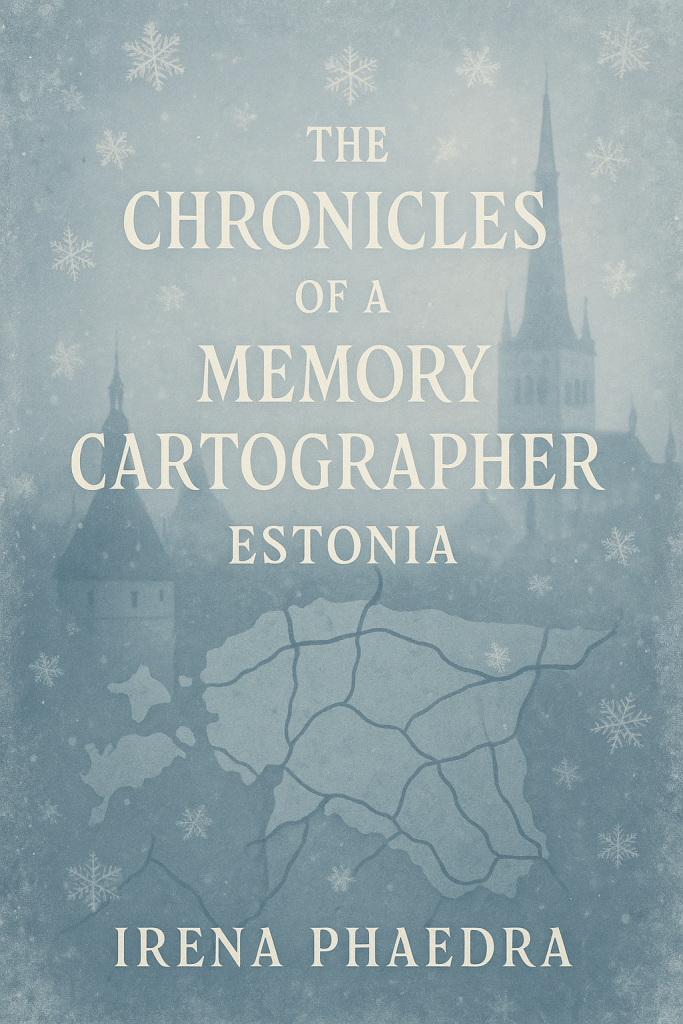
 The C.O.M.C. Files