
The Road to Tartu
The G-Wagon cuts through the Estonian countryside under a pewter sky. Forest and farmland blur past, punctuated by Soviet-era bus stops that look like concrete prayers to nowhere. Elena watches the landscape from the passenger seat, hyperaware of Tarmo’s hands on the steering wheel, the way he handles the curves with the same controlled precision he handles everything else.
They’ve been driving for twenty minutes in careful conversation—weather, logistics, the university delegation waiting in Tartu. Professional topics that skate over the surface of what happened in Pärnu.
“The rector will want photos,” Elena says, consulting her tablet. “Standard press opportunity.”
“Naturally.”
His voice is neutral, but she catches him glancing at her mouth when he thinks she’s not looking.
The radio crackles with Estonian pop, and Tarmo switches it off with more force than necessary. The silence stretches until Elena’s phone buzzes.
“Kristi wants to confirm the timeline,” she says, but before she can answer, Tarmo’s phone rings through the car speakers.
He glances at the display, and his jaw tightens almost imperceptibly.
“I need to take this.”
The voice that fills the car is male, urgent, speaking rapid Estonian. Elena catches fragments: “probleem, Tallinn”, something about timing. Tarmo responds in the same language, his tone shifting to something sharper, more authoritative. This is the voice that commands rooms, that makes subordinates straighten their spines.
“Ei, ei. Täpselt nagu ma ütlesin. Mitte mingeid muudatusi.” No, no. Exactly as I said. No changes.
Elena pretends to focus on her tablet, but she’s cataloguing every inflexion, filing away the glimpse of who he becomes when he thinks she can’t understand. The conversation continues for several minutes—logistics, confirmations, what sounds like barely contained irritation at someone’s incompetence.
When he ends the call, the silence feels different. Heavier.
“Everything alright?” Elena asks.
“Minor coordination issue.” He merges onto the highway toward Tartu with mechanical precision. “Nothing that can’t be managed.”
But before Elena can respond, another call comes through. This time, the caller ID shows only numbers, and when Tarmo answers, his voice drops into Russian.
“Да, я слушаю.” Yes, I’m listening.
The shift is subtle but unmistakable. His posture changes, and he becomes more guarded. The Russian flows like water, smooth and practised, but there’s an edge to it that wasn’t there in Estonian. Elena keeps her expression neutral, pretending absorption in her emails, but every instinct sharpens.
“Нет, это невозможно. У нас есть график.” No, that’s impossible. We have a schedule.
She catches references to Moscow, something about clearances, and a name that might be Volkov or Volgin. Tarmo’s knuckles whiten on the steering wheel as the conversation grows more heated.
“Послушай меня внимательно,” he says, and Elena doesn’t need translation to recognise the tone of a man giving orders. Listen to me carefully.
When he finally ends the call, the car feels charged with unspoken tension. Elena looks up from her tablet as if she’s been completely oblivious, but she can see the calculation in his eyes as he glances at her—wondering how much she understood, how much she might have filed away.
“Sorry about that,” he says in English, his voice carefully modulated back to professional courtesy. “Busy morning.”
“I imagine coordination gets complex,” Elena replies neutrally. “Especially with multiple stakeholders.”
Something flickers across his face—approval? Suspicion?—before the mask settles back into place.
“Indeed.”
Tarmo
We cross onto the old believers’ land under a sky the colour of pewter, the fields stitched with onion domes and the occasional half-collapsed prayer house. By the time we stop in Tartu, I’ve already slipped back into my old skin: silent and calculating.
Still, I can’t help an internal longing that stirs when I see the Taevaskoja signpost outside town—Heaven’s Chambers. The last time I was there, I’d lost more than my bearings and usual control (and, arguably, my better sense). I wonder: when will I be allowed in heaven’s chambers again? Also, is that a good idea? Something twists in me.
What has this woman done to me? The irreducible strangeness of it, as if I’d stumbled through some magic gate and found myself dizzy in a city of gold. When will I be in heaven’s chambers again? The edge of memory sharpens my mouth into a private smile.
Elena, beside me, is tuned to another frequency entirely. She clocks the crowd of university students on the square—loose-limbed, laughing, oblivious to the undertow of older ghosts. Her eyes linger, just a second too long, on the youngest of them: fresh-faced, careless, the world still unhurried and unruined. I notice. How could I not? She’s always favoured youth. The easier spark. The possibility of a clean ledger.
A pang. Not quite jealousy, but not pride either. Something more complicated: the awareness that desire is always pointed elsewhere, never quite proprietary. Sometimes it stings. I tell myself it’s just information, but my hands clench on the steering wheel anyway.
The word hangs between them as they crest a hill and Tartu spreads below: red roofs and church spires, the Emajõgi River winding through the medieval heart of Estonia’s intellectual capital. It’s beautiful in the grey morning light. Still, Elena finds herself thinking less about the scenery and more about the man beside her—the layers of language and loyalty, the way intimacy can reveal as much as it conceals.
Last night, she’d thought she’d seen through his armour. Now she wonders if what she’d taken for vulnerability was just another kind of performance, perfectly calibrated to make her feel like she was the one doing the undoing.
The university buildings loom ahead, and with them, another day of careful choreography. But the echo of Russian consonants lingers in the car like smoke, and Elena finds herself wondering exactly which version of Tarmo she’ll be watching perform today.
“Ready?” he asks as they pull into the parking area.
“Always,” she replies, and means it in ways he probably doesn’t expect.
Our first stop after the university reunion: I led her down Riia street to Raamatukauplus Krisostomo. The bookstore is a holdover from another century. The brass bell above the door still thumps. Dust smells like recipes for survival. It’s a quiet, stubborn place at the edge of the old quarter—a haven for unread stories, with shelves stacked close and the air thick with the stubbornness of paper and dust. No introductions, just a transaction.
Elena
Tarmo glances at a stack of periodicals, I flip through a volume of local poetry—each of us present in body, absent in spirit, holding our own private distances.
Business is swift, almost antiseptic. Tarmo signs for a package—something sealed, serious. He doesn’t explain, and I don’t ask. In this world, curiosity is a liability.
We step back into the afternoon, heads down, the rhythm of the itinerary driving us forward. At Armastus Café, we pause for lunch. The owner—a wiry woman with hands hardened by decades—pours strong coffee without ceremony. We sit by the window as students clatter in and out, each bundled in scarves against the sharp wind.
I tell Tarmo the story—half for conversation, half as anthropology.
“She started all this with a pushcart, you know. Spent years hustling pastries on the street corners. It took her half a lifetime to buy these chairs and these lights. Everyone here has a story like that—digging themselves out after Russia’s collapse, rebuilding with whatever scraps the world left behind.”
Tarmo listens, impassive, his focus more on the patrons than my words. I can feel him measuring risk, not sentiment.
The day moves forward. We pass the ice-skating rink, the scrape of blades echoing off the ice. Next stop: Fahrenheit 451, the kind of bookstore-bar that pretends not to care about politics but stocks samizdat under the counter if you know how to ask. Another tightly wrapped pickup.
But beneath my anthropologist’s detachment, I’m fighting my own currents—wondering if there’s room in this life for the person I’m becoming, or if, like everything else in this broken, rebuilding country, you have to earn your way into new territory with grit and cleverness, one uncertain day at a time.
I walk beside him, boots crunching in the layered snow, eyes fixed forward—not daring to glance up, not needing confirmation of last night’s erasure. The cold stings my cheeks; each breath feathers the air, but there’s an odd comfort moving in step with him, this big, silent man whose presence both shields and unsettles me.
I know better than to look for warmth in his expression. Tarmo in daylight is all jaw and distance, his face a closed fist, no trace of the hunger or surrender that undid us hours ago. He doesn’t touch me, and I don’t let myself hope for it. Still, there’s something almost restful in the certainty of his stride, the way his shadow edges mine—close but never encroaching.
We walk as two figures stitched against wind and blowback, our bodies buffered by layers, our secrets zipped up high. Maybe we won’t speak of what happened; perhaps that’s just how things go. And yet, next to him I feel steadied, as if there is a pact in our silence—a private knowledge that requires no proof, no glances, no smiles.
He is unreadable. I am resolved. But we are walking the same path, and in the hush and grit of Baltic snow, that is enough for now.
May sticks and stones, caves and wands astonish along your road.
Author’s Note
Stories thrive on moments that unsettle, crack us open, and leave us altered—often in ways we can’t immediately name. Tarmo’s bewilderment in “The Road to Tartu” is not the loss of old illusions, but the raw astonishment of first contact with a depth he’d never met within himself. To visit “heaven’s chambers” is, for him, to stumble into awe and unsettling clarity: the kind of intimacy that makes distance impossible and self-protection suddenly obsolete.
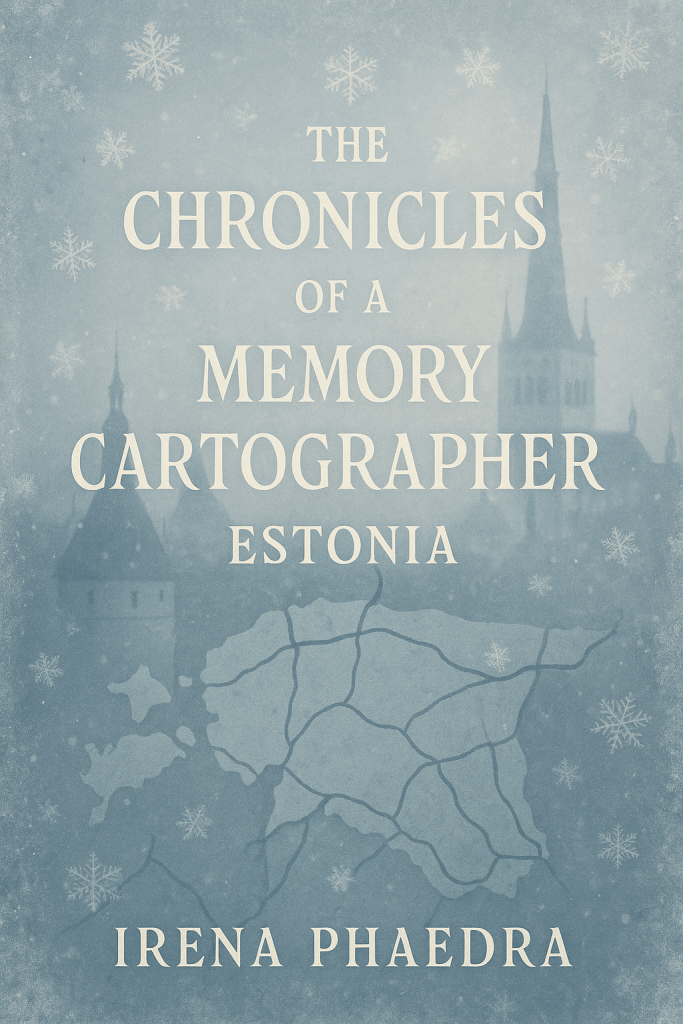
For me, writing these characters is an act of navigating those uncertain places where old certainties fail. Estonia’s landscapes—bleak and bright, haunted and hopeful—mirror the interior world of my protagonists: shaped by history, stitched with longing, searching for new footholds in the ruins of what came before. Elena and Tarmo walk beside each other, stitched together not by answers, but by the shared grit of living through ambiguity.
Thank you for reading, and for walking these winter roads with me.
I.Ph.
 The C.O.M.C. Files