
Detour to Pärnu
Tarmo
Tarmo stood at the smoked-glass window of his Tallinn suite, the city blurred beyond the pane. He reread the report: Karim sighted at the sauna with Elena. No photo, no proof, just a string of cautious words from his watcher. He found no comfort in ambiguity.
He called for his assistant. Mikael entered—precise, impassive, as ever.
Tarmo kept his voice even. “The itinerary for Tartu has changed. Have the car ready within the hour. Elena will need to leave tonight.”
Mikael nodded. “Sir?”
“Plans change.” Tarmo glanced at him, searching for any flicker of judgment. He found none—loyalty, or good acting?
“Direct route?” Mikael asked.
“We’ll detour through Pärnu. Don’t announce it. Scramble anyone who tries to track us.”
Pause. He forced himself not to drum his fingers. “And the vehicle, sir?”
“Not the Bentley. The G-class—armoured. Keep it discreet.”
“Of course.”
Tarmo returned his gaze to the window as Mikael withdrew toward the door. His Right hand would manage the logistics perfectly; he always did. But even perfection had limits, and it was limits that distrusted Tarmo most.
Who sent Karim? He was meant to be off the board, irrelevant, out of the equation. Yet here he was, reappearing where only someone with backing could go. European games, perhaps. Or something closer to home gone rotten.
He felt a flash of anger—hot, but measured, as lethal as a scalpel. In Moscow, in Ankara, even in Narva, he had always dictated the game, not chased the pieces. Now Elena, already slippery, was becoming a nexus. His leverage to unlock Narva’s loyalty, the carrot for Turkey’s shifting, mercenary alliances. And now unpredictable—even to him.
He pressed the comm, voice clipped. “Mikael—double the standard sweep on the G Wagon. Secure Elena’s communications. And I want a secondary decoy vehicle, nondescript, shadowing from Tallinn to Pärnu. If you see so much as a glint of that bastard Karim, call it in. Understood?”
“Understood, sir.” Short, sure, no wasted words.
Good wingman. But loyalty only stretched as far as fear or profit, and Tarmo never forgot that.
He let his hand fall, commanding himself to focus.
She will come to Tartu because I say so. She will go to Narva, she will bargain with the Russians, and this entire farce will close with my hands around the board. Karim is a note in the margin—irritating, yes, but not insurmountable. As long as I have Elena, the game is mine to win.
Outside, the city lights flickered—reflected, like moves on a chessboard. Tonight, they would move, and the rules would bend to his will. Or else he would break them.
The cobbled streets of Tallinn glistened with leftover snow as I slipped out of the sauna, skin flushed, head reeling from the convergence of heat, risk, and Karim. He’d vanished—no parting words, no backwards glance—swallowed by the alley’s shadows as if he’d never been more than a feverish trick her mind played in the steam.
I move through the city’s hush, boots echoing, the night air cool against my burning skin. Part of me—a traitorous, dreamy corridor inside—still hummed with memory: the press of his body, the fullness that lingered not just in aching muscles but deeper, as if some border had been crossed within me. Young Arabian lover, I think, recalling Dahkla—the way hunger and danger wound so easily together, how foreign touch could rewrite years of certainty in a single hour.
How quickly the mind unravels for what the body wants, I mused, letting myself feel, for a moment, the wish to be reckless—savoured and then locked away. I could not afford sentiment. Especially not now.
The Hotel Telegraaf’s old-world glamour felt absurdly fragile as I let myself in, heart drumming, nerves fizzing. In the marble-tiled bathroom, I turn the shower on full blast, letting hot water pound the rawness from my limbs, scouring away the scent of birch, sweat, and him. But the imprint lingered—a secret pulse between my thighs, a drifting, electric tenderness that felt dangerously close to loss of control. I leaned my forehead against the glass.
What am I doing? Heat rising again—a tangled mix of guilt and euphoria. What does he want? And why is some ancient part of me not afraid to want him, too? I remembered Karim’s eyes, watchful and vulnerable all at once, and felt myself slip again toward longing before muscle memory snapped me back.
There is no room for this. Not with this situation at hand. Not with Narva. Not with anyone.
The bathroom filled with steam—a ghostly double of the sauna, but now I was truly alone.
I wrapped myself in the hotel’s thickest towel and padded out, reaching for my phone on the nightstand. A new message pulsed on the locked screen—from Tarmo.
PLANS HAVE CHANGED. LEAVE TONIGHT. BE READY IN AN HOUR TO BE PICKED UP. FULL STOP.
I do not freeze. I bristle. I am not built for being summoned. What irritates me most is the assumption that I, in my shoes, will fall obediently into any slot in someone else’s game. It’s new, this taste of powerlessness, and it makes me feral, not afraid.
I pace the length of my hotel room, towel still clinging to damp hair, the glare of Tarmo’s message burning from her phone screen. I pause by the window, searching the night beyond for a sense of composure, then hit dial.
Mrs. Henderson answered after four rings, voice clipped, efficient, and just slightly weary.
“Henderson speaking.”
I exhale, forcing calm. “It’s me. Apologies—it’s late, I know. Something’s changed.”
A beat—Elena could almost hear Mrs. Henderson glancing at her watch, or perhaps at three screens at once.
“Let me guess: our Estonian friend is feeling unpredictable?”
Her tone was dry, but not unkind.
“That’s one way to put it,” Elena replied. “Tarmo just informed me we have to leave tonight. Less than an hour’s notice. No reason given.”
Mrs. H. didn’t miss a beat; Elena pictured her shifting instantly into operational mode. “You’re scheduled for two interviews tomorrow and a photo session in the afternoon, not to mention the CYcrds event. If you drop off the radar now, the timeline frays.”
“Exactly. I need my alibi tight. Media appearances, event photos—the whole portfolio. If the threads don’t match, this all unravels. Can you shore things up remotely?”
“That’s what you pay me for,” Mrs. Henderson said, typing audibly in the background. “I’ll send Sandi, the new assistant, with all the updated itineraries and assets. She can handle everything public-facing—your photos and interviews will proceed according to plan. You’ll be listed as attending an urgent off-site with investors. No one will blink.”
I feel the tension easing, fractionally. “Thank you. But if anyone tracks live movement, it’ll look strange.”
“I’ll handle questions. You stay silent—don’t freelance, don’t improvise any statements if someone corners you. When you’re en route, text me. I’ll handle the fallout. If it gets dicey, I’ll escalate.”
Mrs. Henderson’s voice softened, just a note. “Go get packed, Elena. And send your coordinates when you’re in transit.”
There was nothing else to say—their dance of contingency plans practised and precise. Still, Elena found herself lingering on the call, taking comfort in the steadiness on the other end.
“Thank you, Mrs. H., for all of it.”
A quiet huff—or maybe the shadow of a chuckle. “You owe me a proper vacation update when this is over. And serviceable copy. Go, before you’re late.”
The line clicked out.
When I hang up, I feel the old clarity again, tempered by the ache of pleasure, the irritation of command, and the kindling of something new: a refusal, quiet and incandescent, to become less than myself.
This is how it begins. Always: in the conflict between what is done to me and what I, unflinchingly, choose. I am not a chess piece. I am the hand that flicks a pawn from the board.
I let the towel fall and step into the faint citylight drifting through the curtains, the air impossibly cool against skin still flushed from the sauna, from him. My thighs ache—a new kind of bruise, deep and private, a secret pressed into me by Karim’s hands and mouth. I draw on my underwear gingerly; the fabric drags over tender flesh, raw from where I let him take me
and leave his mark. Pulling the silk up over my hips, I cringe and savour all at once, a living echo of fullness, of shuddering release.
The bra is next. Lace and silk: chosen for armour, not for softness, but today every thread feels like a challenge. I fasten the clasp, hissing softly as the lace brushes my nipples—still hypersensitive, still tingling from teeth and tongue. I want to cover up, protect, but there’s no hiding what’s awake now, not even from myself.
Each layer feels like an argument with memory: pants, blouse, the strictness of linen over pink, stinging claims. I check for visible marks in the mirror—nothing to betray what’s been taken, what I’ve given. Outwardly composed. Inside, still thrumming.
But I force my mind outward, to what comes next:
Tartu tomorrow. University hall by noon, those icy corridors and the smell of old books. Visit the Estonia office after—Vyta, the gold plaque, the sharp espresso, Kristi waiting with her arms wide, wanting both selfies and strategy. Meetings, interviews, every word a thread in my public tapestry, my real alibi.
The duality is dizzying: the ache between my legs, a ghost of Karim still moving inside me, set against the spreadsheets in my phone, the names I must remember, the performances I cannot falter. As I step into my shoes, my bones feel porous. I am both more and less myself than I was this morning—cracked open, stitched back, dressed in routine but vibrating with the afterburn of risk.
Before I leave, I smooth my blouse, recheck the phone, and watch my own face harden in the reflection. No one will guess what I carry. My body belongs to this moment, and to the memory of him; my mind is already boarding the G-Wagon, reciting facts, manufacturing the legend I live by.
I square my shoulders. I am ready. I am the sum of everything burning and everything concealed.
May we revelate what once was concealed in ourselves.
IrenA pHaedra
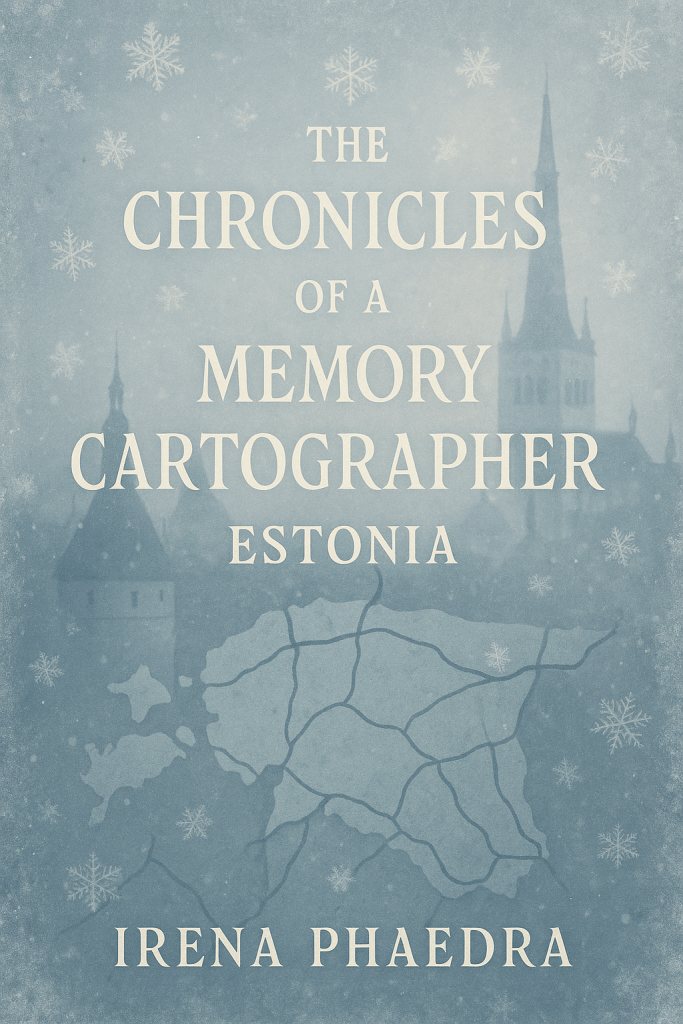
Author’s Note
Let the city keep its secrets, and let Elena keep hers. In this story, bodies are not just vessels of risk—they are the evidence that, beneath the endless manoeuvring, something fundamental has cut through the game’s polished surface. Tallinn’s alleys may glisten with rain, but it’s the unwashed ache, the bruises hidden by silk, that mark the chapter’s true cost.
Tonight, victory isn’t measured in moves but in the refusal to surrender memory, desire, or shame to someone else’s narrative. Tomorrow, the choreography resumes—every alliance rehearsed, every alibi pressed and creased anew. But tonight, we linger in the pause after danger, tracing the outlines of what’s been claimed and what cannot be returned.
Here, the rules bend—not just for power, but for the hunger that makes us gorgeously, fallibly real.
 The C.O.M.C. Files