
The Pact—and One Last Mental Note
Back in the Dar, finally alone, I send my final coded message to Sirine: “If anything goes wrong at dawn, follow the blue line. You have the packet.” “Always. And Salam.”
The phone’s glow dies, leaving only the city’s hush and the stutter of distant Vespas.
The blue line isn’t just code for us—it’s real. A trail of blue stones running from the monument in Place Moulay El Hassan, tracing the curve of the peninsula right under the skin of the city. The tourist brochures call it heritage; the monarchy’s designers marked it across old neighbourhoods as a stamp of presence and control. But those who know Dakhla know its secret: follow that line from the plaza to the old port, and you can slip through the city nearly unseen, blending where eyes are always watching but rarely focused.
For outsiders, it’s just a pretty path. For us, it’s escape written along the lines of occupation—feet pressing new meaning into the monarch’s mosaic. Every path here is a palimpsest, the real grid running beneath in Berber, in forgotten street names, in routes that follow memory, not marble.
I press Hasna’s shard in my pocket—a sliver of promise and contingency. Tonight, I vow what all archaeologists vow in the dark: to remember the city beneath the city, its buried wisdom, mosaic whispers, the lean silences between festival banners and old stone.
Tomorrow, winds will roar and crowds will swallow the alleys. Every secret we kept will be unmasked, bargained, or lost to someone else’s agenda. Athletes, money, secrets, and one anthropologist who has already bartered away objectivity for a chance at the real story.
But for this thin, charged night—on the edge of spectacle and aftermath—I remain at the threshold. Spine tight, lungs prickling with what the morning might claim or erase.
No matter who takes the surface tomorrow, memory will belong to those who do not look away.
I remind myself, blurred by sleep deprivation and raw with the promise of dawn, that in fieldwork and in love, the notes are always neater than the life they try to capture.
For now, I keep the threshold. For now, sarcasm is armour, memory is contraband, and trust is so new I want to label it: Handle with care. Contents may shift during turbulence.
Tonight, the city holds its breath.
The Night Holds
Tomorrow, the city explodes: athletes, money, secrets, and at least one anthropologist who has already burned her professional objectivity for the sake of something resembling truth.
For now, I keep the threshold. For now, sarcasm is armour, memory is contraband, and trust is so new I almost want to label it: “Handle with care. Contents may shift during turbulence.”
The Competition Peaks
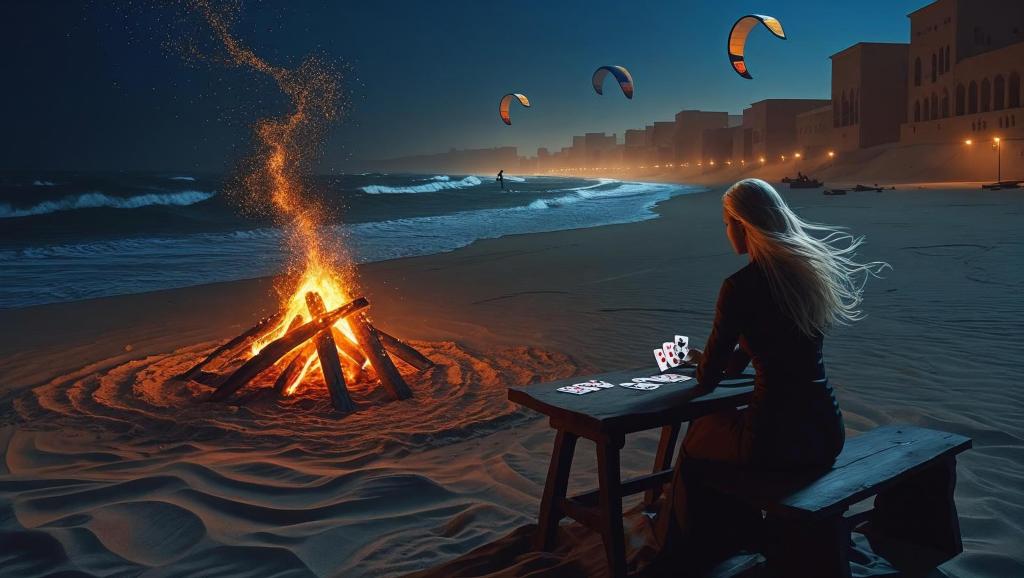
At the edge of the lagoon, day and night blur. The competition ends not with the pop of a cork but the crash of waves and the howl of the Atlantic. Floodlights paint the water gold, banners flap, and the world’s best kitesurfers take sweaty, sunburnt bows to the music of Sahrawi drums and global applause.
No one here wears a tuxedo. Salt crusts every collar, and sand sneaks into every shoe. The bonfire at the finish line throws wild shadows—athletes, tourists, locals, journalists, sponsors—everyone glowing with exhaustion, adrenaline, and something like hope.
Officialdom has its own tent on the new breakwater, with glassware and imported champagne, but nobody stays there long. The real party is on the sand: surfboards make benches; old plastic tables overflow with sweet mint tea and grilled sardines; the DJ spins North African pop and club hits that sound the same in every harbour on earth. Tonight, Dakhla is the axis of the world.
Eyes Wide Open
Press badge flashing, I drift between groups: officials from Rabat looking wary and overdressed, wind-burned locals, investors with sharks’ smiles, and the teens I met on my first night—kites stacked beside them, arms draped around one another, already recounting their near-misses and small victories.
Amina, no longer a guardian but something more dangerous, passes me a mug of tea. She leans in, voice low over the music:
“They watch each other now, not just us.”
She means the officials, the sponsors, the archaeologists from Rabat who can’t quite decide if they’re saviours or smugglers.
Collision of Worlds
From across the crowd, I spot him—Tarmo Amellal, the Estonian investor everyone’s been whispering about. Tall, silver at the temples, Baltic stoicism softened by the Atlantic wind. His jacket is tailored, but his shoes are dusted with Dakhla’s grey sand. He’s surrounded by officials, laughing at their jokes, but his eyes constantly scan the crowd, calculating.
When he sees me, his expression sharpens. A gesture to his companions, and suddenly I’m being approached.
“Elena Delange,” I extend my hand. “Quite a party.”
His smile is practiced, charming. “This is what the world should look like—young, hungry, filled with music older than the cities themselves.” He gestures toward the surfers, the locals, the whole beautiful chaos. “The VIP tent has champagne, but the real wealth is here.”
There’s something underneath the mogul’s charm, a current I can’t quite read.
He presses a card into my hand—Tallinn address, expensive paper. “I’m heading north next. We should continue our conversation about the mosaics.”
The way he says it makes clear he’s not talking about academic research.
“What conversation?” I ask, but he’s already turning away.
“You know what you owe me,” he says over his shoulder, disappearing back into the crowd.
I stare at the card, heart racing. So much for thinking this was a game of cat and mouse—turns out it might be poker. Good thing my nanny’s trucker boyfriend taught me Texas Hold’em while my parents were at the opera. Some childhood skills you never expect to need in the field.
Whatever game this is, it just got more complicated.
May life give you good cards and the awareness to know them when you see them.
Author’s Note
The poker detail: my nanny’s trucker boyfriend teaching me Texas Hold’em while my parents were at the opera, is true. So are many other fragments scattered throughout this book, disguised as fiction but drawn from lived experience.
Elena’s voice emerged when I stopped inventing and started excavating my own memories: the privilege colliding with pragmatism, the anthropological precision meeting street-learned intuition, the moment when you realise you’re playing a completely different game than you thought. Her sardonic benedictions—”May life give you good cards and the awareness to know them when you see them”—come from those private prayers we offer ourselves when stakes suddenly become real.
The blue line through Dakhla, the coded messages, the realisation that objectivity has its limits—some stories I keep quiet and transform into fiction, but they carry the weight of truth. Writing Elena became an act of anthropological precision: excavating what matters, preserving what’s essential, letting the rest fall away.
Sometimes, the most unlikely teachers prepare us for the highest stakes. Sometimes the best training for navigating complex terrain comes from experiences we never expected to need.
P.S. Hold on to your britches, bitches—the final chapters, if published, will make you question everything you thought you knew about life and its origins (sex, pure passionate sex).
 The C.O.M.C. Files