
Novi Sad
Chapter 13: The Bishop’s Palace, Vladičanski dvor
At the end of Zmaj Jovina Street stood the Bishop’s Palace, a Neo-Renaissance building that housed rare artworks and served as the residence for the Serbian Orthodox Bishop of Bačka.
I photographed the façade, the chapel with its Baroque iconostasis, the portraits, and the carved furniture that testified to centuries of cultural continuity.
But I found myself most drawn to a small detail: a guest book, its pages filled with names and brief comments in dozens of languages. Layers of appreciation and curiosity from visitors who had come from everywhere, each leaving a trace of their attempt to understand this place.
Marko stood beside me, present, but with a new kind of carefulness, as if the air between them had shifted since last night.
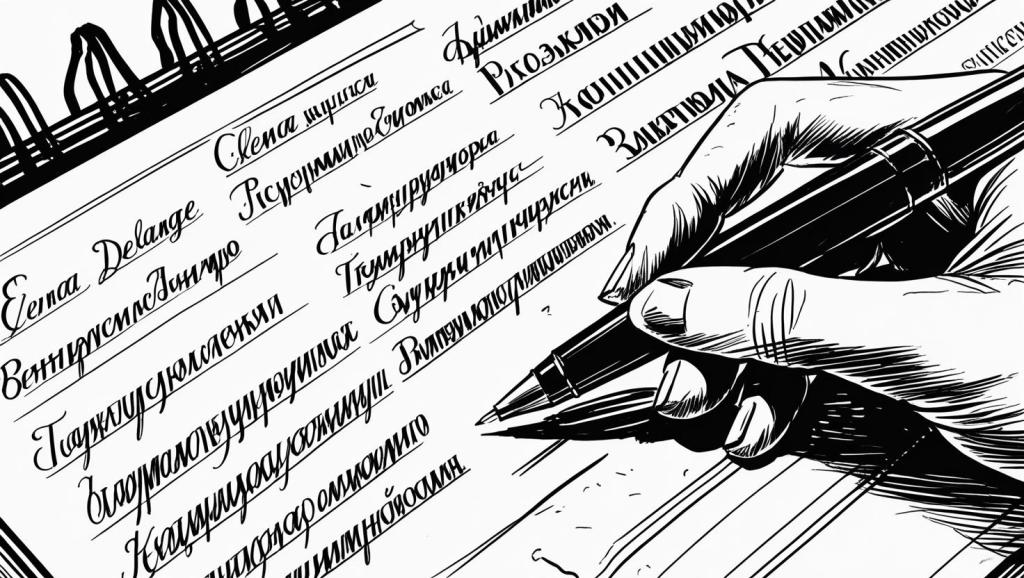
“I should sign this,” Elena said, eyes on the page.
Marko watched her uncap the pen. “Go on, then.”
I paused, considering. The words were simple: “Thank you for letting me try to see.” I signed in English, hesitated, then added my name in Cyrillic—the way Marko had shown me.
Елена Деланж
He glanced at the page. “You picked the local spelling.”
I nodded. “Feels right.”
For a moment, neither said anything.
The quiet of the palace pressed in, filled with old echoes and the faint scratch of my pen.
I closed the guest book gently, the soft thud echoing in the hall.
Marko offered me a small, uncertain smile.
“I can walk you back, if you like,” he said.
I shook my head and smiled—genuine, but with just enough distance. “Thanks, but I’d like to wander a bit. The city feels different now.”
He nodded, not pressing.
“Goodnight, Elena.”
“Goodnight, Marko.”
I stepped out into the fading light, letting Novi Sad’s rhythm pull me along. Of course, I was thinking about Marko—his careful distance, that ridiculous accidental kiss, the way he manages to be both transparent and unreadable at the same time.
Honestly, you’d think I’d have learned by now. Ciro swept me off my feet in his own spectacularly confusing way, and here I am again, apparently unable to resist a man with an accent and a talent for emotional ambiguity. Uff, girl, hold your horses. You’re a researcher, not a collector of bilingual heartbreaks, and you really don’t need to make a habit of this in every city with decent beer.
But then again, if life offers, who am I to decline? Maybe curiosity isn’t just for archives and interviews. But it did eat the cat! Okay, maybe, just this once, I can let myself see where the story goes, without footnotes or disclaimers.
Novi Sad blurred around me, all possibility and dusk. I almost at myself, but I kept walking, wondering,” Honestly, if I keep falling for men who can pronounce ‘phenomenology’ without choking, I’ll need to start a loyalty program; buy five heartbreaks, get the sixth espresso free.
Chapter 14: Revelations
Our second-to-last day in Novi Sad, and I found myself drawn to Danube Park—a 33,000-square-meter oasis in the city’s heart, where the chaos of traffic and construction melted into birdsong and the slow choreography of strollers. I wandered past flowerbeds and teenagers pretending not to notice each other, my camera dangling at my side, and stopped under the ancient English oak. Its trunk was scarred and ringed with barriers, as if the city had decided the best way to honour something old was to keep it out of reach.
Marko joined me, hands in his pockets, gaze fixed on the tree.
“The oak’s been here longer than the city,” he said. “Longer than any building we’ve photographed.”
“Does that make it more authentic?” I asked, half to him, half to myself.
He shrugged. “It makes it different. Trees don’t choose what to remember.”
We found a bench and let the afternoon unfold. Children darted between benches, old couples shuffled arm-in-arm, and pigeons patrolled for crumbs. None of it was in the guidebooks, but all of it felt like the city’s real pulse.
My thoughts drifted—always back to the project, the cards, the question of purpose. I was supposed to be documenting, but lately it felt more like searching for a reason to keep caring.
“I’ve been thinking about the cards,” I said, breaking our companionable silence. “About what charity they should support.”
Marko didn’t answer right away.
He’s good at waiting—maybe too good.
“I think you were right,” I continued. “About supporting the elderly. The ones with stories. The ones who remember, even when it hurts.”
He gave me a sideways look, half smile, half something else. “That wasn’t just my idea. You saw it. I just named it.”
I wanted to say something clever, something that would make it all feel less heavy. Instead, I watched a little girl climb onto the protective barrier around the oak, her father pretending not to notice. Preservation and distance, again. Sometimes the things we try to save are the ones we’re most afraid to touch.
If I’m honest, I wasn’t just thinking about the tree, or the cards, or even the city. I was thinking about Marko, about what we choose to protect, and what we risk when we let ourselves get close.
Maybe that’s the real revelation: that every act of preservation is also an act of longing, a hope that something or someone might last.
Chapter 14.5: The Evening After the Oak
Back at my hotel, I couldn’t process the day’s photographs. The images blurred together; the ancient oak, the families in the park, Marko’s expression when he’d talked about trees not choosing what to remember.
I scrolled through them, but nothing stuck. Everything felt just out of reach, like trying to recall a dream after waking.
A knock at my door interrupted the spiral. Marko stood in the hallway, holding a bottle of wine and looking—if I wasn’t mistaken—uncertain for the first time since I’d met him.
“I brought this,” he said, showing me the label. “From the restaurant with a view of the fortress. I thought you might want to taste again and decide if you actually like the outcome from the soil we’ve been talking about.”
I let him in, watching as he moved through my temporary space with the same careful attention he brought to everything else. He opened the wine with his usual methodical precision, but his hands were less steady than I’d ever seen.
When he handed me the glass, he stepped closer.
The wine’s perfume—earthy and a little sharp—mixed with the scent of his skin. His arm slipped around my waist, drawing me in until there was no polite professional distance left between us.
Is this a good idea? I wanted to ask, but the words came out as a half-murmur, half-laugh. “Good idea?”
I wasn’t sure if I meant the wine, the kiss, or the whole precarious experiment we’d been running since the brewery.
“Not sure,” he said, which would have been more convincing if his lips hadn’t found my cheek, just at the edge of my mouth—close enough to make the answer irrelevant.
Later, tangled in my guest nest, I stared at the ceiling, counting the spiderwebs and wondering how many of them had witnessed a scene like this before.
Marko lay beside me, silent, his hand tracing idle patterns on my hip, like he was trying to memorise a map he’d promised never to contemplate again.
“Well,” I said, “that certainly won’t go on the cards.”
He laughed, but there was something in his eyes, a flicker of something unreadable. Perhaps he carried a little sadness like his accent, impossible to translate, but always there in the background.
Or I was overthinking, as usual. Either way, I wasn’t about to interrogate the moment out of existence.
I almost laughed, too, but at myself. If this was a mistake, it was a thorough one, and worth a footnote in some future paper on the hazards of immersive research.
His fingers had been tracing lazy circles on my hip when I dozed off. I woke to the sound of him getting dressed.
“You’re leaving.”
“I have to.” He was buttoning his shirt, not looking at me.
“Because of her. The woman you live with.”
He stopped, hands still. “Mrs Dragica saved my family.
I met her when I was selling myself to keep us alive.
She gave me a way out. University, a future, security for my mother and siblings.”
He turned to face me. “In exchange for my complete devotion until she dies.”
The words hung in the form of a thread between us…
“And falling in love would break that pledge?”
“Yes.”
Chapter 15: Cathedral Church of Saint George
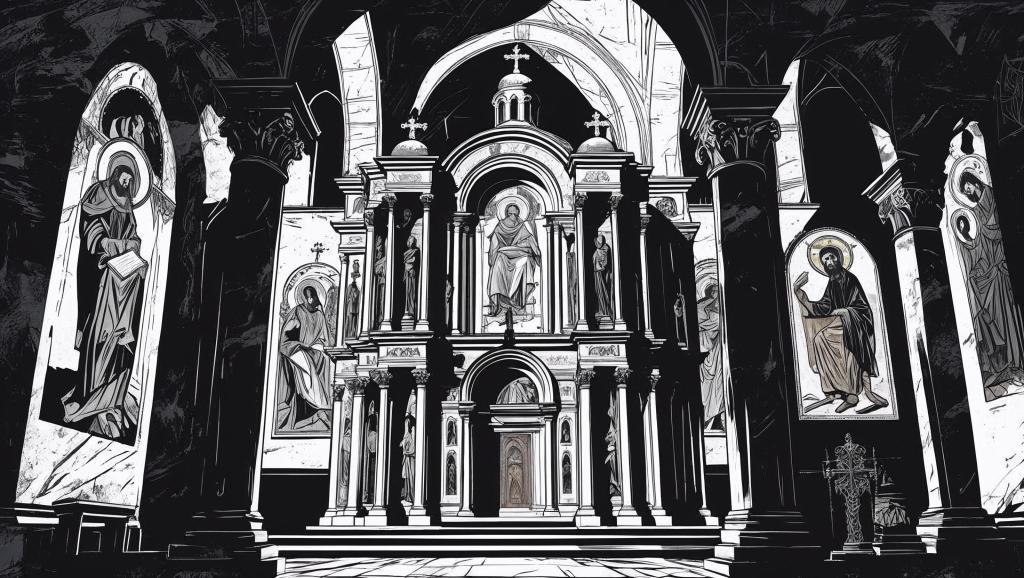
On our final day together, we visited the Cathedral Church of Saint George, with its iconostasis painted by Paja Jovanović and wall paintings by Stevan Aleksić. I photographed the religious art, the play of light through stained glass, and the faces of saints rendered with humanity and dignity.
But my mind kept circling back to the night before. A gigolo. Gods below!. I’d always prided myself on reading people, on understanding the subtext beneath surface interactions. Apparently, my radar was about as reliable as a chocolate teapot.
“Do you believe in God?” I asked Marko the question, slipping out as much to fill the silence as to probe the boundaries of belief. The iconostasis loomed, all gold leaf and solemn faces, a monument to faith I didn’t share. Redemption, salvation, words that belonged to another lexicon. But I was curious what they meant to him, a man who’d lived through so much.
“I believe in the human need to create meaning from beauty,” he said. “Same thing, maybe.”
I looked at the painted faces surrounding them, saints and angels and Christ himself, all rendered by human hands, trying to capture something beyond human understanding. Saints who’d probably had their own complicated pasts.
Though I doubted any of them had a CV that included “exotic dancer.”
“My cards won’t capture this place,” I said, focusing on the work because that was solid ground. Professional. Safe.
“No. But they will help people find their way here. And then the place can speak for itself.”
“Speaking of speaking,” I said, adjusting my camera settings, “just out of curiosity, have you always been a… You know?”
“A gigolo?” He almost smiled. “No. Before that, I was just a stripper.”
I nearly dropped my camera. “Oh, well, that’s reassuring. I was worried you might have started with something really shocking, like accounting.”
May your numbers synchronise under the right star,
Irena Phaedra
Note: this is an early draft excerpt. The edited version of The Frontier Chronicles will be available soon.
The Frontier Chronicles © 2026 I.Ph. de Lange All rights reserved. Published by CYcrds OÜ.
 The C.O.M.C. Files