
Chapter 10: Brauhaus
That evening, Marko took me to the Brauhaus Brewery, where the air was thick with the scent of hops and roasted barley, and the hum of conversation blurred into a comfortable background.
“Ah, Brauhaus—where the umlaut is foreign, the beer is local, and ownership is Dutch. Authenticity, served cold… with a corporate twist.”
The tables were worn smooth by years of elbows and laughter.
I’d planned to photograph the brewing process for a card about local traditions. Still, I found myself more interested in watching Marko explain the beer’s flavour profile with the same methodical precision he brought to describing the fortress’s architecture or troubleshooting sound equipment.
“You approach everything like a systems analyst,” I teased, swirling the pale amber liquid in my glass.
He grinned, eyes crinkling. “Because everything is a system. This brewery, the city’s tourism infrastructure, and the way people connect with places they don’t understand yet.”
He pulled out his phone, thumb brushing mine as he handed it over. “I built this for the brewery, it lets customers trace the source of every ingredient, learn about the traditional processes, even connect with local farmers. The owner’s daughter manages the content.”
I studied the screen. The design was clean but personal, clearly crafted for this place and no other.
“The Amsterdam team reviewed this in my interview,” Marko said. “They called it ‘charming but not scalable.’ Their goal is a platform that works for any brewery, restaurant, or local business. One codebase, infinite deployments, maximum efficiency.”
“And what do you want?” I asked, feeling the beer’s warmth in my cheeks.
”He hesitated, then put his phone away. “I want to keep developing programs that can’t just be copy-pasted, code that, like plants, takes root and grows uniquely from the soil I cultivate.” He shrugged. “But that’s not how you build a tech career anymore.”
“You’re not just a guide,” I said, surprising myself. “You’re a translator.”
He looked at me, really looked, and for a moment the noise of the brewery faded. “Between what and what?”
“Between the city and people who don’t speak its language yet.”
He smiled, softer this time. “Is that what you think you’re doing? Learning the city’s language?”
“I’m trying to,” I said. “But it’s more than that. With CYcrds, I want to let the city speak for itself—to show and share its stories, its layers, its history, understood. Not just to document but to translate. To let anyone, anywhere, feel what it’s like to stand here, breathing in centuries of life.”
For a while, we just sat there, the world around us blurring into golden light and laughter. Our knees touched under the table. I felt the beer’s gentle spin, the warmth of his presence, the way Marko’s gaze lingered on my mouth when I smiled.
He leaned in, just enough that I could smell the hops on his breath. The space between us felt impossibly small. I didn’t think, I just leaned forward, and so did he.
The kiss was soft, hesitant, tasting of beer and uncertainty. We pulled apart almost at the same time, both of us startled, the spell broken by the scrape of a chair nearby.
I looked away, pretending to check my phone.
Marko cleared his throat, his hand already moving to gather his things.
“It’s late,” he said, voice a little rough. “I should get you back.”
We didn’t speak much on the way out. The air outside was cool, the city lights sharp against the night. I tried to focus on the sounds of Novi Sad settling into darkness, not the feel of his lips or the awkward silence growing between us.
But even as we walked apart, I knew something had changed; something neither of us was ready to name.
Chapter 11: The Serbian National Theatre
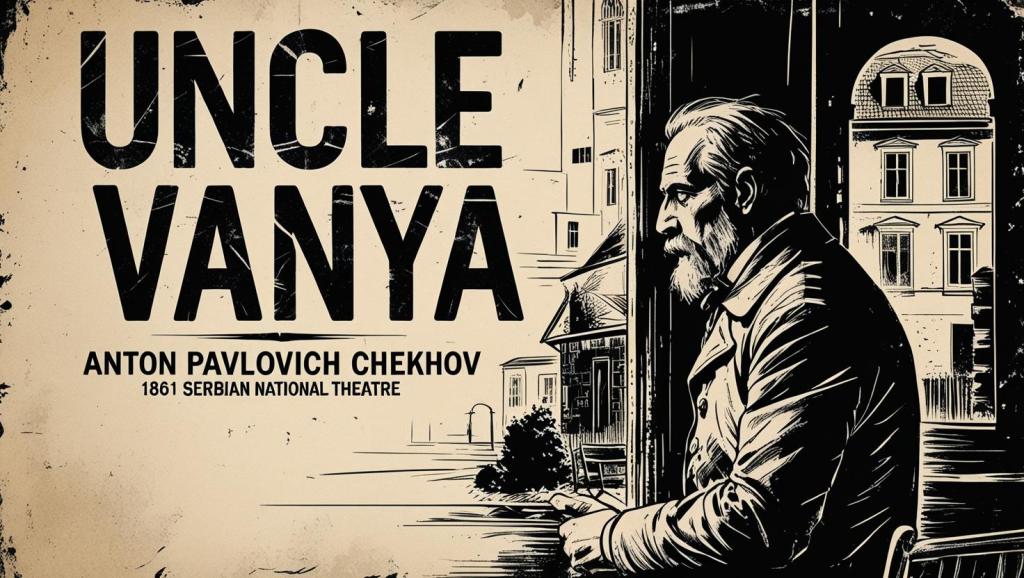
The next day took us to the Serbian National Theatre, established in 1861 but now housed in a modernist block from 1981. I photographed the façade, the lobby’s marble and glass, the main stage as it was being dressed for Chekhov—props scattered, the hush of anticipation thick in the air.
“Chekhov in Serbian,” I mused, lowering my camera. “Translation again.”
Marko smiled, but it didn’t reach his eyes. “Everything is translation. Even speaking to someone in your own language. You’re always trying to convey something internal through external means.”
I glanced at the stage, where a faded poster announced Uncle Vanya. Anton Pavlovich Chekhov, a Russian playwright, is beloved in Serbia.
His plays have been staged here for decades, admired for their emotional subtlety and the way they capture longing, silence, and the complexity of everyday life. Serbian theatres return to Chekhov again and again, finding in his work a mirror for their own history and sensibility.
“Do you think Chekhov survives translation?” I asked.
Marko considered. “Maybe not in the details. But in the feeling—the ache for something just out of reach, the way people misunderstand each other, even when they’re speaking the same language—that survives. Maybe that’s why his plays work everywhere.”
We sat in the empty theatre, velvet seats yawning around us. The space felt expectant, holding its breath for the evening, for the audience, for the collective suspension of disbelief that would transform actors into characters and the stage into a world.
I glanced at him, unsure how to broach the awkwardness that had settled between us since last night.
“What are you translating?” I asked quietly.
He looked at the stage, not at me. “What do you mean?”
“In your work. What internal thing are you trying to make external?”
He was silent for a long moment. The hush of the theatre seemed to press in on us, amplifying the distance.
“The feeling of belonging to a place that’s always changing,” he said finally. “Of loving something that might not exist the same way tomorrow.”
I understood this, though I’d never found the words for it. My own work—academic, methodical—had always been about preservation, about holding onto things that seemed always on the verge of disappearing.
“I’m sorry about last night,” Marko said suddenly, voice low. “I crossed a line. That was unprofessional.”
I shook my head. “We were both there.”
He gave a small, humourless laugh. “Still. I don’t want to pretend it didn’t happen. Or that it didn’t mean anything.”
We sat in silence, the stage lights warming to life, the city outside shifting restlessly. For the first time, I wondered if we were both translating the same longing, trying to make sense of something fleeting, impossible to hold.
Chapter 12: Zmaj Jovina Street
We walked down Zmaj Jovina Street, one of the city’s oldest thoroughfares, now lined with cafés and shops.
The air was alive with voices, the clink of coffee cups, the scent of fresh bread and rain on stone.
I photographed the street’s layered facades—Austrian, Ottoman, Socialist—evidence of the city’s endless cycle of destruction and rebirth.
“After the 1849 revolution,” Marko explained, “most of the city centre had to be rebuilt. Every building you’re photographing represents someone’s decision about what the city should become.”
I paused outside a bookshop, watching through the window as an elderly man debated something with the proprietor. Their gestures were broad, faces animated by whatever literary, political, or philosophical point was at stake.
“Do you think they know they’re part of the city’s cultural heritage?” I asked.
Marko’s answer was quiet, almost lost in the street noise.
“Do you know you are?”
The question stopped me. I was used to being the observer, the documenter, the outsider looking in.
It hadn’t occurred to me that my own presence—my project, my interactions with Marko, my slow learning of the city—was also shaping the ongoing story.
I looked at him, searching for something in his expression. He seemed both closer and further away than ever, as if he was weighing what to reveal and what to keep hidden.
“Marko,” I said, “why does it feel like you’re always holding something back?”
He didn’t answer right away. Instead, he watched the old men in the bookshop, his reflection overlapping theirs in the glass.
“Maybe I am,” he said finally. “But I’m trying not to.”
We stood together, the city moving around us, both of us caught between what was being preserved and what was being lived.
May witt hold you steady, and mischief find root in unlikely places,
Irena Phaedra
P.S. Some chapters plant seeds, others pull back the curtain. The next one? Let’s just say it changes the view. The story gets juicier…
 The C.O.M.C. Files