
Chapter 5: The Synagogue, Novosadska Sinagoga
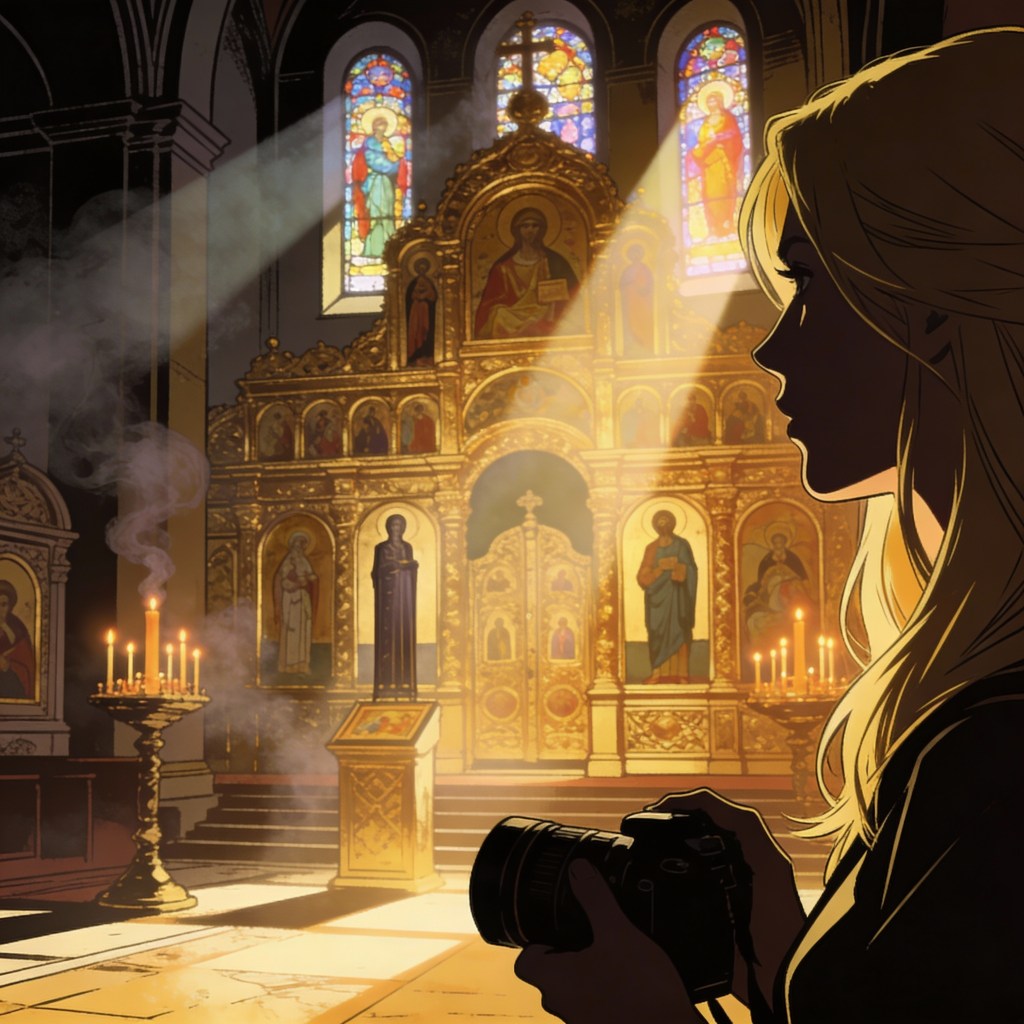
The synagogue unsettled me from the moment we stepped inside, because the air itself seemed to hold its own memory. I’d read the history: built in 1909 for a thriving Jewish community, it later served as a deportation centre during the war, and now it’s a concert hall, though still open for the few remaining families to mark their holidays.
But the facts felt thin compared to the reality of the space: the hush that settled over us, the way colored light filtered through stained glass, the acoustics that made every footstep resonate as if the building itself was listening.
Marko’s voice was low as he explained, “The same acoustics that make it perfect for classical music once carried prayers—and later, screams.” The words lingered in the air, and I felt something shift in my understanding of what I was trying to capture with my cards. This wasn’t just about beauty or history; it was about memory, and the way a place could hold both celebration and trauma in the same breath.
I spoke before I’d really thought it through. “My cards—what charity should they support?”
Marko looked at me, surprised. “That’s a good question. I haven’t thought about it much. Maybe we should ask around, see what the community feels is needed.”
“But what would you choose?” I pressed. “And don’t just think about the human impact—consider the system design, too. What kind of intervention would actually work?”
He was quiet for a long moment, and I could almost see him running through possibilities, weighing outcomes the way he does with coding. “Maybe something for elderly people,” he said finally. “The ones who remember what this place was like before. They have stories, but not many people left to tell them.”
“Like your heritage trail app,” I said.
He glanced at me, a little startled. “You looked at my work?”
I felt myself blush. “I was curious about your work. Your real work, not just the guiding.”
A rare smile flickered across his face. “That app is what I’m proudest of. When you grow up in a place like Crna Trava, you learn early how much local stories matter. It’s why I built it to be community-controlled, something that grows on its own terms, not just another platform to scale. The opposite of what Amsterdam wants me to build.”
“Community-controlled.” I turned the phrase over in my mind. In this part of the world, those words still carried the aftertaste of communism—collective farms, committees, decisions made by everyone and no one. But in Marko’s mouth, it sounded different. Less about ideology, more about belonging. I wondered if it was possible to reclaim the idea, to let it mean something honest again.
We stood in the centre of the synagogue, surrounded by echoes of music, of prayer, of things lost and things still holding on. For a moment, the distance between us felt smaller, bridged by the quiet understanding that some stories resist being packaged, and some interventions are only meaningful if they let a community speak for itself.
Chapter 6: Strand Beach
Saturday brought a heat that seemed to rise from the cobblestones themselves. Marko suggested Strand Beach—a long, sandy stretch along the Danube where Novi Sad comes to breathe in the summer. Officially opened in 1911, but loved by locals long before, it’s where families, teenagers, and old friends all seem to find their way when the city gets too hot to bear.
The beach was crowded: families under striped umbrellas, teenagers volleying a ball over sand, vendors hawking beer and grilled corn from battered coolers. I tried to capture the scene—the easy laughter, the slap of water, the way even strangers seemed to belong here for a few hours. But my lens kept drifting to Marko.
He moved through the crowd with practised ease, pausing to greet the elderly man renting pedal boats, chasing down a runaway beach ball for a harried mother, accepting a beer from a group of friends who greeted him with a mix of affection and teasing. I watched the way he fit, and wondered what it meant to belong somewhere so easily.
“You grew up here,” I said. It wasn’t a question.
He hesitated, then shook his head.
“Not really. I came to Novi Sad young, did whatever work I could find.”
He glanced at the river, then back at me. “Eventually, I started looking after an elderly woman. She had no family, but she made sure I had a place to stay and pushed me to study. That’s how I ended up in IT.”
His voice was even, revealing nothing. I sensed there was more, but I let it rest.
“And now?” I asked.
He shrugged. “Now I’m deciding if I want to build the infrastructure for other people’s experiences, or finally claim something for myself.”
I lifted my camera and photographed him as he looked out at the river, his expression unguarded for once. For a moment, I wasn’t sure if I was capturing the place or just trying to understand the distance in his gaze.
May the sense of life find us,
Irena Phaedra
© 2026 I.Ph. de Lange All rights reserved. Published by CYcrds OÜ.
 The C.O.M.C. Files