
Novi Sad
Synopsis
The Chronicles of a Memory Cartographer: Novi Sad follows Dr. Elena Delange, a seasoned anthropologist and creator of CYcrds, as she arrives in Novi Sad to map the city’s living memory; not with lines and coordinates, but with stories, images, and the subtle traces left by generations.
Fresh from her transformative experience in Naples, Elena seeks to bridge the gap between academic inquiry and everyday life, curating a new deck for Cultural City Cards that captures the spirit of Novi Sad.
Along the way, she meets Marko, a local IT coder with a pragmatic outlook and a double life. Marko guides Elena through the city’s undercurrents, while Elena, in turn, challenges Marko to look beyond algorithms and see the poetry, complexity, and humanity woven into the everyday.
As they collect stories from the city’s streets, both discover that mapping memory is as much about changing how you see it as it’s about preserving what’s there — and that every chronicle is also an invitation to transformation, a confession of shifting perspectives…
Chapter 1: Arrival at Železnička stanica Novi Sad
I call myself a memory cartographer, though I’ve never owned a compass or drawn a single map. My tools are less precise: a battered notebook, a camera that’s seen too many borders, and a curiosity that refuses to fade with age.
Cities rarely reveal themselves all at once; they are palimpsests, layered with stories, secrets, and the silent weight of time.
Ten years of researching heritage in European cities had shaped my habits: methodical, professional, and invisible — the kind of middle-aged woman who blended into crowds and spoke to no one unless necessary.
In Naples, though, those habits were unsettled. There, memory drifted through the city like music from an open window — impossible to pin down, yet impossible to ignore.
I arrived expecting to observe, but found myself drawn into a mosaic of stories: midnight conversations with Ciro, laughter in alleyways, learning that the past isn’t just inscribed in stone, but lingers in gestures and the way people remember and forget. I left with the sense that memory is less an archive than a current, sometimes hidden, sometimes rushing, constantly reshaping the landscape it moves through.
That lesson followed me to Novi Sad, where I hoped, once again, to trace not just monuments, but the quiet mysteries that give a city its soul.
The train from Belgrade rattled into Novi Sad just after noon, the windows streaked with dust and the promise of summer storms.
I stepped onto the platform, suitcase in one hand, notebook in the other, and my camera bag dangling.
Outside, the city shimmered — old facades patched with new paint, the river glinting beyond the trees. I could smell the rain on hot pavement, combined with the air on the train platform, which was thick with diesel and cigarette smoke, the low murmur of travellers blending with the distant clang of tram bells.
I adjusted my camera bag, feeling the familiar ache in my shoulder — a reminder that every journey leaves its mark, even before it truly begins.
I was here to create a new deck for CYcrds: fifty-eight glimpses into the city’s soul, each card a small act of preservation and rebellion. This work felt meaningful and collaborative, a way to build bridges that lasted beyond the page, to give Novi Sad’s stories a tactile presence in people’s hands, and to let the city’s quiet voices be heard beyond the walls of academia. For me, this deck was more than a project; it was a way to return to the root of my curiosity, to collaborate with artists and neighbours, and to prove that heritage could be both a celebration and a catalyst for change.
But standing there now, breathing air thick with the weight of 330 years, I wondered: could fifty-eight cards ever hold a place like Novi Sad? The city’s official story began in the late 17th century, yet people had lived on this ground since the Stone Age — Romans, Celts, and medieval folk all leaving their traces beneath my feet.
My phone buzzed. A message from the Upwork platform:
Marko will meet you at the fortress at 3 PM. He knows the city better than anyone.
I smiled, half in anticipation, half in memory. In Naples, I’d set out to work alone, but meeting Ciro had changed everything, reminding me that cities, like stories, are best explored in company. Novi Sad already felt less like a city to be conquered and more like a puzzle to be solved — one I might need help to piece together.
I stepped out of the station and into the city, notebook in hand, ready to begin my map, one memory at a time.
Everything felt both familiar and slightly off, as if I’d wandered into a memory that wasn’t quite mine.
I unpacked in my rented flat above a bakery, the smell of bread rising through the floorboards. Outside, thunder rolled over the river. Later that evening, I sat by the window, notebook open, and wondered what it would take to feel at home here, or anywhere.
Chapter 2: The Guide
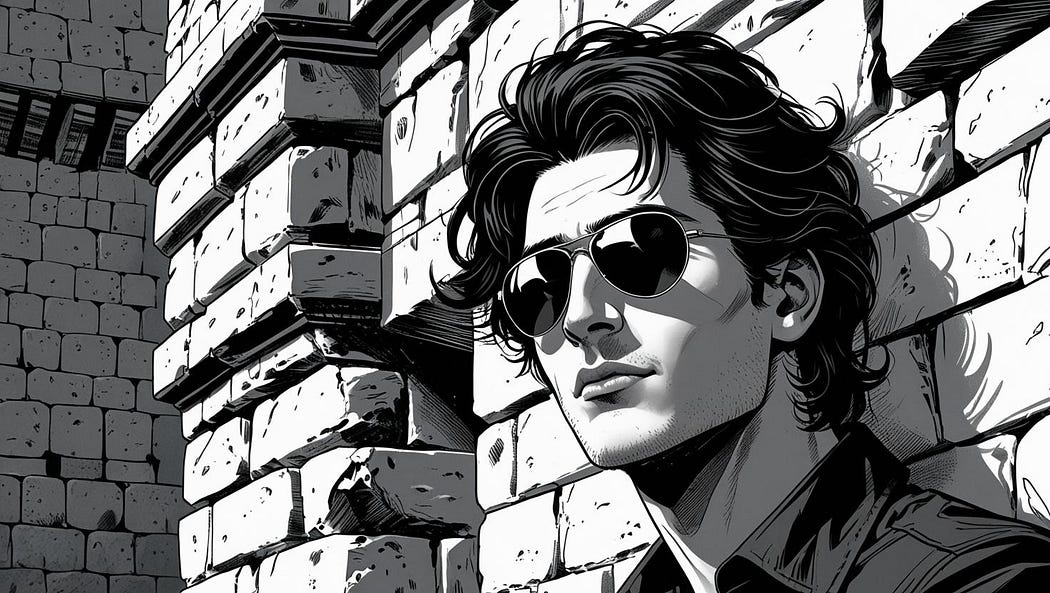
I found Marko Petrović waiting by the fortress wall, sunlight glinting off the edge of his sunglasses. He was taller than I’d expected, with a kind of quiet self-assurance that made him seem at home even against centuries-old stone. Nothing about him suggested the stereotype of the pale, hunched programmer I’d half-imagined on the train.
“Dr. Delange?” He straightened, brushing imaginary dust from his sleeve before offering his hand. His English was polished, sharp, with an accent shaped by explaining code to clients from every corner of the globe.
“You’re here about the Cultural City Cards project.”
There was a precision in the way he spoke, an economy of words that suggested a mind trained to solve problems efficiently. He seemed practical, focused, qualities I’d come to expect from people who work with code. Yet beneath that focus, I sensed a quiet alertness, a habit of reading the room, as if he’d learned early that survival depended on noticing what others missed.
“So, you’re the cultural anthropologist from London,” he said, a quick, genuine smile flickering across his face. “I liked your project description. It sounded… different.”
I nodded, setting down my camera bag. “And you’re the only applicant who didn’t try to sell me on SEO optimisation or a chatbot. That counts for a lot.”
He laughed, the sound easy and unforced. The platform hadn’t sent me a guide; it had connected me with someone who, at least on paper, knew his way around both code and cobblestones. For now, that was enough. Sometimes, the best collaborators are those who’ve had to invent their own paths.
I gestured toward the equipment and the banner. “Is this your side project, or just a favour for a friend?” The fortress must have seen its share of stories.”
Marko’s smile deepened, as if he recognised the invitation to go off script. “Every place tells you what it wants to be,” he said, glancing up at the stone above us. “These walls have seen more than most. They know how to keep secrets.”
There was a brief pause. I caught the hint of something left unsaid, but Marko just looked out over the city, unreadable. I let it be and filed it away. In my experience, the best answers surface when you stop chasing them.
“Most people see Novi Sad as a stopping point,” he said, his gaze fixed on the city. “Somewhere between Budapest and Belgrade. But you’re here for two weeks.”
“The complexity requires time,” I said.
He glanced at me, one eyebrow raised. “Does it? Or does time require complexity?”
Note to self: Novi Sad, it turns out, is best discovered with a guide who knows how to be both present and unreadable.
© 2026 I.Ph. de Lange All rights reserved. Published by CYcrds OÜ.
 The C.O.M.C. Files