
Journey Through Myth, Memory, and Mild Misadventure
This particular incursion unfolds years after my first, and this time, I arrive with my own expeditionary force: my youngest daughter and her father. The occasion? In her infinite wisdom (and with grades to match), she selected Leeuwarden as her academic hunting ground. Early acceptance, no less—her scholastic prowess opening doors from The Hague to Utrecht, but, to my delight, she chose the northern outpost.
We landed in a biting December. Her father, a man who’s traversed every conceivable corner of the globe, somehow never managed to set foot in Amsterdam- ironic, considering he met me in his hometown after a South American sojourn. He likes to claim he searched the world only to find me right where he started, but that’s a tale for another time.
So, on our first day, I wandered awkwardly among the tourists in my birthplace, Amsterdam’s very heart, paying my respects, naturally, to the Wallen. To my surprise, the women in the windows were all young and attractive; gone were the days of the older, rounder, and more boisterous dames I remembered. Progress, I suppose, or perhaps just a shift in the market.
The next day, we set our course for Frisia. As we crossed the Afsluitdijk, my team stared, wide-eyed and slightly overwhelmed, at the endless waters hemming in the road, a landscape equal parts Dutch engineering and myth. Arriving in Leeuwarden was a breeze; the car’s computer led us straight there, though, as usual, a student’s improvised navigation through the university’s labyrinthine buildings outperformed any machine.
How I wish I could linger here, to wander and teach them all I’ve unearthed about Frisia, perhaps starting with the origins of its name.
Fryslân
De namme komt fan Freyr
Seekaarten wize nei Magna Frisia
Eilân ûnder Iislân.
Translation:
Friesland
The name comes from Freyr
Sea charts point to Magna Frisia
An island beneath Iceland.
And then, of course, there are the legends and their flag, which, wherever possible, the Frisians display with the pride of a people who know their roots.
De pompeblêden
De âldste Europeeske flagge kaam as banier fan de ferballe Skandinavyske kening Friso om it jier 1085 hinne dy’t him hjir ta wenjen sette en dêrmei de blauwe banen en de herten (pompeblêden) yntrodusearre.
Translation:
The water lily leaves
The oldest European flag arrived as the banner of the exiled Scandinavian king Friso around 1085. He settled here and thus introduced the blue stripes and the hearts (water lily leaves).
But back to the journey: my daughter was enchanted, and her father, after sampling the old town and its many establishments of entertainment, was convinced. (Let’s be honest- alcohol remains a core subject at university, not that he’d know from experience.)
After some meandering, we returned to Amsterdam and indulged in poffertjes and a respectable Italian dinner. The next morning, they departed for Spain, while I boarded a plane for my next adventure: Tallinn, Estonia. But that, dear reader, is another story.
Fast forward: the next expedition, this time with the backup team (read: grandparents) and her father, to celebrate my daughter’s birthday in Frisia. She’d struck a bargain with grandpapa, so there we were. The trip was no conquest but almost as heroic, despite grandma’s back pain, grandpa’s recently operated heart, and our collective disregard for the car’s navigation system. The navigator seemed determined to parade us through every possible detour in Leeuwarden, turning our arrival at the hotel into a slapstick odyssey that had us all in stitches, aches and all.
After the comic-tragic trip, we found ourselves in the heart of Leeuwarden, in an old palace moonlighting as a hotel.
The Stadhouderlijk Hof was once a noble residence, then the seat of Frisian stadtholders, later a royal palace, and finally a hotel. It is a living testament to Dutch adaptability and the layers of history one can sleep between.
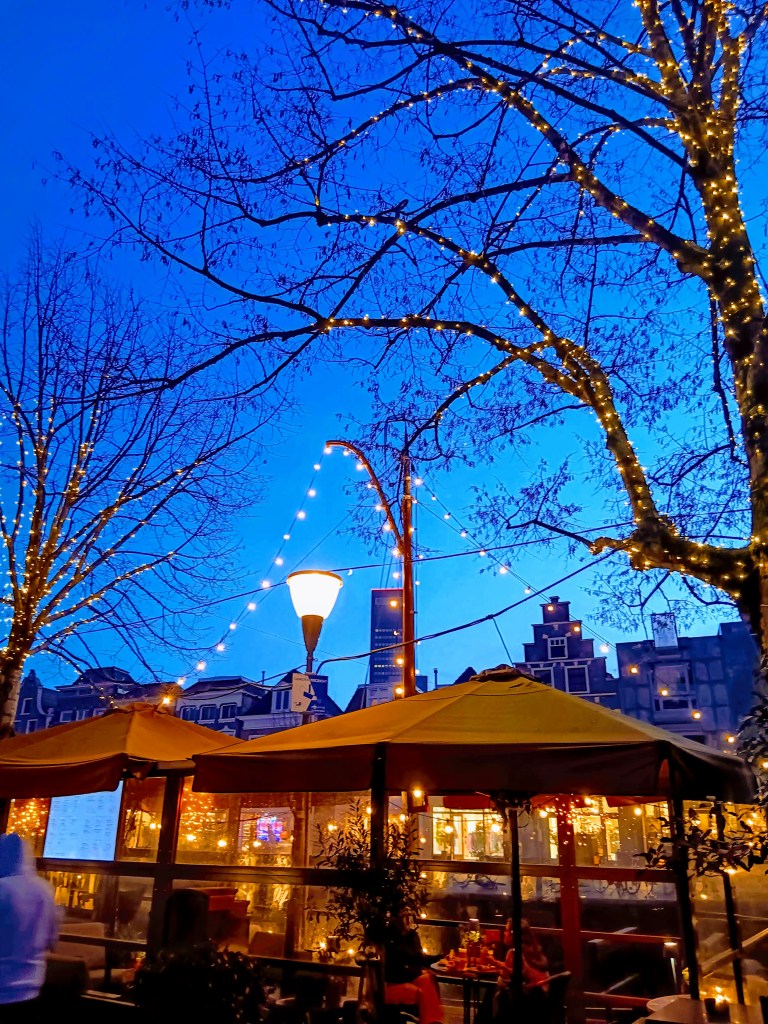
That evening, I sat outside with my team at the very spot where, nearly a decade earlier, I’d been charmed by Roos and Rienk and the promise of Frisian culture. Then it was July, now October, chillier, but the Frisians, ever pragmatic, refused to let the elements dictate their joy. Under vast umbrellas, heaters blazed, blankets lay ready, but no one needed them; the beer flowed, the snacks kept coming, and the laughter was undiminished.
The grandparents were content, except for one (more) navigational misadventure, when their son, in a feat of misplaced confidence, led us straight into what turned out to be an elderly home. We realised the mistake only as the rain began its gentle assault, and, as fate would have it, not a taxi in sight for over an hour. So, there we were: bedraggled, slightly bewildered, and forced to stumble back through the drizzle, dignity only somewhat intact.
After countless dinners, sightseeing, and even a boat trip through Leeuwarden’s canals, it was time to say goodbye to where I first lost my heart: Magna Frisia.
But of course, dear reader, there is always an epilogue, yes siree.
Two months later, I returned to reconnect with my old love.
Now, for you, the question-and for me, the answer-who, or perhaps what, that love might be.
May Harmony find you,
Irena Phaedra
P.S. For the record, the only real conquest that weekend was our accidental invasion of an elderly home, led by a navigator (read father) convinced it was a hidden gem. With no taxis for an hour and rain as our only companion, we stumbled back, soaked but laughing. If you ever want to test family bonds, try getting lost in the drizzle with three generations and a malfunctioning sense of direction. It’s less Magna Frisia, more Magna Farce, but perhaps that’s the true legend.
 The C.O.M.C. Files
“I love the cadence of the name—Magna Frisia—it rolls off the tongue with the kind of mystery and swagger that makes for a legendary expedition. My own adventures, whether through history or imagination, always seem to pick up that same rhythm: part fact, part fiction, and entirely my own. So, whether Magna Frisia was a kingdom, a confederation, or just a really good story, it’s the kind of name that makes you want to set sail, or at least write about setting sail, on a journey both ancient and new.”
LikeLike