
Part Three: Skûtsjesilen, Suspicion, and the Art of Getting Lost
October 2016.
The invitation drifted in on an October tide, from Ulbe Zwaga himself, a man whose handshake carries the weight of Frisian tides and whose conditions are as non-negotiable as the North Sea.
The catch? I’d have to join the Skûtsjesilen-a Frisian regatta, where old cargo barges, once resigned to hauling coal, now race for glory and local bragging rights.
In return, Ulbe dangled the promise of privileged access: a glimpse of the elusive Frisian islands- Texel and her wind-battered sisters- and a tour laced with local lore. I accepted, graciously, though not without the gnarly memory of childhood lakes and my well-honed Spanish habit of dodging nautical invitations. After all, I live by the coast, and every mother-womb-loving (read the sea) miscreant here has a vessel. My sea legs are the stuff of myth, specifically, the myth that they exist.
Still, off I went. The welcome was warm, the reconnection marvellous. Ulbe’s day workers and afternoon beer buddies no longer scandalised at my presence; I had, it seemed, graduated from curiosity to tolerated anomaly. But his daughter, ah, the daughter had other plans. She spirited me into the woods, a rite of passage for the suspicious mind. The forest thickened with every question, but I answered each one, no matter how pointed or peculiar. Anthropological weirdness, it turns out, is both a curse and a key. When she was finally convinced of my incomprehensible curiosity, she found the way out.
The big (and early) morning arrived. I eyed my yellow skinny pants and cowboy boots with regret, sartorially adventurous, perhaps, but not exactly seaworthy. Time to don the uniform of the initiated, or at least something that wouldn’t get me thrown overboard before the first tack.
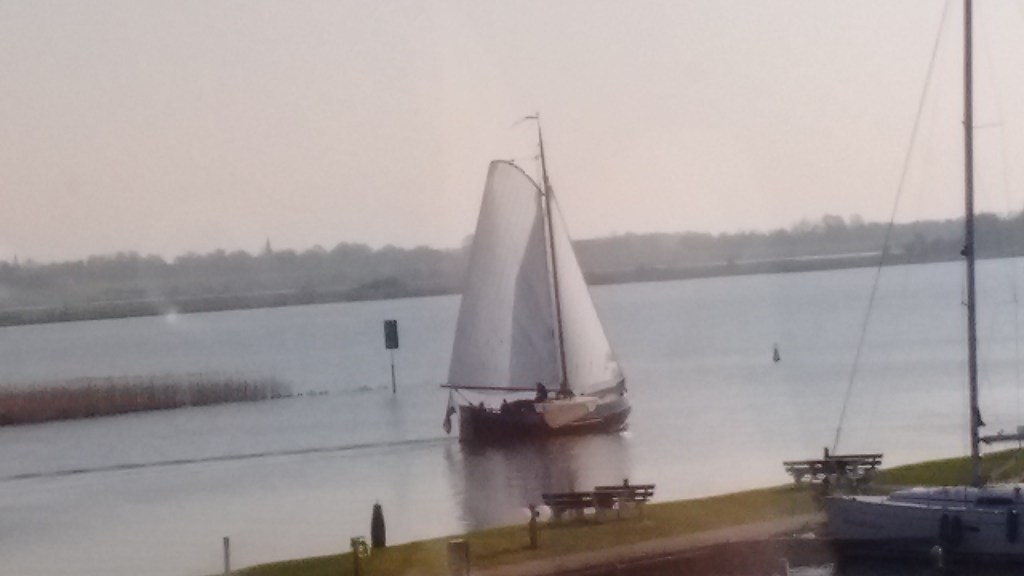
By the time I’d spirited away a mug of coffee and stepped out the door, the Skûtsje awaited, majestic, freshly painted, and radiating the kind of pride only days of communal labour can produce.
The crew was already assembled, each absorbed in their task, a silent choreography of competence. I was helped aboard—graciously, if not entirely without trepidation- and Ulbe handed me a rope, gesturing toward the bollard.
I managed to loop it around on the first try. Ulbe’s smirk was subtle but unmistakable- a small, private victory. Only later did I realise the crew had been watching from the corners of their eyes, taking the measure of the outsider.
Apparently, years of horse fetching at the behest of older girls had prepared me for this moment.
Anthropological lesson: Every society has its rites of passage; some just involve more livestock or nautical hardware than others.
We set off under engine power, gliding over waters so still they seemed to conspire with the morning. Nature was in quiet cohesion, save for a herd of deer Ulbe pointed out with conspiratorial delight. The voyage was thick with expectation, which settles in your bones when you’re both guest and experiment.
As the waterways narrowed and the bridges multiplied, the landscape pressed in, a reminder that in Friesland, even the journey is a negotiation with history and topography. The spectacle was an example of organised chaos when we arrived at the gathering point. Skûtsjes moored side by side, music blaring, voices greeting old friends and rivals alike. It was busy, loud, and unmistakably Frisian, yet somehow, everyone knew exactly where to be. Skûtsjes everywhere, a flotilla of tradition and rivalry..To reach the shore, we had to hop from barge to barge- a literal leap of faith across decks, ropes, and the unspoken rules of maritime etiquette.
As I steadied myself on the final deck, now clad in borrowed sailing gear and buoyed by the subtle nods of acceptance, I realised the real trial lay ahead. Beyond the last barge, the bridges fell away, and ahead the open waters of Heegemeer beckoned wide, grey, unpredictable, and waiting for their next story.
May Harmony find you,
Irena Phaedra
P.S. Next time: As the starting horn sounds over the Heegemeer, I join a crew moving as one bound by wind, water, and a tradition older than any map. The Frisians read the breeze like a family secret, while I do my best to blend in, armed with orders and a stubborn compliance. Out here, there’s no rivalry, only rhythm, and every outsider’s blunder becomes part of the story the lake will whisper long after the sails are furled.
 The C.O.M.C. Files
One Comment Add yours