
How Old Magic Rekindles New Inspiration
There are people who live one life in one place with one story. I am not one of those people. I have lived many lives—sometimes all in the same afternoon—and if there’s a thread running through them, it’s that I seem to leave a trail of art in my wake, like breadcrumbs for the aesthetically obsessed. And, as some have whispered (or declared outright), a touch of the witch’s magic too.
The First Portrait: The Origin of the Muse
My debut as a muse was not of my own making. Fifty-two years ago, my mother commissioned my likeness in oil. I was immortalised before I even understood what it meant. That painting still exists, a silent witness to the beginning of a pattern: people see me, and suddenly, they need to capture, sculpt, or paint what they cannot quite name.
The Basque Sculptor: Freedom and Witchery
The first time I inspired art for love it was a Basque sculptor smitten by my insatiable hunger for freedom. I was young, wild, and apparently, muse material. He tried to carve liberty into amber and capture it on canvas as if he could keep it on a shelf. I never told him that freedom, like a true muse—or a witch—can’t be contained. Perhaps this untamable spirit made some quietly murmur “witch,” half in awe, half in warning.
The Supermarket Encounter: The Art of Being Unforgettable
Then there was the sleepy, snobbish town near the German border, where I landed for “family reasons” (a phrase that deserves its own column). I was the only mother with long blond hair, an ankle-length fur coat, and a hat, pedalling a bicycle through the village like some misplaced character from a film noir.
One day, in the supermarket, a man said, “Nice hat you have there.” I replied, “Why, thank you,” and pedalled off, thinking nothing of it.
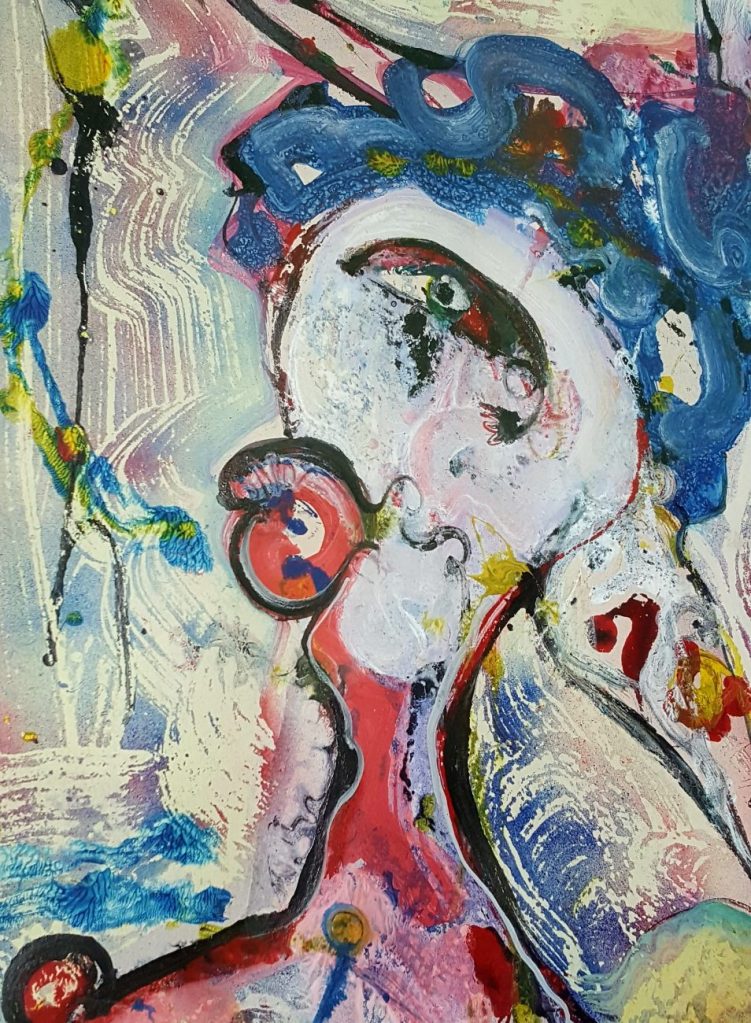
That afternoon, my doorbell rang—a rare event, as most people in that town preferred to sneak in through the back. There, on my doorstep, was an enormous painting and a note:
I have tried to get you from my mind on a painting so I can think of anything else.
How did he know where I lived? Easy. I was the only woman in town who looked like she’d escaped from a Prudence Flint painting and rented the only empty house on the outskirts.
The paintings kept coming, year after year, until one day, they stopped. He had passed away, but the canvases remain—a gallery of silent conversations and, perhaps, a touch of enchantment.
The Harvard Haiku and the Flying Dutchman
Of all the tributes a muse might collect, few are as delightfully peculiar as the ones that found their way into my post box courtesy of a Harvard professor. Not just any professor, mind you—a published novelist, poet, and castle owner with a Wikipedia page to his name. While others sent flowers or letters, he composed haiku: those crisp, three-line Japanese poems designed to distil longing, beauty, and obsession into a handful of syllables.
There is a special kind of infatuation that fits inside a haiku—intense, compressed, and, in his case, delivered with the regularity of a postal subscription. I sometimes wondered if the neighbours thought I was running an underground poetry syndicate or if the local postman suspected I was the subject of a very niche literary experiment.
And then there was the Dutchman—my daughters, with a flair for the dramatic, dubbed him “the Flying Dutchman.” He was less about subtlety and more about spectacle: he tattooed my name, PHAEDRA, in enormous light blue letters across his forearm. Not a haiku, but certainly poetic in its own operatic fashion. If the Harvard professor immortalised me in verse, the Dutchman did so in ink—proof that the muse’s spell can be cast in syllables or skin, and sometimes both at once.
The Polish Intermezzo: The Muse Abroad
Years later, on a business trip, I found myself snapping photos and running into two Polish men enjoying a drink. They were amicable and witty, but I declined their invitation after a brief exchange. But fate, or perhaps the muse’s mischief, intervened. We crossed paths again, and this time I accepted.
Wine flowed, languages mingled, numbers were exchanged.
A few days later, my phone buzzed with a photo: a painting of me, and a question—Where can I send it to?
The Witch and the Muse: Two Sides of the Same Spell
If you’ve read my Muse Manifesto, you’ll know I never applied for this job. There was no interview, no onboarding, no health insurance—just a trail of artists, each trying to pin down what they can’t possess.
But as any student of myth knows, the muse and the witch are sisters under the skin.
The Greeks gave us Pasiphae, Circe, and Medea—witches whose power was both feared and desired and whose presence could inspire creation or chaos. In a world that loves to label women, “witch” is just another word for a woman who refuses to be ordinary, who bends reality, who inspires and unsettles in equal measure.
So when my youngest’s father calls me a witch, I wear the word like a talisman—part warning, part tribute to the wildness in me that resists domestication.
Lately, however, I’m less preoccupied with the names others give me and more enchanted by the alchemy at work in my own life. Out of the blue, as if conjured by some forgotten spell, HE reappeared (unexpected, unheralded) at the very moment my soul must have whispered for company long before I knew I needed him. It makes me wonder if some souls are bound to us by a magic older than memory, slipping through the seams of time to answer a summons our hearts send out in silence, guardians in disguise.
A Muse’s (and Witch’s) Reflection
Perhaps being a muse is less about being seen and more about being remembered, about leaving a trace, a spark, or a story in someone else’s creative fire. Or maybe, as I like to think, it’s just what happens when you live your life with your eyes (and your heart) wide open, pedalling through the world in perfect hat with a bit of magic in your wake.
May Harmony find you,
Irena Phaedra
P.S.: If you ever find a mysterious painting on your doorstep, don’t be alarmed. It’s just the universe’s way of saying, “You’re someone’s muse (or witch) now.”
P.P.S.: I still have the hat—and the spellbook is strictly metaphorical.
 The C.O.M.C. Files